Vireo vicinior
Gray Vireo
no rights reserved · CC0
Family: Vireonidae · Class: Aves · Order: Passeriformes
Conservation status: G5 S2
Vireo vicinior (Gray Vireo) is a California animal in the Vireonidae family.
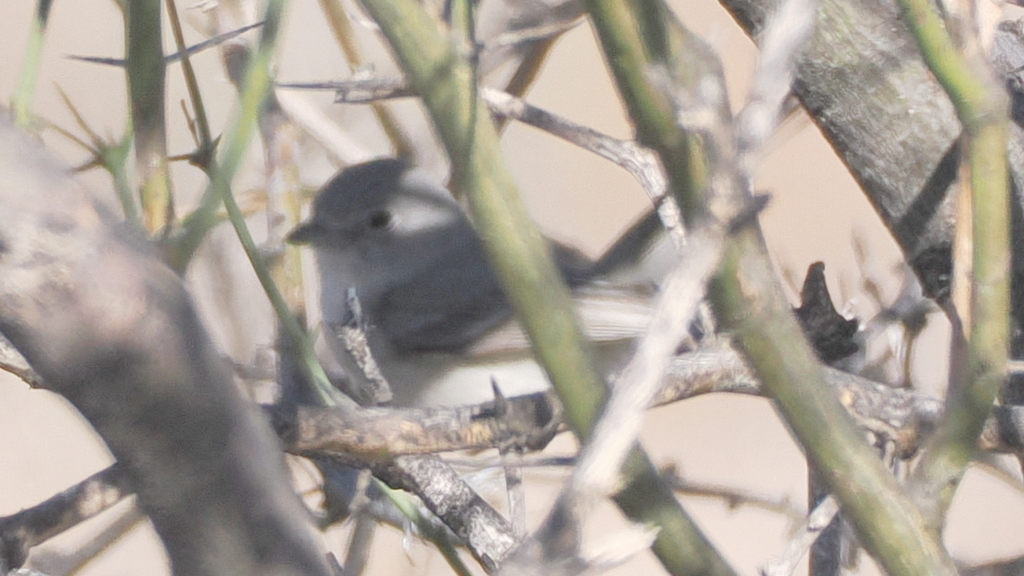
The Gray Vireo is a small, plainly colored songbird measuring 13 to 15 cm (5.1 to 5.9 inches) in length with a wingspan of approximately 20 cm (7.9 inches). Adults weigh 10 to 14 grams. The species exhibits subtle gray plumage on the upperparts with white to pale yellow underparts. Unlike many vireos, the Gray Vireo lacks prominent wing bars and eye-rings, appearing relatively featureless. The bill is dark gray with a slightly hooked tip, and the legs are blue-gray to black. Males and females show similar plumage, though breeding males may display slightly brighter yellow wash on the flanks and undertail coverts. The Gray Vireo breeds in scattered locations across the southwestern United States and northwestern Mexico. In California, the species occurs primarily in the southern Sierra Nevada, Transverse Ranges, and Peninsular Ranges. The breeding range extends through portions of Inyo, Kern, Los Angeles, Riverside, and San Bernardino counties. During winter, most individuals migrate to western Mexico, though some may winter in southern California and Arizona desert regions. This species inhabits arid and semi-arid shrublands, particularly areas dominated by pinyon pine and juniper woodlands. Gray Vireos prefer habitat between 1,200 and 2,400 meters (3,900 to 7,900 feet) elevation, though they can occur as low as 900 meters in some areas. The species shows strong affinity for dense shrub cover, including oak chaparral, mountain mahogany, and manzanita. Breeding territories typically include a mosaic of shrubs and small trees with canopy coverage between 30 and 70 percent. Gray Vireos are primarily insectivorous, gleaning caterpillars, beetles, moths, and other arthropods from foliage and bark surfaces. They employ a deliberate foraging strategy, methodically searching branches and leaves. The species also consumes small amounts of berries during late summer and fall. Breeding occurs from April through July, with peak activity in May and June. Females construct cup-shaped nests suspended from forked branches, typically 1 to 3 meters above ground. Clutches contain 3 to 5 white eggs with sparse brown spotting. Incubation lasts 13 to 14 days, and nestlings fledge after 11 to 12 days. The Gray Vireo maintains a global conservation status of G5 (secure) but receives a state rank of S2 (imperiled) in California, indicating substantial vulnerability within the state. Population trends suggest declining numbers in some portions of the range, particularly at lower elevations. Primary threats include habitat loss from urban development, altered fire regimes that reduce shrub density, and potential impacts from climate change affecting suitable elevation zones. Grazing pressure and invasive plant species may degrade habitat quality in some areas. The species' limited California range and specific habitat requirements make local populations vulnerable to environmental changes.
Classification
Class: Aves · Order: Passeriformes · Family: Vireonidae
Conservation status
G5 S2
Frequently asked questions
How is Vireo vicinior classified?
Vireo vicinior belongs to class Aves, order Passeriformes, family Vireonidae.
What family does Vireo vicinior belong to?
Vireo vicinior is in the Vireonidae family.
Is Vireo vicinior protected or of conservation concern?
Vireo vicinior carries the following status: G5 S2.
What is Vireo vicinior?
The Gray Vireo is a small, plainly colored songbird measuring 13 to 15 cm (5.1 to 5.9 inches) in length with a wingspan of approximately 20 cm (7.9 inches).
Is Vireo vicinior found in California?
Yes. Vireo vicinior is recorded in California in The California Species Project's catalogue.
Related species
Other California species in the same genus, family, or bioregion.
Data from The California Species Project — 14,000+ California species with verified data from CNPS, CDFW, USFWS, and more.