Vulpes macrotis
Kit Fox
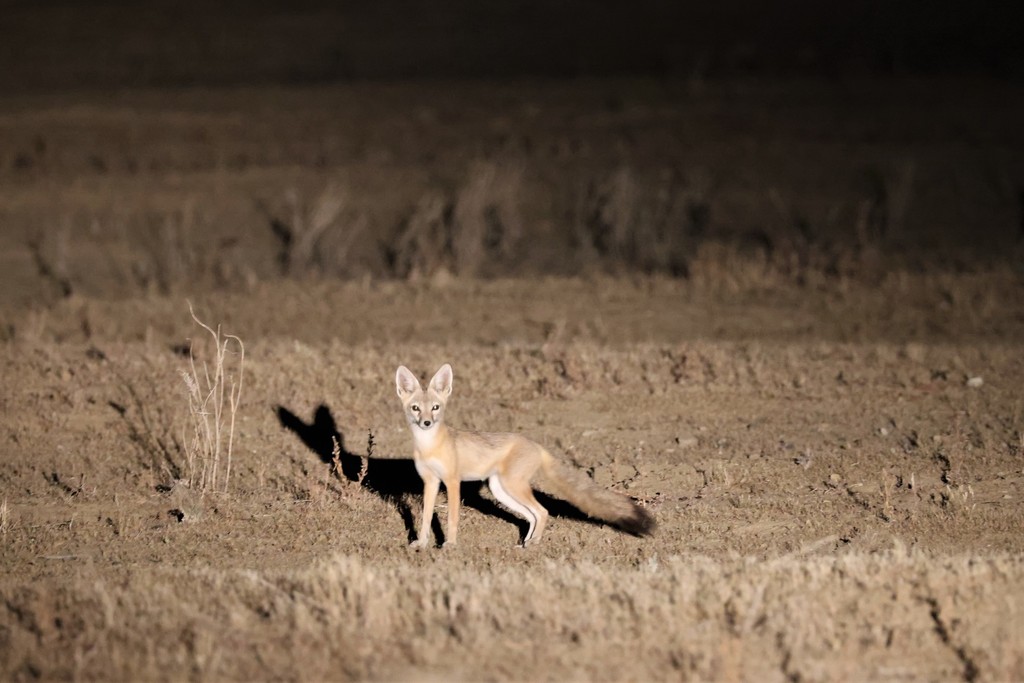
no rights reserved · CC0
Family: Canidae · Class: Mammalia · Order: Carnivora
Vulpes macrotis (Kit Fox) is a California animal in the Canidae family.
The kit fox is a small, desert-adapted canid endemic to western North America. Adults measure 38 to 50 cm (15 to 20 inches) in body length, with tails adding another 23 to 32 cm (9 to 13 inches). Weight ranges from 1.4 to 2.7 kg (3 to 6 pounds), with females typically smaller than males. The species displays pale gray to yellowish-brown dorsal coloration with white to cream-colored underparts. The large ears, measuring up to 10 cm (4 inches), provide enhanced hearing and thermoregulation. A distinctive black-tipped tail and dark patches on either side of the muzzle distinguish kit foxes from other small canids. Kit foxes historically ranged throughout California's Central Valley, the Mojave and Sonoran deserts, and portions of the San Joaquin Valley. Current distribution extends from Kern County north to southern Sacramento County, with populations in the San Francisco Bay Area, Central Valley, and southern California desert regions. The species also occurs in Nevada, Utah, Arizona, and northwestern Mexico, though California populations represent distinct subspecies with varying conservation status. The species inhabits arid and semi-arid grasslands, scrublands, and agricultural areas with sparse vegetation. Kit foxes prefer areas with friable soils suitable for den construction, typically avoiding regions with dense vegetation or high human activity. Elevation range extends from below sea level in desert valleys to approximately 1,500 meters (4,900 feet) in foothill areas. Den sites are critical habitat components, with foxes excavating multiple burrows within their territory for thermoregulation, protection from predators, and raising young. Kit foxes are primarily nocturnal, emerging after sunset to hunt small mammals, particularly kangaroo rats, pocket mice, and ground squirrels. The diet also includes insects, birds, reptiles, and occasionally plant material. Breeding occurs from December through March, with females producing litters of two to six kits after a 49 to 55 day gestation period. Kits remain with parents through their first summer, dispersing in autumn. Territory size varies with prey density and habitat quality, ranging from 2 to 12 square kilometers. Conservation status varies significantly among California kit fox populations. The San Joaquin kit fox subspecies (Vulpes macrotis mutica) has been federally listed as endangered since 1967 and remains critically imperiled due to habitat loss from agricultural conversion and urban development. According to the U.S. Fish and Wildlife Service, San Joaquin kit fox populations have declined by more than 95% since the 1930s. Other California populations, while not federally protected, face similar threats including habitat fragmentation, vehicle strikes, and secondary poisoning from rodenticides. The California Department of Fish and Wildlife monitors populations through ongoing research and habitat conservation programs, though recovery efforts focus primarily on the endangered San Joaquin subspecies.
Classification
Class: Mammalia · Order: Carnivora · Family: Canidae
Frequently asked questions
How is Vulpes macrotis classified?
Vulpes macrotis belongs to class Mammalia, order Carnivora, family Canidae.
What family does Vulpes macrotis belong to?
Vulpes macrotis is in the Canidae family.
What is Vulpes macrotis?
The kit fox is a small, desert-adapted canid endemic to western North America.
Is Vulpes macrotis found in California?
Yes. Vulpes macrotis is recorded in California in The California Species Project's catalogue.
Related species
Other California species in the same genus, family, or bioregion.
Data from The California Species Project — 14,000+ California species with verified data from CNPS, CDFW, USFWS, and more.