Vulpes vulpes necator
Sierra Nevada red fox
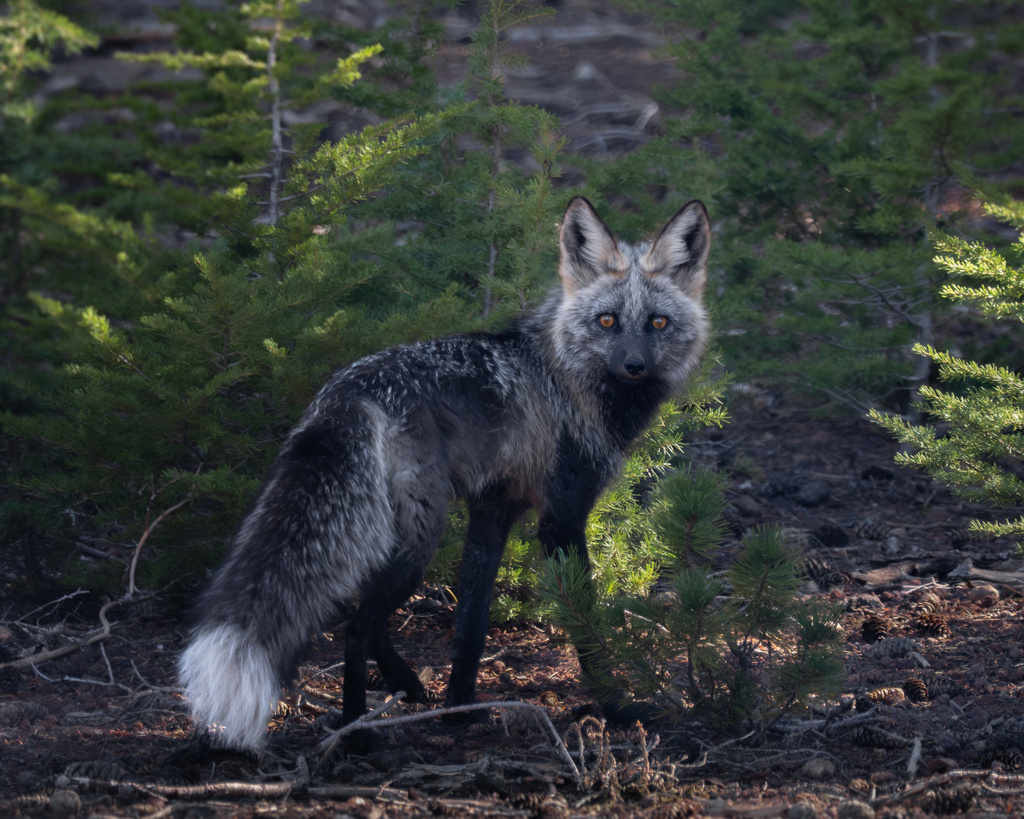
(c) David Willingham, some rights reserved (CC BY) · licence
Family: Canidae · Class: Mammalia · Order: Carnivora
Conservation status: Endangered
Vulpes vulpes necator (Sierra Nevada red fox) is a California animal in the Canidae family.
The Sierra Nevada red fox is a medium-sized carnivore and subspecies of the red fox (Vulpes vulpes). Adults typically measure 35 to 40 cm (14 to 16 inches) at the shoulder and weigh 3.2 to 6.8 kg (7 to 15 pounds). The subspecies exhibits the characteristic red fox morphology with reddish-orange fur, black ears and legs, and a distinctive white-tipped tail. The coat may vary seasonally, becoming thicker and more vibrant during winter months. Historically, the Sierra Nevada red fox ranged throughout much of the Sierra Nevada, the southern Cascades near Lassen Peak and Mount Shasta, and the Klamath Mountains near Mount Eddy and the eastern Trinity Alps in California and Nevada (CDFW). Current distribution is severely restricted, with recent detections limited to the Lassen Peak region and the central Sierra Nevada near Sonora Pass and Yosemite National Park. According to the U.S. Fish and Wildlife Service, sightings have been confined to federal lands in Alpine, Fresno, Inyo, Madera, Mono, and Tuolumne counties (USFWS 2021). Sierra Nevada red foxes inhabit high-elevation environments, typically occurring above 1,524 meters (5,000 feet) in the southern Cascades and above 2,134 meters (7,000 feet) in the central Sierra Nevada (CDFW). The subspecies utilizes diverse montane habitats including alpine and barren areas, subalpine forests, red fir forests, lodgepole pine forests, mixed conifer forests, and mountain meadows. These foxes demonstrate specialized adaptation to harsh alpine conditions, including deep snow and extreme temperature variations. Like other red fox subspecies, Sierra Nevada red foxes are opportunistic omnivores with a diet consisting of small mammals, birds, insects, fruits, and vegetation. Breeding occurs in late winter, with females producing litters of 2 to 10 kits after a gestation period of approximately 52 days. Dens are typically constructed in rocky outcrops, under tree roots, or in burrows. The species exhibits solitary behavior outside of breeding season, with individuals maintaining territories through scent marking. The Sierra Nevada Distinct Population Segment was listed as federally endangered in 2021. Current population estimates indicate only 18 to 39 individuals remain in the wild, representing one of North America's most critically imperiled mammal subspecies (USFWS 2021). Primary threats include unpredictable events such as wildfire and drought, competition with coyotes, prey base reduction, and widespread hybridization with non-native red fox populations. Small effective population sizes render the subspecies vulnerable to population crashes, inbreeding depression, and loss of genetic integrity. The large distances between fragmented populations make natural gene flow extremely rare. Recovery efforts focus on habitat protection, threat mitigation, and genetic monitoring to prevent further decline of this endemic Sierra Nevada carnivore.
Classification
Class: Mammalia · Order: Carnivora · Family: Canidae
Conservation status
Endangered
Frequently asked questions
How is Vulpes vulpes necator classified?
Vulpes vulpes necator belongs to class Mammalia, order Carnivora, family Canidae.
What family does Vulpes vulpes necator belong to?
Vulpes vulpes necator is in the Canidae family.
Is Vulpes vulpes necator protected or of conservation concern?
Vulpes vulpes necator carries the following status: Endangered.
What is Vulpes vulpes necator?
The Sierra Nevada red fox is a medium-sized carnivore and subspecies of the red fox (Vulpes vulpes).
Is Vulpes vulpes necator found in California?
Yes. Vulpes vulpes necator is recorded in California in The California Species Project's catalogue.
Related species
Other California species in the same genus, family, or bioregion.
Data from The California Species Project — 14,000+ California species with verified data from CNPS, CDFW, USFWS, and more.