Vulpes vulpes patwin
Sacramento Valley Red Fox
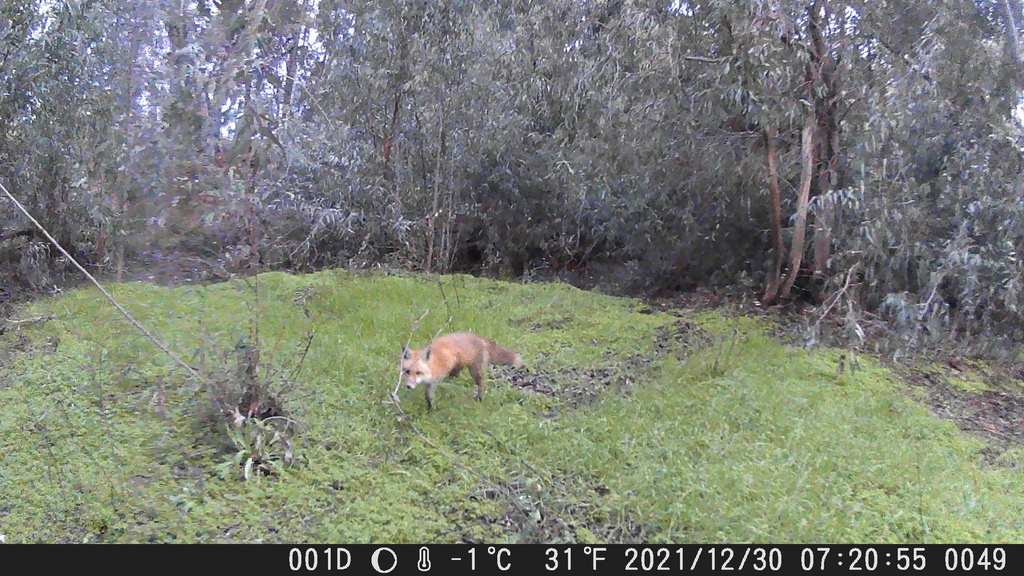
(c) Ryan Elliott, some rights reserved (CC BY) · licence
Family: Canidae · Class: Mammalia · Order: Carnivora
Conservation status: G5T2 S2
Vulpes vulpes patwin (Sacramento Valley Red Fox) is a California animal in the Canidae family.
The Sacramento Valley red fox (Vulpes vulpes patwin) is a native subspecies of red fox endemic to California's Central Valley. Adults typically measure 900 to 1,200 mm (35 to 47 inches) in total length, including a tail of 300 to 400 mm (12 to 16 inches), and weigh 3.6 to 6.8 kg (8 to 15 pounds). The pelage is typically reddish-orange with black-tipped ears, black legs, and a white-tipped tail. Males are generally larger than females, following the pattern common in red fox subspecies. Historically, the Sacramento Valley red fox occupied much of California's Central Valley and surrounding foothills. The current range is estimated at approximately 14,000 square kilometers based on California Wildlife Habitat Relationships range modeling (CWHR 2021). The subspecies occurs primarily in the northern and central portions of the Sacramento Valley, with populations documented in suitable habitat from the valley floor to lower montane elevations. According to NatureServe, the subspecies has experienced significant range contraction from its historical distribution. Sacramento Valley red foxes inhabit a variety of terrestrial habitats including grasslands, agricultural lands, riparian woodlands, oak woodlands, and chaparral. They show particular affinity for edge habitats where multiple vegetation types converge, providing diverse hunting opportunities and denning sites. The subspecies adapts to human-modified landscapes, utilizing agricultural areas, suburban edges, and managed grasslands. Elevation ranges typically span from valley floors to approximately 1,500 meters (4,900 feet) in foothill regions. As opportunistic carnivores, Sacramento Valley red foxes exhibit a diverse diet including small mammals, birds, reptiles, amphibians, insects, and seasonal fruits. Primary prey species include rodents such as ground squirrels, pocket gophers, and various mouse species. Breeding occurs from December through March, with females producing litters of 1 to 10 kits (average 4 to 6) after a gestation period of approximately 52 days. Kits are born in underground dens, often excavated in banks, hillsides, or beneath structures. Family groups typically disperse by late summer, with juveniles establishing territories within 10 to 100 kilometers of their natal den. The Sacramento Valley red fox carries a global rank of G5T2, indicating the subspecies is imperiled with a high risk of extinction. California Department of Fish and Wildlife recognizes two native red fox subspecies in the state: the Sacramento Valley red fox and the Sierra Nevada red fox (Vulpes vulpes necator), distinguishing them from introduced eastern red fox populations that have established in California since the 1870s. Primary threats include habitat loss and fragmentation from agricultural conversion and urban development, vehicle strikes, predator control programs, and potential hybridization with non-native red fox populations. Climate change may further impact suitable habitat distribution. The subspecies faces additional challenges from disease transmission and competition with introduced species. Conservation efforts focus on habitat protection, population monitoring, and research to better understand current distribution and genetic integrity.
Classification
Class: Mammalia · Order: Carnivora · Family: Canidae
Conservation status
G5T2 S2
Frequently asked questions
How is Vulpes vulpes patwin classified?
Vulpes vulpes patwin belongs to class Mammalia, order Carnivora, family Canidae.
What family does Vulpes vulpes patwin belong to?
Vulpes vulpes patwin is in the Canidae family.
Is Vulpes vulpes patwin protected or of conservation concern?
Vulpes vulpes patwin carries the following status: G5T2 S2.
What is Vulpes vulpes patwin?
The Sacramento Valley red fox (Vulpes vulpes patwin) is a native subspecies of red fox endemic to California's Central Valley.
Is Vulpes vulpes patwin found in California?
Yes. Vulpes vulpes patwin is recorded in California in The California Species Project's catalogue.
Related species
Other California species in the same genus, family, or bioregion.
Data from The California Species Project — 14,000+ California species with verified data from CNPS, CDFW, USFWS, and more.