Xanthocephalus xanthocephalus
Yellow-headed Blackbird
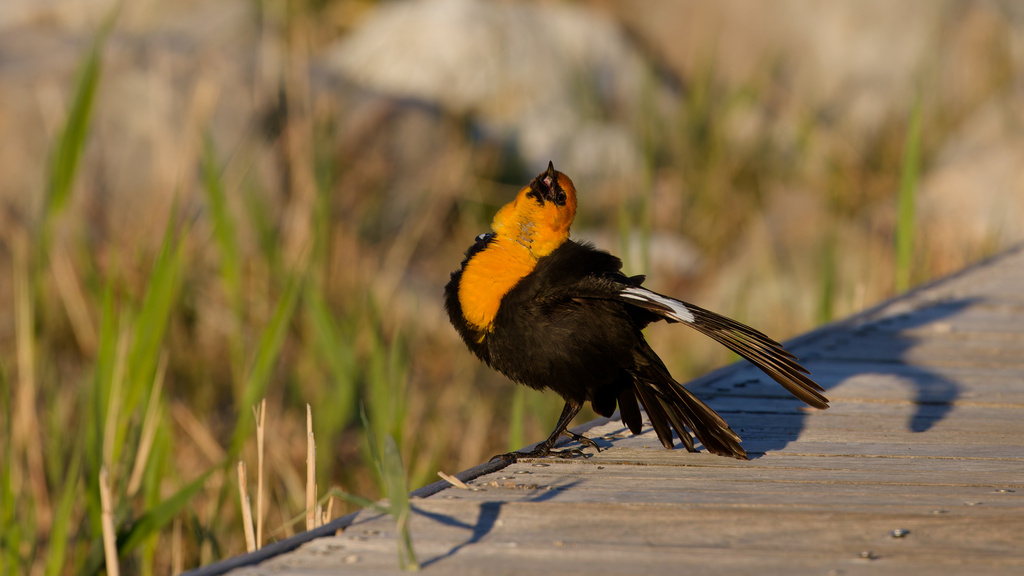
(c) Daughter Dad, some rights reserved (CC BY) · licence
Family: Icteridae · Class: Aves · Order: Passeriformes
Conservation status: G5 S3
Xanthocephalus xanthocephalus (Yellow-headed Blackbird) is a California animal in the Icteridae family.
The Yellow-headed Blackbird is a medium-sized passerine bird measuring 20 to 28 centimeters (8 to 11 inches) in length with a wingspan of 38 to 44 centimeters (15 to 17 inches). Adult males weigh 60 to 100 grams and display striking sexually dimorphic plumage. Breeding males exhibit bright yellow heads and breasts contrasting with black bodies, wings, and tails. White wing patches are visible in flight and during display behaviors. Adult females are smaller, weighing 40 to 60 grams, with brownish-black plumage and pale yellow coloration restricted to the throat and breast area. Juveniles resemble females but show more streaked underparts. Historically, Yellow-headed Blackbirds bred throughout much of California's Central Valley and northeastern regions. The species currently maintains breeding populations in the northeastern counties, including portions of Modoc, Lassen, and Siskiyou counties. Small breeding populations persist in isolated Central Valley locations where suitable wetland habitat remains. The species occurs more widely during migration and winter, with birds dispersing throughout the Central Valley and southern California coastal areas. Yellow-headed Blackbirds require emergent wetland vegetation for breeding, particularly cattail marshes and bulrush stands in water depths of 30 to 100 centimeters (12 to 39 inches). Nesting colonies typically occur in large, permanent or semi-permanent wetlands with extensive stands of Typha species and Scirpus species. During winter months, birds utilize agricultural areas, including rice fields, feedlots, and grain fields, often forming mixed flocks with other blackbird species. This highly social species breeds in colonial aggregations, with dominant males establishing territories encompassing multiple nesting sites. Males arrive at breeding areas in April and engage in conspicuous territorial displays, singing from prominent perches while spreading their wings to reveal white patches. Females construct cup-shaped nests woven among cattail stems 30 to 120 centimeters above water surface. Breeding occurs from May through July, with females laying 3 to 5 pale green eggs marked with brown spots. Incubation lasts 11 to 13 days, and nestlings fledge after 9 to 12 days. The species is primarily granivorous outside the breeding season, consuming seeds of grasses and agricultural crops. During breeding, adults feed extensively on aquatic invertebrates, including dragonfly larvae, beetles, and other protein-rich prey items essential for nestling development. The Yellow-headed Blackbird maintains a global conservation status of G5 (secure) but is ranked S3 (vulnerable) in California, reflecting significant population declines and habitat loss. The species is not federally or state listed but faces substantial threats from wetland destruction, water diversions, and agricultural conversion. Central Valley breeding populations have declined by an estimated 60 percent since the 1940s due to drainage of seasonal and permanent wetlands. Climate change poses additional challenges through altered precipitation patterns and increased drought frequency, affecting water levels critical for successful breeding.
Classification
Class: Aves · Order: Passeriformes · Family: Icteridae
Conservation status
G5 S3
Frequently asked questions
How is Xanthocephalus xanthocephalus classified?
Xanthocephalus xanthocephalus belongs to class Aves, order Passeriformes, family Icteridae.
What family does Xanthocephalus xanthocephalus belong to?
Xanthocephalus xanthocephalus is in the Icteridae family.
Is Xanthocephalus xanthocephalus protected or of conservation concern?
Xanthocephalus xanthocephalus carries the following status: G5 S3.
What is Xanthocephalus xanthocephalus?
The Yellow-headed Blackbird is a medium-sized passerine bird measuring 20 to 28 centimeters (8 to 11 inches) in length with a wingspan of 38 to 44 centimeters (15 to 17 inches).
Is Xanthocephalus xanthocephalus found in California?
Yes. Xanthocephalus xanthocephalus is recorded in California in The California Species Project's catalogue.
Related species
Other California species in the same genus, family, or bioregion.
Data from The California Species Project — 14,000+ California species with verified data from CNPS, CDFW, USFWS, and more.