Xanthogaleruca luteola
Elm Leaf Beetle
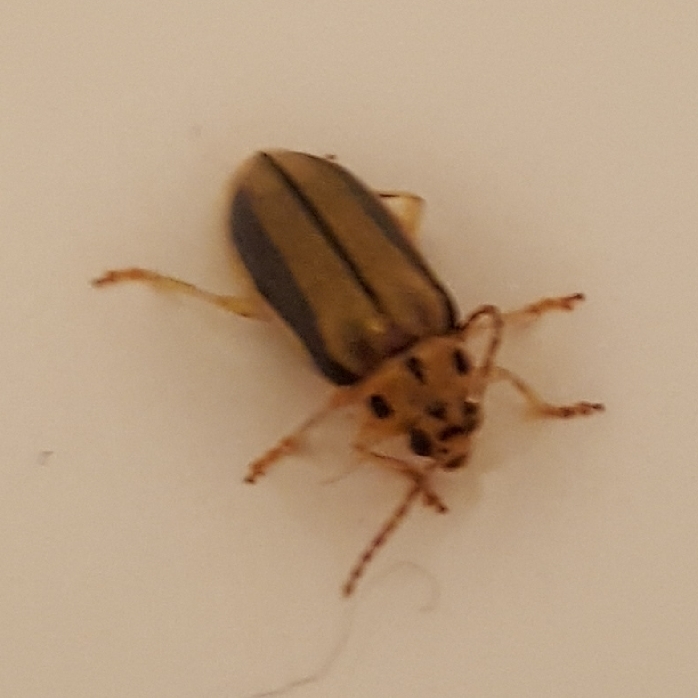
(c) Justin, some rights reserved (CC BY) · licence
Family: Chrysomelidae · Class: Insecta · Order: Coleoptera
Xanthogaleruca luteola (Elm Leaf Beetle) is a California animal in the Chrysomelidae family.
The Elm Leaf Beetle is a small, invasive chrysomelid beetle measuring 6 to 8 mm (0.2 to 0.3 inches) in length. Adults display yellowish-green to olive-brown coloration with darker longitudinal stripes running along the elytra. The species name 'luteola' refers to its characteristic yellowish appearance. Larvae are distinctive yellow grubs with black spots arranged in rows along their bodies, and they feed exclusively on the undersides of elm leaves, creating a characteristic skeletonized feeding pattern. Native to the western Palearctic region, the Elm Leaf Beetle was introduced to North America and is now established across a broad range from California to Florida and extending north to Nova Scotia and British Columbia (BugGuide). In California, the species has become widely distributed wherever elm trees are planted, particularly in urban and suburban environments. The species is closely associated with elm trees (Ulmus species), which serve as its exclusive host plants (BugGuide). Adults and larvae are found on various elm species including American elm, Siberian elm, and European elm varieties. The beetles prefer urban landscapes, parks, and residential areas where ornamental elms are commonly planted. They are particularly abundant in areas with moderate climates that support year-round elm growth. Elm Leaf Beetles exhibit a complex annual life cycle with overwintering adults seeking shelter in dry, protected locations beginning as early as August (BugGuide). Adults emerge in late spring, with egg-laying occurring in late May or early June. Females deposit bright yellow, spindle-shaped eggs in clusters on the undersides of elm leaves. Larvae hatch within approximately one week and feed for 2 to 3 weeks, creating distinctive skeletonized patterns as they consume leaf tissue while leaving the upper epidermis and major veins intact. Mature larvae crawl down tree trunks to pupate in bark crevices or soil debris. The species typically completes 1 to 2 full generations per year, with a possible partial third generation in favorable conditions. The first generation causes the most significant damage to host trees (BugGuide). As a non-native species, the Elm Leaf Beetle has no formal conservation status and is not protected under federal or state regulations. Instead, it is considered an urban forestry pest that can cause significant defoliation of elm trees when populations are high. Severe infestations can weaken trees and make them susceptible to other stresses, though healthy elms typically survive repeated defoliation. Management strategies focus on integrated pest management approaches including biological control agents, targeted insecticide applications, and cultural practices. The beetle's establishment across North America demonstrates the successful colonization of an introduced European species that has found suitable habitat and host plants in urban environments. Climate change may potentially expand the species' range and increase generation numbers in northern regions where cold temperatures currently limit population growth.
Classification
Class: Insecta · Order: Coleoptera · Family: Chrysomelidae
Frequently asked questions
How is Xanthogaleruca luteola classified?
Xanthogaleruca luteola belongs to class Insecta, order Coleoptera, family Chrysomelidae.
What family does Xanthogaleruca luteola belong to?
Xanthogaleruca luteola is in the Chrysomelidae family.
What is Xanthogaleruca luteola?
The Elm Leaf Beetle is a small, invasive chrysomelid beetle measuring 6 to 8 mm (0.2 to 0.3 inches) in length.
Is Xanthogaleruca luteola found in California?
Yes. Xanthogaleruca luteola is recorded in California in The California Species Project's catalogue.
Related species
Other California species in the same genus, family, or bioregion.
Data from The California Species Project — 14,000+ California species with verified data from CNPS, CDFW, USFWS, and more.