Xantusia gracilis
Sandstone Night Lizard
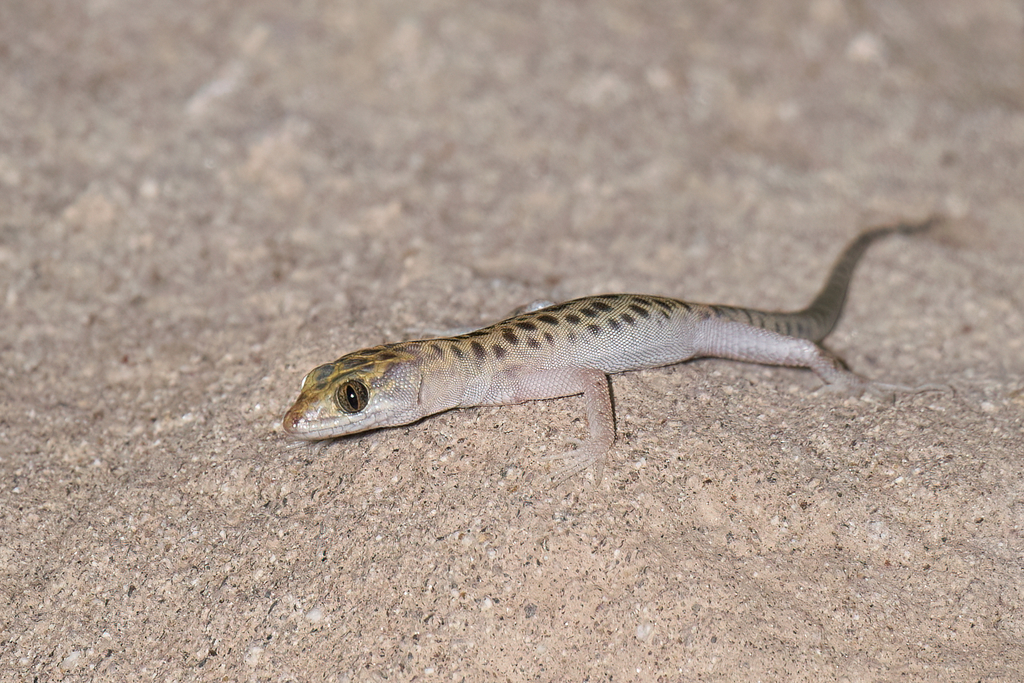
(c) Grigory Heaton, some rights reserved (CC BY-SA) · licence
Family: Xantusiidae · Class: Reptilia · Order: Squamata
Conservation status: G1 S2
Xantusia gracilis (Sandstone Night Lizard) is a California animal in the Xantusiidae family.
The Sandstone Night Lizard is a small, secretive reptile endemic to a highly restricted area of California. Adults typically measure 45 to 65 mm (1.8 to 2.6 inches) in snout-vent length, with a total length reaching approximately 120 mm (4.7 inches). The species exhibits cryptic coloration with a brown to gray dorsal surface marked by darker crossbands and scattered lighter spots. The ventral surface is cream to pale yellow. Like other night lizards, it possesses smooth, granular scales, large eyes with vertical pupils, and immovable eyelids. The tail is fragile and readily autotomized when threatened. The Sandstone Night Lizard occurs only in the Truckhaven Rocks area of San Diego County, within Anza-Borrego Desert State Park. This represents one of the most restricted ranges of any North American reptile, encompassing an area of less than 2.6 square kilometers (1 square mile). The species was first described scientifically in 1986 by Grismer and Galvan, initially classified as a subspecies of the Granite Night Lizard before being elevated to full species status in 2007. This species inhabits a specialized microhabitat of sandstone and mudstone outcrops and boulder formations. The lizards are found at elevations ranging from 240 to 305 meters (790 to 1,000 feet). They occupy deep crevices and spaces between rock layers, which provide thermal regulation and protection from predators. The sandstone substrate is essential for the species' survival, as it creates the specific humidity and temperature conditions required for their physiology. Sandstone Night Lizards are nocturnal and crepuscular, emerging from rock crevices at night to forage for invertebrates including beetles, moths, ants, and spiders. Observations have documented individuals preying on various arthropods, with one lizard recorded emerging from its crevice retreat to capture prey before returning to shelter. The species has also been observed consuming the eggs of Leaf-toed Geckos. Reproduction is poorly understood, but breeding likely occurs during May and June, with females giving birth to live young in September. As with other night lizards, the species is viviparous, producing small litters of 1 to 3 offspring. The Sandstone Night Lizard has a Global rank of G1 (critically imperiled) and a California State rank of S2 (imperiled), reflecting its extremely limited range and small population size. While not federally listed under the Endangered Species Act as of December 2025, the species is designated as a California Species of Special Concern. Primary threats include habitat disturbance from recreational activities, climate change effects on the desert environment, and the species' inherent vulnerability due to its restricted range. Any significant alteration to the Truckhaven Rocks area could potentially threaten the entire global population of this endemic reptile.
Classification
Class: Reptilia · Order: Squamata · Family: Xantusiidae
Conservation status
G1 S2
Frequently asked questions
How is Xantusia gracilis classified?
Xantusia gracilis belongs to class Reptilia, order Squamata, family Xantusiidae.
What family does Xantusia gracilis belong to?
Xantusia gracilis is in the Xantusiidae family.
Is Xantusia gracilis protected or of conservation concern?
Xantusia gracilis carries the following status: G1 S2.
What is Xantusia gracilis?
The Sandstone Night Lizard is a small, secretive reptile endemic to a highly restricted area of California.
Is Xantusia gracilis found in California?
Yes. Xantusia gracilis is recorded in California in The California Species Project's catalogue.
Related species
Other California species in the same genus, family, or bioregion.
Data from The California Species Project — 14,000+ California species with verified data from CNPS, CDFW, USFWS, and more.