Xantusia riversiana
Island night lizard
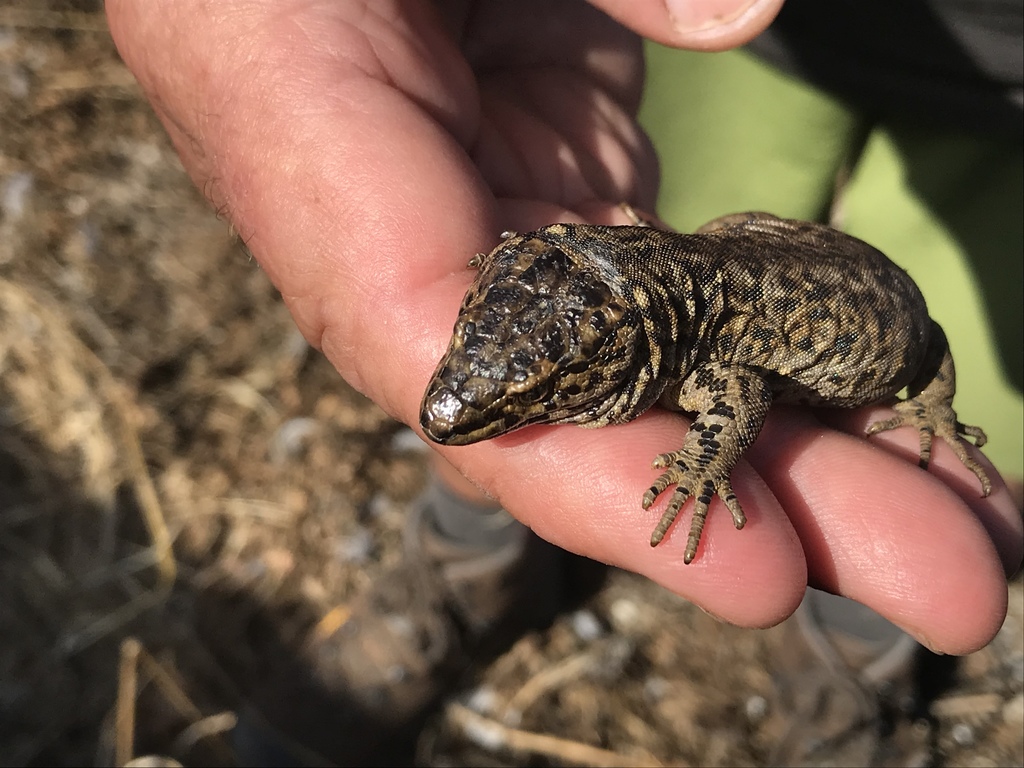
(c) Sula Vanderplank, some rights reserved (CC BY) · licence
Family: Xantusiidae · Class: Reptilia · Order: Squamata
Conservation status: Delisted · G3 S3
Xantusia riversiana (Island night lizard) is a California animal in the Xantusiidae family.
The island night lizard is a medium-sized reptile endemic to California's Channel Islands, measuring 5 to 8 inches (12.7 to 20.3 cm) in total length. This species represents the largest member of the night lizard family (Xantusiidae). The lizard displays gray to yellowish-brown coloration with dark spots across the body. Some individuals exhibit a light dorsal stripe bordered by dark edges. The species is characterized as a soft-skinned lizard, with small, loose-appearing scales particularly noticeable around the neck region. Like other night lizards, they lack moveable eyelids and possess distinctive vertical pupils. The island night lizard occurs exclusively on three of California's Channel Islands: San Clemente Island, San Nicolas Island, and Santa Barbara Island. A small population also exists on Sutil Island, located several thousand yards from Santa Barbara Island. Two subspecies are recognized: Xantusia riversiana riversiana on San Nicolas Island and X. r. reticulata on San Clemente and Santa Barbara islands. This extremely limited range makes the species one of the most geographically restricted reptiles in North America. The species inhabits diverse island environments that provide shelter and shade, including maritime desert scrub, grassland, chaparral, oak savanna, cactus communities, dry stream beds, cliffs, rocky beaches, and sparsely vegetated areas. Island night lizards seek refuge in rock crevices, ground cracks, and beneath surface objects such as rocks, fallen vegetation, and beach driftwood. This broad habitat tolerance has been crucial to the species' recovery on islands with varying topography and vegetation. Island night lizards are viviparous, giving birth to 2 to 9 live young, primarily in September. The species is primarily nocturnal and crepuscular, using its excellent night vision to hunt for small invertebrates. Their diet consists mainly of insects, spiders, and other arthropods found within their island habitats. The vertical pupils and lack of eyelids represent adaptations for their nocturnal lifestyle. The U.S. Fish and Wildlife Service originally listed the island night lizard as threatened under the Endangered Species Act in 1977 due to severe habitat degradation caused by introduced herbivores. Non-native goats and pigs on San Clemente and San Nicolas islands, along with rabbits on Santa Barbara Island, stripped vegetation and caused significant erosion. Feral cats on San Clemente Island posed additional predation pressure. Following successful habitat restoration efforts and removal of invasive species, the island night lizard populations recovered substantially. According to USFWS, after 36 years of federal protection, the species was successfully delisted in 2014, marking one of the notable recovery success stories under the Endangered Species Act. California Department of Fish and Wildlife notes the species as recovered, and current populations are considered stable across all three primary islands.
Classification
Class: Reptilia · Order: Squamata · Family: Xantusiidae
Conservation status
Delisted · G3 S3
Frequently asked questions
How is Xantusia riversiana classified?
Xantusia riversiana belongs to class Reptilia, order Squamata, family Xantusiidae.
What family does Xantusia riversiana belong to?
Xantusia riversiana is in the Xantusiidae family.
Is Xantusia riversiana protected or of conservation concern?
Xantusia riversiana carries the following status: Delisted · G3 S3.
What is Xantusia riversiana?
The island night lizard is a medium-sized reptile endemic to California's Channel Islands, measuring 5 to 8 inches (12.7 to 20.3 cm) in total length.
Is Xantusia riversiana found in California?
Yes. Xantusia riversiana is recorded in California in The California Species Project's catalogue.
Related species
Other California species in the same genus, family, or bioregion.
Data from The California Species Project — 14,000+ California species with verified data from CNPS, CDFW, USFWS, and more.