Xantusia vigilis
Desert Night Lizard
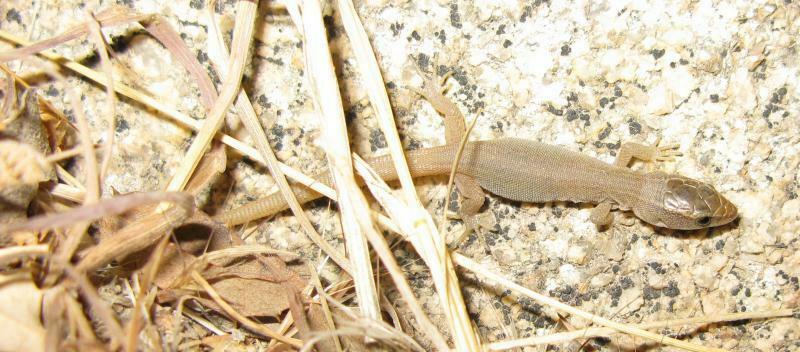
(c) CaracalShan, some rights reserved (CC BY) · licence
Family: Xantusiidae · Class: Reptilia · Order: Squamata
Xantusia vigilis (Desert Night Lizard) is a California animal in the Xantusiidae family.
The Desert Night Lizard is a small, secretive reptile measuring 38 to 64 mm (1.5 to 2.5 inches) in snout-vent length, with a total length including tail of 10 to 13 cm (4 to 5 inches). The body is flattened with granular scales and typically colored gray, brown, or olive with darker spots, blotches, or reticulated patterns across the back. The head is triangular and distinct from the neck, with large eyes adapted for low-light conditions. The tail is nearly as long as the body and serves as a fat storage organ during periods of resource scarcity. The Desert Night Lizard occurs throughout much of California's desert regions, including the Mojave and Colorado deserts. The nominate subspecies Xantusia vigilis vigilis ranges from the eastern Sierra Nevada south through the Mojave Desert to Baja California. A second subspecies, the Sierra Night Lizard (X. v. sierrae), is restricted to granite boulder fields in the southern Sierra Nevada of Kern County. The species extends beyond California into Nevada, Arizona, and Baja California, Mexico. This species inhabits arid desert environments, typically at elevations from sea level to 1,830 meters (6,000 feet). Desert Night Lizards are closely associated with Joshua trees (Yucca brevifolia), other yucca species, and agave plants, utilizing fallen branches and leaf litter as shelter. They also occur among granite boulders, rock crevices, and under various desert debris including fallen logs and human structures. The Sierra subspecies is specifically adapted to granite boulder habitats in montane areas. Desert Night Lizards are primarily nocturnal and secretive, spending daylight hours hidden beneath cover objects where they maintain optimal body temperature and humidity. They are insectivorous, feeding on termites, ants, beetles, moths, and other small arthropods. The species exhibits viviparity, with females giving birth to 1 to 3 live young after a gestation period of approximately 90 days. Breeding typically occurs in spring, with births occurring in late summer or early fall. These lizards can live 5 to 8 years and are capable of surviving extended periods without food by utilizing fat reserves stored in their tails. Neither the Desert Night Lizard nor its Sierra subspecies currently holds federal listing status. However, the Sierra Night Lizard is designated as a California Species of Special Concern due to its extremely limited range and specialized habitat requirements. The subspecies occupies fewer than 200 hectares of granite boulder habitat and faces potential threats from climate change, recreational activities, and habitat disturbance. The nominate subspecies appears more stable due to its broader distribution, though local populations may be affected by urban development, renewable energy projects, and habitat degradation in desert regions. According to the California Department of Fish and Wildlife, monitoring continues to assess population trends and habitat conditions for both taxa.
Classification
Class: Reptilia · Order: Squamata · Family: Xantusiidae
Frequently asked questions
How is Xantusia vigilis classified?
Xantusia vigilis belongs to class Reptilia, order Squamata, family Xantusiidae.
What family does Xantusia vigilis belong to?
Xantusia vigilis is in the Xantusiidae family.
What is Xantusia vigilis?
The Desert Night Lizard is a small, secretive reptile measuring 38 to 64 mm (1.5 to 2.5 inches) in snout-vent length, with a total length including tail of 10 to 13 cm (4 to 5 inches).
Is Xantusia vigilis found in California?
Yes. Xantusia vigilis is recorded in California in The California Species Project's catalogue.
Related species
Other California species in the same genus, family, or bioregion.
Data from The California Species Project — 14,000+ California species with verified data from CNPS, CDFW, USFWS, and more.