Xema sabini
Sabine's Gull
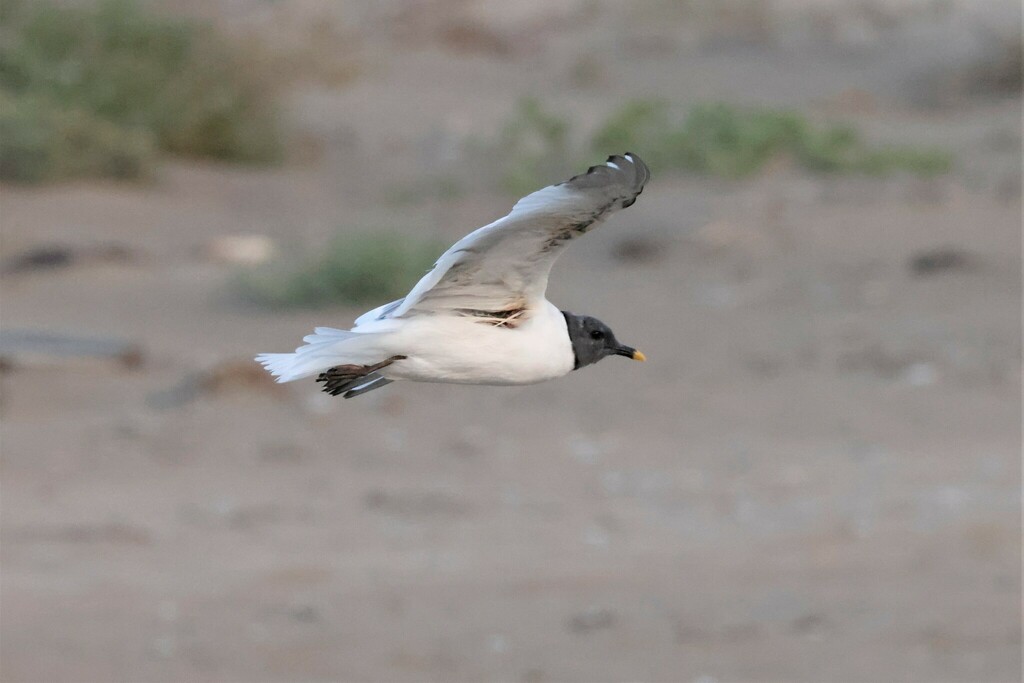
no rights reserved · CC0
Family: Laridae · Class: Aves · Order: Charadriiformes
Xema sabini (Sabine's Gull) is a California animal in the Laridae family.
Sabine's Gull is a small, distinctive seabird measuring 27 to 32 cm (10.6 to 12.6 inches) in length with a wingspan of 80 to 87 cm (31 to 34 inches). Adults in breeding plumage display a dark slate-gray hood that contrasts sharply with a white collar and underparts. The mantle and back are pale gray, while the wings show a striking triangular pattern of black primaries, white secondaries, and gray coverts that creates a distinctive three-toned appearance in flight. The bill is black with a bright yellow tip, and the legs are dark gray to black. Non-breeding adults lose the dark hood, showing only a partial dark collar around the nape. Juveniles exhibit a scaled brown and white pattern on the upperparts with a distinctive forked tail. Sabine's Gull breeds in the high Arctic tundra of Alaska, northern Canada, and Greenland. In North America, breeding populations are concentrated along the Arctic Ocean coast and on tundra islands. The species migrates through both Atlantic and Pacific flyways, with Pacific populations wintering primarily off the coasts of Peru, Ecuador, and northern Chile. California serves as an important migration corridor, particularly along the offshore waters. The species is most commonly observed in California waters from August through October during southbound migration, and less frequently from April through May during northbound movements. During the breeding season, Sabine's Gulls inhabit Arctic tundra near coastal areas, freshwater ponds, and marshy lowlands. They prefer areas with scattered vegetation and access to shallow water bodies. Outside the breeding season, the species is strictly pelagic, inhabiting open ocean waters far from shore. In California waters, they are typically found 10 to 50 kilometers offshore, often associated with upwelling areas and convergence zones where marine productivity is high. Sabine's Gulls feed primarily on marine invertebrates, small fish, and during breeding season, terrestrial and aquatic insects. At sea, they employ surface-dipping and shallow-diving techniques to capture prey, often feeding in association with other seabirds at productive upwelling zones. Breeding occurs from June through August, with pairs constructing simple ground nests lined with grass and moss. Females typically lay two olive-brown eggs with dark markings. Both parents share incubation duties for approximately 23 to 25 days, and chicks fledge after 30 to 35 days. Sabine's Gull is not federally listed under the Endangered Species Act and maintains stable global populations. The species is classified as Least Concern by the International Union for Conservation of Nature. However, climate change poses potential threats to Arctic breeding habitats through altered precipitation patterns and warming temperatures. Marine pollution and overfishing in wintering areas off South America represent additional conservation concerns. The species' dependence on productive marine ecosystems makes it vulnerable to oceanographic changes that could affect prey availability during migration and wintering periods.
Classification
Class: Aves · Order: Charadriiformes · Family: Laridae
Frequently asked questions
How is Xema sabini classified?
Xema sabini belongs to class Aves, order Charadriiformes, family Laridae.
What family does Xema sabini belong to?
Xema sabini is in the Laridae family.
What is Xema sabini?
Sabine's Gull is a small, distinctive seabird measuring 27 to 32 cm (10.6 to 12.6 inches) in length with a wingspan of 80 to 87 cm (31 to 34 inches).
Is Xema sabini found in California?
Yes. Xema sabini is recorded in California in The California Species Project's catalogue.
Related species
Other California species in the same genus, family, or bioregion.
Data from The California Species Project — 14,000+ California species with verified data from CNPS, CDFW, USFWS, and more.