Xenopus laevis
African Clawed Frog
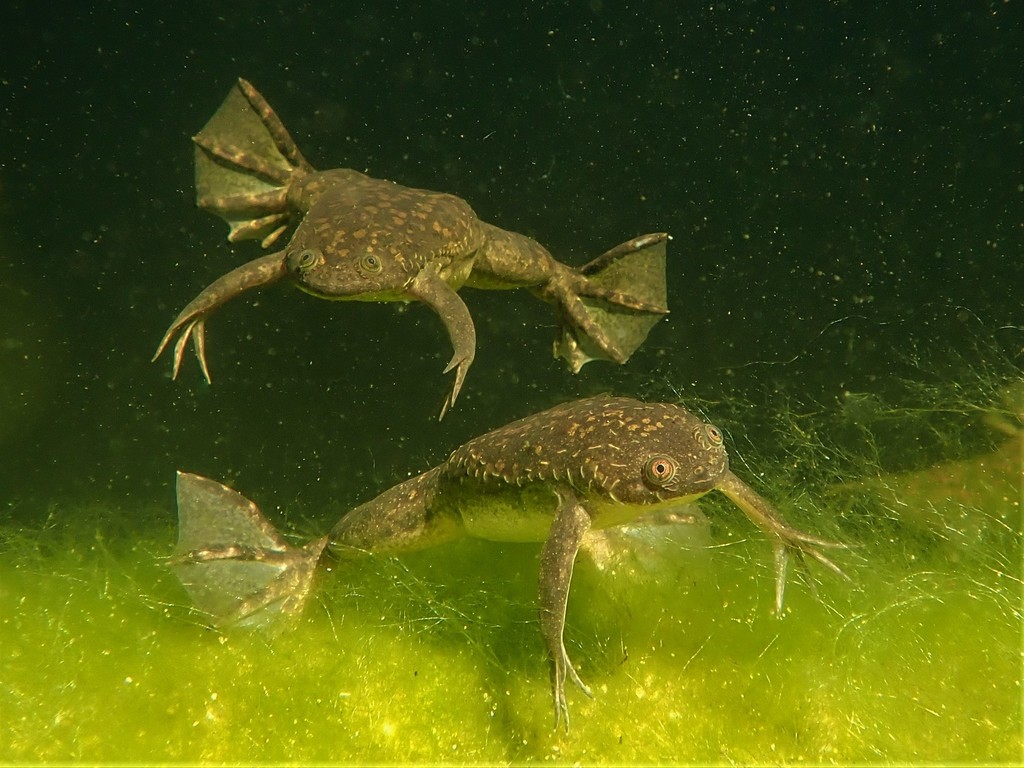
no rights reserved · CC0
Family: Pipidae · Class: Amphibia · Order: Anura
Xenopus laevis (African Clawed Frog) is a California animal in the Pipidae family.
The African clawed frog is a medium-sized aquatic amphibian native to sub-Saharan Africa that has become established as an invasive species in California. Adults measure 25 to 130 mm (1 to 5.1 inches) in snout-vent length, with females typically larger than males. The species lacks a tongue and visible external eardrums. The dorsal surface is olive to brown with darker mottling, while the ventral surface is pale yellow to white. The species is distinguished by its completely webbed hind feet bearing three prominent black claws on the inner toes, from which its common name derives. The front feet are unwebbed with four slender digits. Historically absent from California, African clawed frogs were introduced through laboratory releases and the pet trade beginning in the 1940s. Established populations now occur in scattered locations across southern California, including Los Angeles, Orange, Riverside, and San Bernardino counties. The species has been documented in the Colorado River system and various urban water bodies. Population establishment appears most successful in areas with permanent water sources and minimal predation pressure. African clawed frogs inhabit permanent freshwater systems including ponds, lakes, slow-moving streams, and artificial water bodies such as golf course ponds and ornamental lakes. The species tolerates a wide range of water conditions, from pH 6.5 to 9.0 and temperatures from 15 to 35°C (59 to 95°F). Adults are fully aquatic, rarely leaving water except during drought conditions when they may burrow into mud. They prefer areas with soft substrates and abundant vegetation or debris for shelter. This species exhibits opportunistic feeding behavior, consuming invertebrates, small fish, amphibian eggs and larvae, and organic detritus. Adults are primarily nocturnal, becoming active after sunset to forage along the bottom substrate. Reproduction occurs year-round in California's mild climate, with peak breeding activity during warmer months. Females can produce up to 2,000 eggs per clutch, depositing them individually on submerged vegetation or structures. Eggs hatch within 2 to 5 days depending on temperature, and tadpoles metamorphose after 6 to 8 weeks. The species can live up to 15 years in favorable conditions. The African clawed frog is not protected under federal or state endangered species legislation, as it is considered an invasive species in California. The California Department of Fish and Wildlife prohibits importation and possession without permits due to the species' potential ecological impacts. Established populations pose threats to native amphibians through predation, competition, and potential disease transmission, including the chytrid fungus Batrachochytrium dendrobatidis. Control efforts focus on early detection and removal from newly invaded water bodies, though established populations prove difficult to eradicate due to the species' high reproductive rate and adaptability to diverse aquatic environments.
Classification
Class: Amphibia · Order: Anura · Family: Pipidae
Frequently asked questions
How is Xenopus laevis classified?
Xenopus laevis belongs to class Amphibia, order Anura, family Pipidae.
What family does Xenopus laevis belong to?
Xenopus laevis is in the Pipidae family.
What is Xenopus laevis?
The African clawed frog is a medium-sized aquatic amphibian native to sub-Saharan Africa that has become established as an invasive species in California.
Is Xenopus laevis found in California?
Yes. Xenopus laevis is recorded in California in The California Species Project's catalogue.
More California species
This species has no close relatives in our California data — here are other species to explore.
Data from The California Species Project — 14,000+ California species with verified data from CNPS, CDFW, USFWS, and more.