Xenus cinereus
Terek Sandpiper
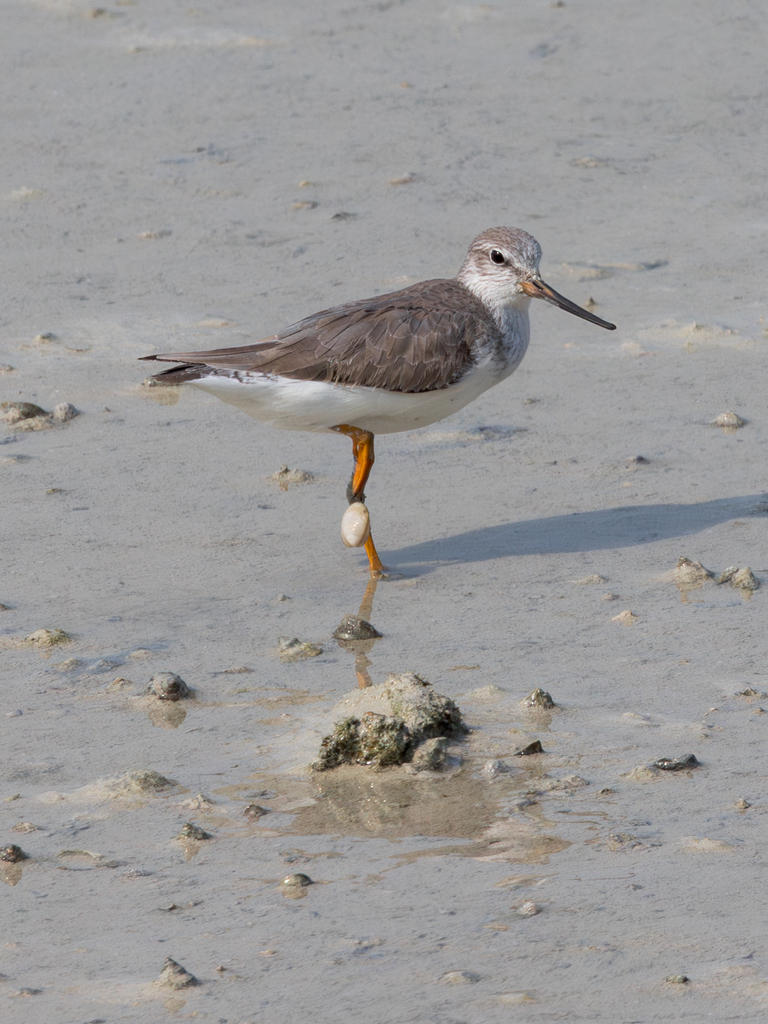
(c) William Stephens, some rights reserved (CC BY) · licence
Family: Scolopacidae · Class: Aves · Order: Charadriiformes
Xenus cinereus (Terek Sandpiper) is a California animal in the Scolopacidae family.
The Terek Sandpiper is a medium-sized shorebird measuring 22-25 cm (8.7-9.8 inches) in length with a wingspan of 57-59 cm (22.4-23.2 inches). The species is distinguished by its distinctive upturned bill, which curves slightly upward at the tip, and relatively short, bright orange-yellow legs. Adults in breeding plumage display brownish-gray upperparts with darker streaking, while the underparts are white with fine dark streaks on the breast and flanks. Non-breeding adults appear more uniformly gray above with clean white underparts. In flight, the species shows a distinctive white trailing edge on the secondaries and a faint white wing stripe. The Terek Sandpiper breeds across the boreal forests of northern Eurasia, from Scandinavia east through Siberia to the Kamchatka Peninsula. The species is a rare but regular vagrant to western North America, including California. In California, Terek Sandpipers have been documented primarily along the coast and at inland freshwater locations during migration periods, typically from late spring through early fall. Most California records occur between May and September, with peak observations in August and September. During the breeding season, this species inhabits marshy areas near wooded rivers, lakes, and bogs in the taiga zone. On migration and wintering grounds, Terek Sandpipers frequent mudflats, sandy beaches, rocky shores, salt ponds, and shallow freshwater wetlands. The species typically forages in areas with soft substrates where it can probe for invertebrates. In California, vagrants have been observed at coastal estuaries, salt ponds, sewage treatment facilities, and shallow inland lakes. Terek Sandpipers are active foragers, using their specialized bills to probe soft mud and sand for invertebrates. Their diet consists primarily of polychaete worms, small crustaceans, mollusks, and aquatic insects. The species exhibits a characteristic feeding behavior, often running quickly along the water's edge while probing rapidly. Breeding occurs from May through July, with females typically laying 4 eggs in a shallow scrape lined with vegetation. The nest is usually located on dry ground near water, often concealed among low vegetation or debris. The Terek Sandpiper is not federally listed in the United States, as it is not a breeding resident. Globally, the species is classified as Least Concern by the International Union for Conservation of Nature, with a stable population estimated at 200,000-300,000 individuals. However, like many Arctic-breeding shorebirds, the species faces potential threats from climate change affecting breeding habitat, coastal development on migration routes, and habitat degradation at stopover sites. In California, the species remains a rare vagrant with fewer than 50 documented records since the 1970s, making each observation significant for understanding migration patterns and vagrancy in Pacific Coast shorebirds.
Classification
Class: Aves · Order: Charadriiformes · Family: Scolopacidae
Frequently asked questions
How is Xenus cinereus classified?
Xenus cinereus belongs to class Aves, order Charadriiformes, family Scolopacidae.
What family does Xenus cinereus belong to?
Xenus cinereus is in the Scolopacidae family.
What is Xenus cinereus?
The Terek Sandpiper is a medium-sized shorebird measuring 22-25 cm (8.7-9.8 inches) in length with a wingspan of 57-59 cm (22.4-23.2 inches).
Is Xenus cinereus found in California?
Yes. Xenus cinereus is recorded in California in The California Species Project's catalogue.
Related species
Other California species in the same genus, family, or bioregion.
Data from The California Species Project — 14,000+ California species with verified data from CNPS, CDFW, USFWS, and more.