Xeris indecisus
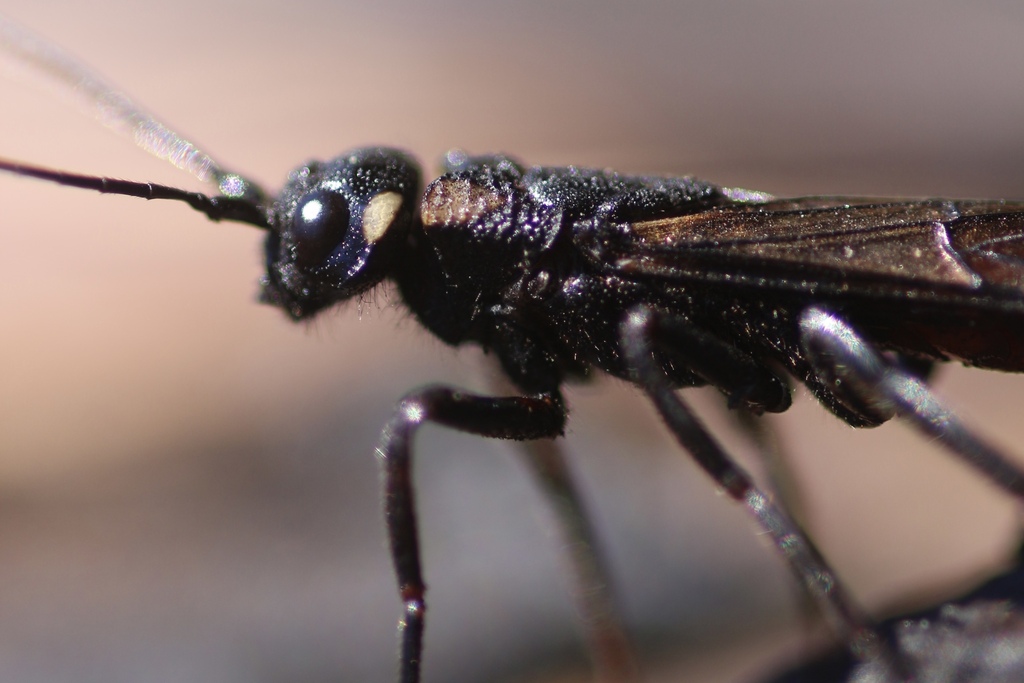
no rights reserved · CC0
Family: Siricidae · Class: Insecta · Order: Hymenoptera
Xeris indecisus is a California animal in the Siricidae family.
Xeris indecisus is a wood wasp in the family Siricidae, a group of sawflies whose larvae develop as borers in dead or dying wood. Adults are typically medium to large-sized hymenopterans, measuring 15-30 mm in length, with elongated bodies and prominent ovipositors in females. Members of the genus Xeris are characterized by their metallic coloration, often appearing dark bronze or black with subtle metallic sheens. The wings are typically clear to slightly smoky, and males can be distinguished from females by their smaller size and lack of the prominent, drill-like ovipositor used for egg-laying. The distribution of Xeris indecisus appears to be limited within North America, though specific range data for this species remains poorly documented in the scientific literature. Based on available records, the species likely occurs in forested regions where suitable host trees are present, though comprehensive distribution mapping has not been completed. The species' presence in California, if confirmed, would represent part of a broader western North American distribution pattern typical of many Siricidae species. Xeris species typically inhabit coniferous and mixed forests where dead, dying, or stressed trees provide suitable breeding substrates. Adults are most commonly encountered in areas with recent tree mortality caused by factors such as fire, disease, drought, or insect damage. The species likely shows a preference for specific host tree species, though detailed host plant relationships for X. indecisus have not been thoroughly documented. Most Siricidae species are associated with conifers, particularly pines, firs, and spruces, where larvae develop in the wood for one to several years. Adult Xeris indecisus are active during warmer months, typically emerging from host trees in late spring through early fall. Females use their elongated ovipositor to drill holes deep into the bark and wood of suitable host trees, where they deposit eggs along with symbiotic fungi that help larvae digest the wood. Development is typically univoltine, with larvae spending one to two years developing within the host tree before pupating and emerging as adults. Males are often seen congregating around freshly cut logs or recently killed trees where females are ovipositing. Xeris indecisus does not appear to have any formal conservation status designations at federal or state levels, reflecting both its relatively stable population status and the limited research attention given to most non-pest hymenopteran species. Like many forest-dependent insects, the species may face localized population fluctuations related to forest management practices, wildfire patterns, and climate change effects on forest health. However, as wood wasps often benefit from periodic disturbances that create dead wood habitat, populations may remain relatively stable in managed forest landscapes. The species' conservation needs are likely best addressed through maintaining diverse forest age structures and allowing natural levels of tree mortality to provide breeding habitat.
Classification
Class: Insecta · Order: Hymenoptera · Family: Siricidae
Frequently asked questions
How is Xeris indecisus classified?
Xeris indecisus belongs to class Insecta, order Hymenoptera, family Siricidae.
What family does Xeris indecisus belong to?
Xeris indecisus is in the Siricidae family.
What is Xeris indecisus?
Xeris indecisus is a wood wasp in the family Siricidae, a group of sawflies whose larvae develop as borers in dead or dying wood.
Is Xeris indecisus found in California?
Yes. Xeris indecisus is recorded in California in The California Species Project's catalogue.
Related species
Other California species in the same genus, family, or bioregion.
Data from The California Species Project — 14,000+ California species with verified data from CNPS, CDFW, USFWS, and more.