Xestia c-nigrum
Setaceous Hebrew Character
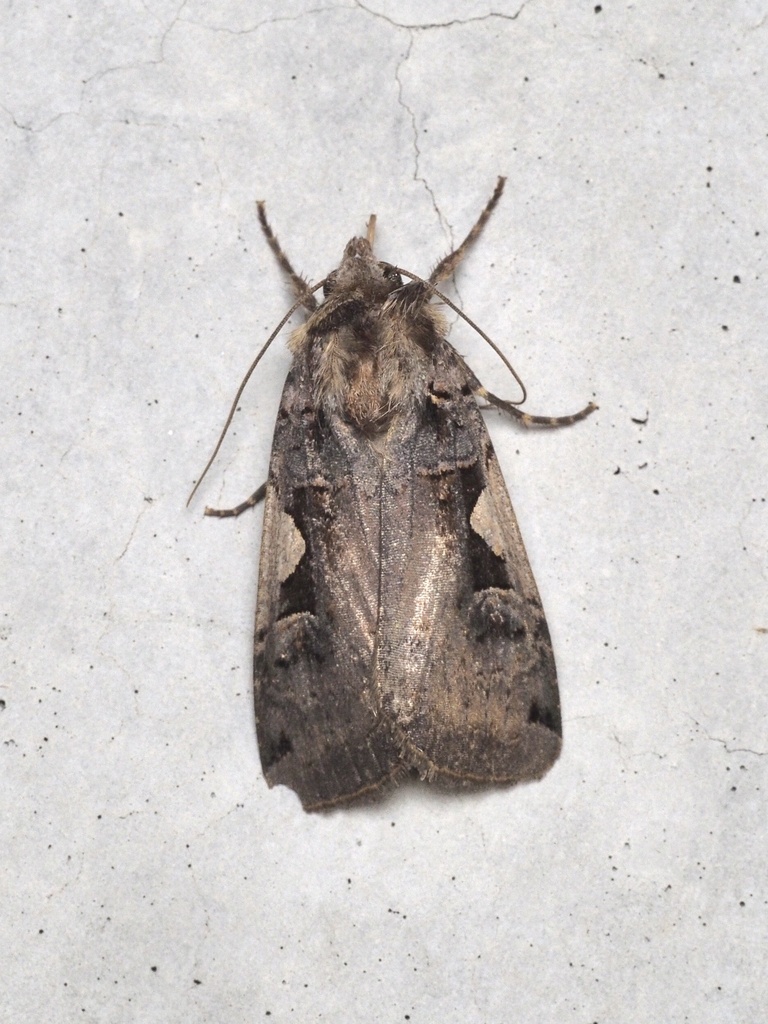
(c) Cosimo Costanzia di Costigliole, some rights reserved (CC BY) · licence
Family: Noctuidae · Class: Insecta · Order: Lepidoptera
Xestia c-nigrum (Setaceous Hebrew Character) is a California animal in the Noctuidae family.
The Setaceous Hebrew Character (Xestia c-nigrum) is a medium-sized moth in the family Noctuidae, characterized by distinctive wing markings that give the species its common name. Adults have a wingspan of 35 to 40 mm (1.4 to 1.6 inches). The forewings are typically brown to gray-brown with a complex pattern of lines and spots, most notably a prominent reniform spot and orbicular spot connected by pale markings that resemble Hebrew characters. The hindwings are pale gray to whitish with darker marginal bands. Males can be distinguished from females by their more strongly bipectinate (feathery) antennae. This species has a Holarctic distribution, occurring across northern North America and Eurasia. In North America, it ranges from Alaska and northern Canada south to the northern United States, with populations extending into mountainous regions of the western states including California. The species is found primarily in boreal and montane forests, typically at elevations above 1,500 meters (4,920 feet) in California's mountainous regions, including the Sierra Nevada and northern Coast Ranges. Setaceous Hebrew Character moths inhabit coniferous and mixed forests, particularly those dominated by fir, spruce, and pine species. Adults are most commonly found in areas with dense canopy cover and abundant understory vegetation. The species shows a preference for cooler, mesic environments and is often associated with forest edges, clearings, and areas with moderate disturbance that promote diverse plant communities. Adults are nocturnal and are attracted to artificial lights. The flight period typically extends from late June through September, with peak activity occurring in July and August. Larvae feed on a wide variety of herbaceous plants and low shrubs, including species in the families Rosaceae, Ericaceae, and Salicaceae. Common host plants include willow (Salix spp.), birch (Betula spp.), and various herbaceous perennials. The species is univoltine, producing one generation per year. Eggs are laid singly on host plant foliage, and larvae overwinter in the soil as pupae. Females deposit eggs on the undersides of leaves during late summer. Larvae are cutworms that feed nocturnally on foliage and may occasionally damage agricultural crops in areas adjacent to natural habitats. The caterpillars are brown to gray with subtle longitudinal stripes and reach approximately 40 mm (1.6 inches) in length when mature. The Setaceous Hebrew Character is not currently listed under state or federal endangered species legislation. The species appears to maintain stable populations throughout most of its range, though like many montane forest species, it may face long-term challenges from climate change and habitat fragmentation. Populations in California represent the southern extent of the species' North American range and may be particularly vulnerable to warming temperatures that could shift suitable habitat to higher elevations. Forest management practices that maintain diverse age classes and natural disturbance patterns likely benefit this species by supporting the variety of herbaceous host plants required by developing larvae.
Classification
Class: Insecta · Order: Lepidoptera · Family: Noctuidae
Frequently asked questions
How is Xestia c-nigrum classified?
Xestia c-nigrum belongs to class Insecta, order Lepidoptera, family Noctuidae.
What family does Xestia c-nigrum belong to?
Xestia c-nigrum is in the Noctuidae family.
What is Xestia c-nigrum?
The Setaceous Hebrew Character (Xestia c-nigrum) is a medium-sized moth in the family Noctuidae, characterized by distinctive wing markings that give the species its common name.
Is Xestia c-nigrum found in California?
Yes. Xestia c-nigrum is recorded in California in The California Species Project's catalogue.
Related species
Other California species in the same genus, family, or bioregion.
Data from The California Species Project — 14,000+ California species with verified data from CNPS, CDFW, USFWS, and more.