Xestoleptura crassipes
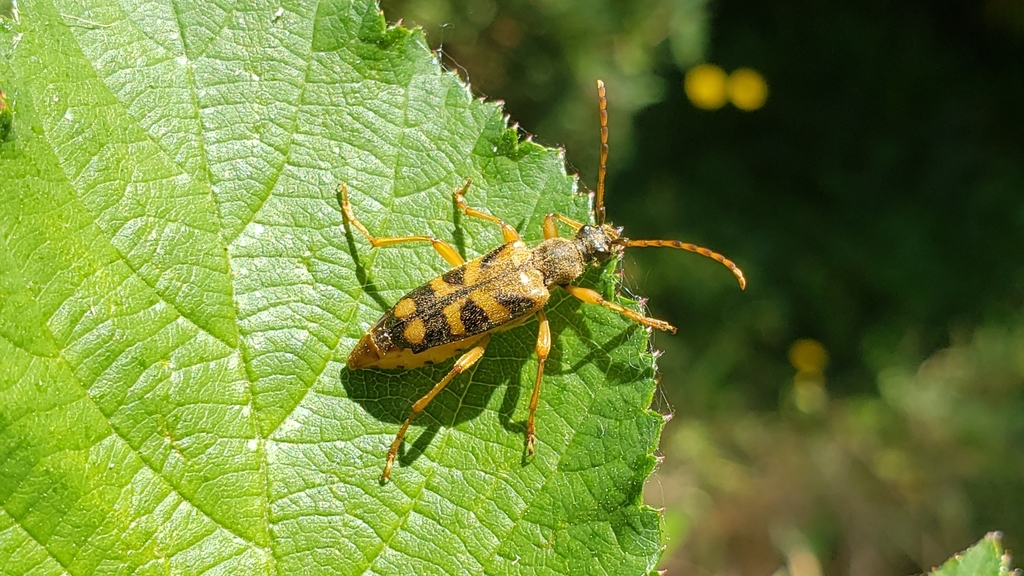
(c) Gavin Slater, some rights reserved (CC BY) · licence
Family: Cerambycidae · Class: Insecta · Order: Coleoptera
Xestoleptura crassipes is a California animal in the Cerambycidae family.
Xestoleptura crassipes is a longhorn beetle belonging to the family Cerambycidae, a diverse group of wood-boring beetles found throughout North America. The species name 'crassipes' refers to thick or enlarged legs, which may be a distinguishing morphological characteristic, though detailed physical descriptions are not well documented in readily available scientific literature. As a member of the genus Xestoleptura, this species likely shares general characteristics with related longhorn beetles, including elongated antennae that may approach or exceed body length, and a typical cerambycid body form with a somewhat cylindrical shape. Adult longhorn beetles in this group typically measure between 10-20 mm in length, though specific measurements for X. crassipes have not been documented in accessible sources. The documented distribution of Xestoleptura crassipes appears to be limited, with NatureServe indicating no available distribution data as of December 2025. This suggests either a very restricted range, limited survey effort, or possible taxonomic uncertainty. Many Cerambycidae species have specialized habitat requirements tied to specific host trees or forest types, which can result in localized distributions. Habitat requirements for this species have not been well characterized in available literature. Most Xestoleptura species are associated with coniferous or mixed forests, where larvae typically develop in dead or dying wood of various tree species. Adult beetles are often found on flowers where they feed on pollen and nectar, particularly favoring umbellifer flowers and other broad, flat-topped flower clusters that provide easy landing platforms. The life cycle likely follows the typical cerambycid pattern, with adults emerging during warmer months to mate and oviposit. Females deposit eggs in bark crevices or directly into wood, where larvae bore through sapwood and heartwood, creating characteristic galleries. Development from egg to adult typically requires one to several years, depending on wood hardness, climate conditions, and species-specific requirements. Adults are generally active during daylight hours and may be attracted to recently cut or stressed trees. No formal conservation status has been assigned to Xestoleptura crassipes by federal or state agencies. The lack of documented populations and distribution data makes it difficult to assess conservation needs or population trends. This data gap is not uncommon among specialized wood-boring beetles, many of which remain poorly studied despite potential ecological importance as decomposers and forest ecosystem components. The limited scientific documentation for this species reflects broader challenges in cerambycid research, where many species remain understudied due to cryptic behavior, specialized habitat requirements, and identification difficulties. Systematic surveys focusing on wood-boring beetle communities could help clarify the distribution, ecology, and conservation status of X. crassipes and related species. If you have additional verified information about this species' biology, distribution, or ecology, please contact us to help improve this species account.
Classification
Class: Insecta · Order: Coleoptera · Family: Cerambycidae
Frequently asked questions
How is Xestoleptura crassipes classified?
Xestoleptura crassipes belongs to class Insecta, order Coleoptera, family Cerambycidae.
What family does Xestoleptura crassipes belong to?
Xestoleptura crassipes is in the Cerambycidae family.
What is Xestoleptura crassipes?
Xestoleptura crassipes is a longhorn beetle belonging to the family Cerambycidae, a diverse group of wood-boring beetles found throughout North America.
Is Xestoleptura crassipes found in California?
Yes. Xestoleptura crassipes is recorded in California in The California Species Project's catalogue.
Related species
Other California species in the same genus, family, or bioregion.
Data from The California Species Project — 14,000+ California species with verified data from CNPS, CDFW, USFWS, and more.