Xylocopa sonorina
Valley Carpenter Bee
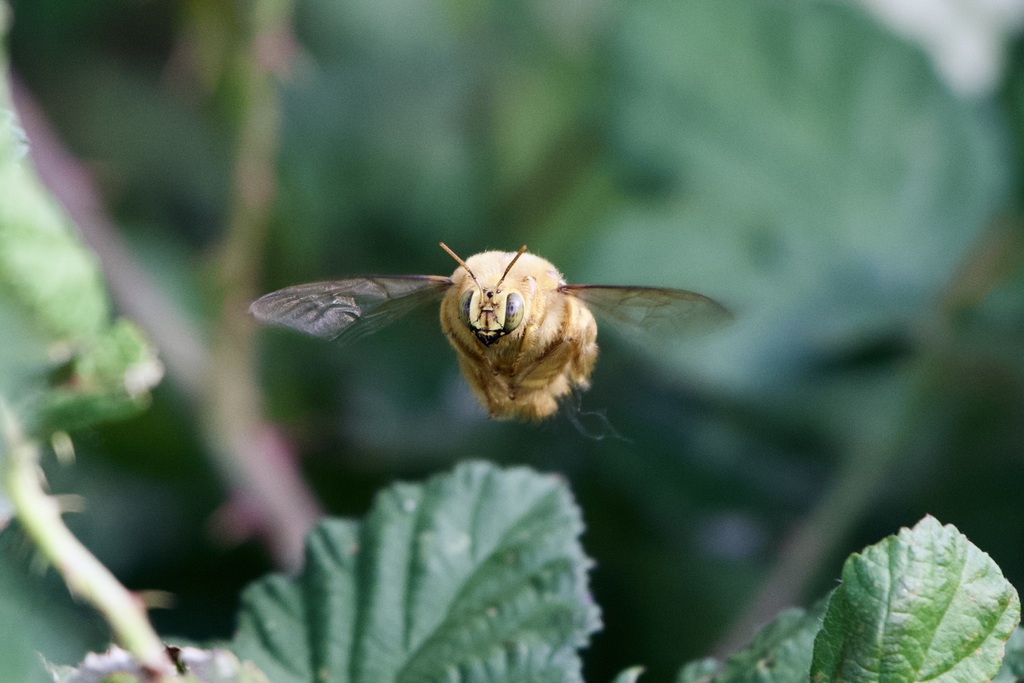
no rights reserved · CC0
Family: Apidae · Class: Insecta · Order: Hymenoptera
Xylocopa sonorina (Valley Carpenter Bee) is a California animal in the Apidae family.
The Valley Carpenter Bee (Xylocopa sonorina) is a large solitary bee species that exhibits striking sexual dimorphism in coloration. Females are entirely black with a robust, shiny appearance, while males are golden-brown to yellowish with distinctive bright green eyes. Adults typically measure 25-30 mm (1.0-1.2 inches) in length, making them among the largest bees in North America. This species ranges from western Texas through Arizona, New Mexico, Nevada, and north to California, including the eastern Pacific islands where it is also known as the Hawaiian Carpenter Bee (BugGuide 2022). In California, Xylocopa sonorina is widely distributed across the state, with documented occurrences in most counties. The species is particularly common in valleys and foothills throughout its range. Valley Carpenter Bees inhabit areas with deciduous trees, particularly oak woodlands and mixed deciduous forests (BugGuide 2022). They are commonly found in semi-natural habitats surrounded by modified landscapes, adapting well to suburban and agricultural areas where suitable nesting sites exist. The species occurs from sea level to moderate elevations in foothill regions. As carpenter bees, females excavate nesting tunnels in dead wood, soft wooden structures, or plant stems. The female creates galleries approximately 12-15 mm in diameter, where she provisions individual cells with pollen balls and lays single eggs. Unlike social bees, Valley Carpenter Bees are solitary, though multiple females may nest in close proximity. Adults overwinter in their tunnels, emerging in spring to mate and begin new nesting activities. The species is active from spring through fall, with peak activity during warmer months. Valley Carpenter Bees are important pollinators of native and cultivated plants. They practice buzz pollination, using flight muscles to vibrate flowers and release pollen. Males are often observed hovering territorially around nesting sites and flowers, though they lack stings and are harmless. Females forage on a variety of flowering plants, including native shrubs, trees, and garden plants. They have been documented visiting roses, geraniums, and various native California flora. The species shows no current conservation concerns and maintains stable populations throughout its range. Valley Carpenter Bees have adapted well to human-modified landscapes and are commonly encountered in suburban gardens, parks, and agricultural areas. Their ability to nest in various wooden substrates, including human structures, has likely contributed to their continued success. The species benefits from diverse floral resources and the preservation of dead wood for nesting sites. In some areas, they may be considered minor structural pests when nesting in wooden buildings, though their ecological value as native pollinators generally outweighs such concerns.
Classification
Class: Insecta · Order: Hymenoptera · Family: Apidae
Frequently asked questions
How is Xylocopa sonorina classified?
Xylocopa sonorina belongs to class Insecta, order Hymenoptera, family Apidae.
What family does Xylocopa sonorina belong to?
Xylocopa sonorina is in the Apidae family.
What is Xylocopa sonorina?
The Valley Carpenter Bee (Xylocopa sonorina) is a large solitary bee species that exhibits striking sexual dimorphism in coloration.
Is Xylocopa sonorina found in California?
Yes. Xylocopa sonorina is recorded in California in The California Species Project's catalogue.
Related species
Other California species in the same genus, family, or bioregion.
Data from The California Species Project — 14,000+ California species with verified data from CNPS, CDFW, USFWS, and more.