Xylotrechus undulatus
Spruce Zebra Beetle
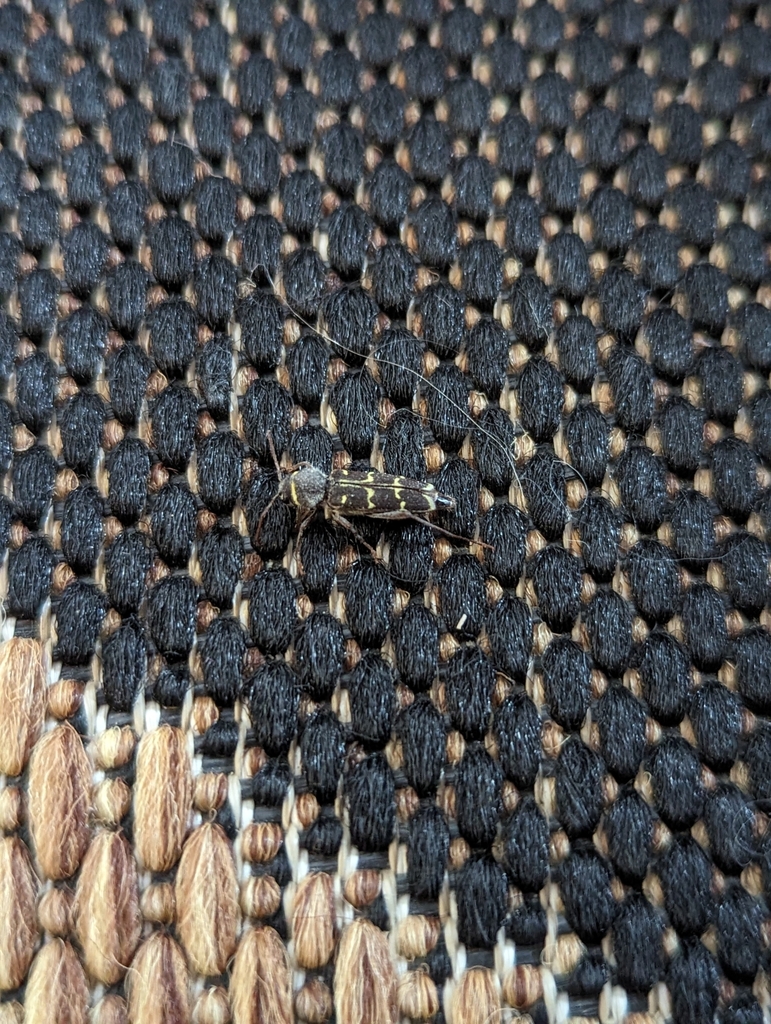
(c) Alexandria 'Alex' Wenninger, some rights reserved (CC BY) · licence
Family: Cerambycidae · Class: Insecta · Order: Coleoptera
Xylotrechus undulatus (Spruce Zebra Beetle) is a California animal in the Cerambycidae family.
The Spruce Zebra Beetle is a medium-sized longhorn beetle in the family Cerambycidae, subfamily Cerambycinae, tribe Clytini. Adults typically measure 8 to 14 mm (0.3 to 0.6 inches) in length and display distinctive yellowish-white zigzag stripes across dark brown to black elytra, creating a zebra-like pattern that gives the species its common name. The antennae are moderately long, extending approximately half the body length, with distinct segmentation typical of cerambycid beetles. Xylotrechus undulatus occurs across the boreal and montane coniferous forests of North America. The species ranges from Alaska and western Canada south through the western United States, including California's Sierra Nevada and Cascade Range. In California, the beetle is found primarily in higher elevation coniferous forests where suitable host trees are present. The species also occurs across the northern Great Lakes region and northeastern United States, extending into southern Canada. This beetle inhabits coniferous forests dominated by spruce, fir, and pine species. Adults are typically found in mature and old-growth forest stands, though they may also colonize recently disturbed areas with suitable dead or dying conifers. The species shows a preference for cooler, moist forest environments typical of boreal and subalpine zones. Elevation ranges vary by region but generally occur from 1,000 to 3,000 meters (3,300 to 9,800 feet) in western mountain ranges. Spruce Zebra Beetle larvae are wood borers that develop in the inner bark and sapwood of dead or dying coniferous trees, particularly spruce (Picea spp.) and fir (Abies spp.). Adults emerge in late spring and early summer, typically May through July, when they mate and seek suitable host material for oviposition. Females deposit eggs in bark crevices or under bark scales of recently killed or severely stressed conifers. The larval stage lasts one to two years depending on climate conditions and wood density. Adults are most active during warm, sunny periods and may be observed on or near host trees, feeding on bark or sap exudates. As a native forest insect, Xylotrechus undulatus plays an ecological role in nutrient cycling by accelerating the decomposition of dead coniferous wood. The species is not considered a significant forest pest, as it typically colonizes trees that are already dead or dying from other causes such as fire, windthrow, or disease. Climate change and forest management practices that alter natural disturbance regimes may affect population dynamics, though specific population trends have not been extensively documented. The beetle serves as prey for various woodpecker species and other insectivorous birds, contributing to forest food webs. No special conservation measures are currently in place for this species, as it appears to maintain stable populations throughout its range where suitable coniferous habitat persists.
Classification
Class: Insecta · Order: Coleoptera · Family: Cerambycidae
Frequently asked questions
How is Xylotrechus undulatus classified?
Xylotrechus undulatus belongs to class Insecta, order Coleoptera, family Cerambycidae.
What family does Xylotrechus undulatus belong to?
Xylotrechus undulatus is in the Cerambycidae family.
What is Xylotrechus undulatus?
The Spruce Zebra Beetle is a medium-sized longhorn beetle in the family Cerambycidae, subfamily Cerambycinae, tribe Clytini.
Is Xylotrechus undulatus found in California?
Yes. Xylotrechus undulatus is recorded in California in The California Species Project's catalogue.
Related species
Other California species in the same genus, family, or bioregion.
Data from The California Species Project — 14,000+ California species with verified data from CNPS, CDFW, USFWS, and more.