Ziphius cavirostris
Goose-beaked Whale
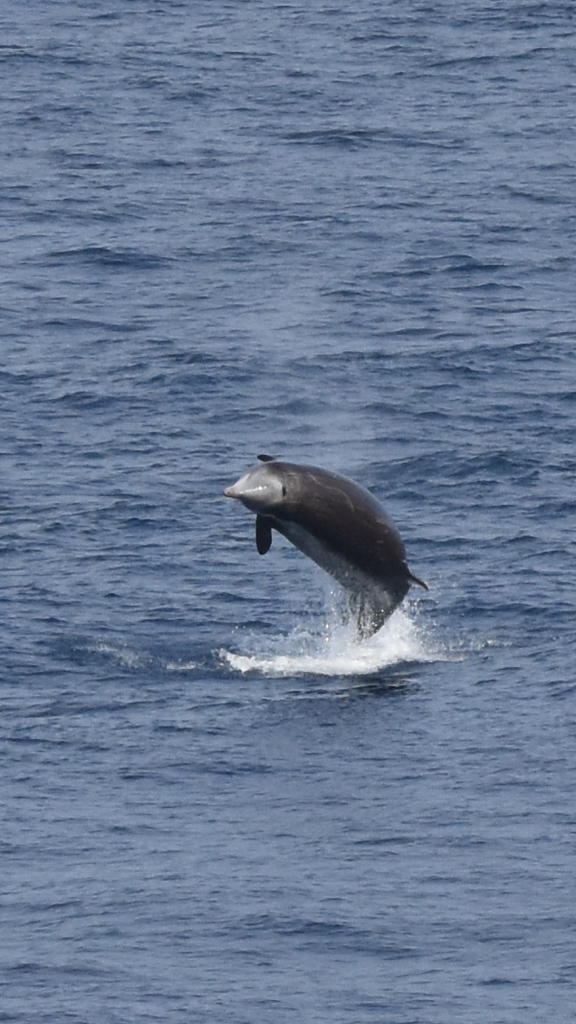
(c) Charlotte Kirchner, some rights reserved (CC BY) · licence
Family: Hyperoodontidae · Class: Mammalia · Order: Artiodactyla
Ziphius cavirostris (Goose-beaked Whale) is a California animal in the Hyperoodontidae family.
Cuvier's beaked whale (Ziphius cavirostris), also known as the goose-beaked whale, is a medium-sized deep-diving cetacean and the most widely distributed member of the beaked whale family. Adults reach lengths of 5.5 to 7 meters (18 to 23 feet) and weigh 2,000 to 3,000 kilograms (4,400 to 6,600 pounds). The species exhibits pronounced sexual dimorphism in coloration and scarring patterns. Adult males typically display a light cream or white coloration on the head and anterior body, with darker gray to brown coloring posteriorly. Females and juveniles maintain a more uniform gray-brown coloration. Males develop two triangular teeth at the tip of the lower jaw that erupt through the gums, while females' teeth rarely emerge. The species' distinctive beak is relatively short and goose-like, giving rise to one of its common names. Cuvier's beaked whales occur in deep waters of all major oceans and seas, making them the most cosmopolitan of all beaked whale species. Off California, they are found year-round in waters deeper than 1,000 meters (3,280 feet), particularly along the continental shelf edge and in submarine canyons. The species ranges from Baja California to the Aleutian Islands in the eastern North Pacific. They are regularly observed in the Southern California Bight, Monterey Canyon, and waters off Central and Northern California. This species inhabits oceanic and deep continental slope waters, typically at depths exceeding 1,000 meters where the seafloor drops steeply. They prefer areas with complex bathymetric features such as seamounts, submarine canyons, and escarpments. Water temperatures in their habitat range from 2 to 25 degrees Celsius, though they show no strong preference for specific temperature regimes. Cuvier's beaked whales are among the most accomplished divers in the animal kingdom, regularly reaching depths exceeding 2,000 meters (6,560 feet) and staying submerged for over two hours. They feed primarily on deep-water squid, including species in the families Cranchiidae, Histioteuthidae, and Onychoteuthidae, supplemented by deep-sea fish and crustaceans. Social groups typically consist of 2 to 7 individuals, though larger aggregations of up to 25 animals have been documented. Breeding appears to occur year-round with a gestation period of approximately 17 months. Females give birth to a single calf every 2 to 3 years. While not federally listed under the Endangered Species Act, Cuvier's beaked whales face significant conservation challenges. The species is particularly vulnerable to anthropogenic noise, especially military sonar operations. Mass stranding events have been linked to naval exercises using mid-frequency active sonar. The Marine Mammal Protection Act provides protection for this species in U.S. waters. Climate change may affect prey distribution and availability, while ship strikes pose an emerging threat in heavily trafficked shipping lanes. Current population estimates for the eastern North Pacific remain uncertain, though the species appears to maintain stable populations in most regions.
Classification
Class: Mammalia · Order: Artiodactyla · Family: Hyperoodontidae
Frequently asked questions
How is Ziphius cavirostris classified?
Ziphius cavirostris belongs to class Mammalia, order Artiodactyla, family Hyperoodontidae.
What family does Ziphius cavirostris belong to?
Ziphius cavirostris is in the Hyperoodontidae family.
What is Ziphius cavirostris?
Cuvier's beaked whale (Ziphius cavirostris), also known as the goose-beaked whale, is a medium-sized deep-diving cetacean and the most widely distributed member of the beaked whale family.
Is Ziphius cavirostris found in California?
Yes. Ziphius cavirostris is recorded in California in The California Species Project's catalogue.
Related species
Other California species in the same genus, family, or bioregion.
Data from The California Species Project — 14,000+ California species with verified data from CNPS, CDFW, USFWS, and more.