Zonotrichia querula
Harris's Sparrow
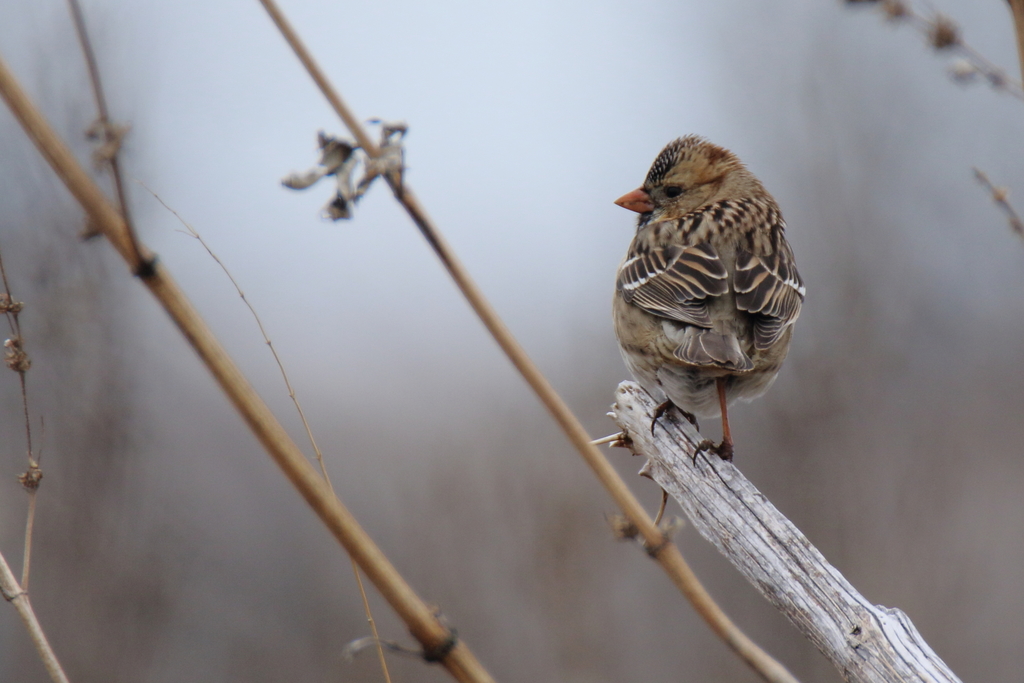
(c) Michael D Fox, some rights reserved (CC BY) · licence
Family: Emberizidae · Class: Aves · Order: Passeriformes
Zonotrichia querula (Harris's Sparrow) is a California animal in the Emberizidae family.
Harris's Sparrow is North America's largest sparrow, measuring 17-20 cm (6.7-7.9 inches) in length with a wingspan of 27 cm (10.6 inches). Adults weigh 26-49 grams. The species exhibits distinctive seasonal plumage variation. Breeding adults display a prominent black crown, face, and throat that contrasts sharply with white cheeks and underparts. The back is brown with dark streaking, and wings show two white wing bars. Non-breeding adults retain the black crown but show reduced black on the throat, often appearing as a black bib. Juveniles and first-winter birds lack the black head pattern, instead showing a buff-colored face with dark streaking and a spotted breast. Harris's Sparrow breeds exclusively in the transition zone between boreal forest and tundra across northern Canada, from the Northwest Territories east to Hudson Bay. This narrow breeding range extends from approximately 60 to 69 degrees north latitude. During winter, the species migrates to the central Great Plains of North America, primarily in Texas, Oklahoma, Kansas, and Nebraska. In California, Harris's Sparrow is considered a rare vagrant, with most records occurring during fall and winter months along the coast and in the Central Valley. Breeding habitat consists of stunted spruce and tamarack at the forest-tundra ecotone, typically where trees are 1-4 meters tall. The species nests on the ground beneath low shrubs or at the base of small conifers. Wintering birds utilize brushy areas, woodland edges, parks, and suburban areas with dense vegetation. During migration, they frequent shelterbelts, riparian corridors, and weedy fields. Harris's Sparrows are primarily granivorous, feeding on seeds of grasses, forbs, and shrubs. During the breeding season, they supplement their diet with insects, particularly when feeding nestlings. The species is social outside the breeding season, often joining mixed-species flocks with other sparrows and juncos. Breeding occurs from late May through July. Females construct ground nests of grass, moss, and twigs, laying 3-5 eggs. Incubation lasts 11-15 days, and nestlings fledge after 9-11 days. The species typically raises one brood per year. Harris's Sparrow is not federally or state listed in California, reflecting its status as a vagrant rather than a resident species. The global population is estimated at 2 million individuals and appears stable. According to the North American Breeding Bird Survey, populations have shown slight increases since 1970. Climate change poses potential long-term threats to breeding habitat in the Arctic, as warming temperatures may alter the forest-tundra boundary. The species' specialized habitat requirements and restricted breeding range make it potentially vulnerable to environmental changes, though current population trends remain positive.
Classification
Class: Aves · Order: Passeriformes · Family: Emberizidae
Frequently asked questions
How is Zonotrichia querula classified?
Zonotrichia querula belongs to class Aves, order Passeriformes, family Emberizidae.
What family does Zonotrichia querula belong to?
Zonotrichia querula is in the Emberizidae family.
What is Zonotrichia querula?
Harris's Sparrow is North America's largest sparrow, measuring 17-20 cm (6.7-7.9 inches) in length with a wingspan of 27 cm (10.6 inches).
Is Zonotrichia querula found in California?
Yes. Zonotrichia querula is recorded in California in The California Species Project's catalogue.
Related species
Other California species in the same genus, family, or bioregion.
Data from The California Species Project — 14,000+ California species with verified data from CNPS, CDFW, USFWS, and more.