Zopherus granicollis
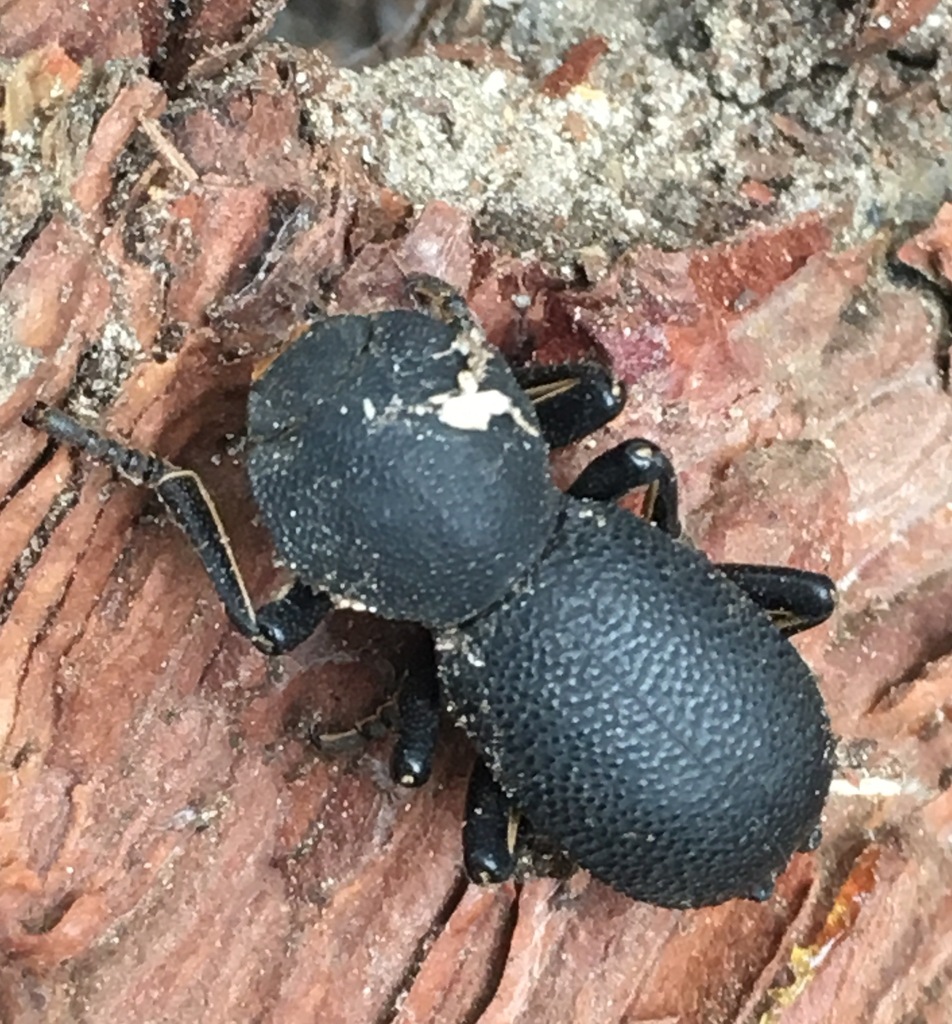
(c) Adam J. Searcy, some rights reserved (CC BY) · licence
Family: Zopheridae · Class: Insecta · Order: Coleoptera
Zopherus granicollis is a California animal in the Zopheridae family.
Zopherus granicollis is a beetle in the family Zopheridae, a group of darkling beetles known for their robust build and scavenging habits. The species belongs to a genus of flightless beetles characterized by their heavily armored appearance and fused wing covers. Adults are typically dark brown to black in coloration with a distinctly granulated thorax that gives the species its name. The elytra (wing covers) are permanently fused, preventing flight, and the body exhibits the characteristic oval, convex shape typical of ironclad beetles. The species occurs in the southwestern United States, with its range extending into California. Based on U.S. Fish and Wildlife Service taxonomic records, Z. granicollis includes at least two recognized subspecies: Z. g. granicollis and Z. g. ventriosus. The distribution pattern suggests adaptation to arid and semi-arid environments characteristic of the southwestern desert regions. Zopherus granicollis inhabits desert and semi-desert environments, typically associating with rocky substrates, desert scrublands, and areas with sparse vegetation. The species appears to favor habitats with adequate shelter provided by rocks, fallen logs, or dense shrub cover. Like other members of the genus, this beetle likely requires specific microhabitat conditions that provide protection from extreme temperatures and desiccation. As a member of the Zopheridae, Z. granicollis exhibits detritivorous feeding behavior, consuming decaying organic matter including plant debris, dead insects, and other decomposing materials. The species is primarily nocturnal, becoming active during cooler evening and nighttime hours when humidity levels are higher. Reproduction likely follows the typical pattern of desert-dwelling beetles, with timing synchronized to periods of adequate moisture and food availability. The larvae develop in soil or organic debris, feeding on decomposing matter until reaching maturity. The conservation status of Zopherus granicollis has not been comprehensively assessed at federal or state levels. The species appears in U.S. Fish and Wildlife Service taxonomic databases but lacks specific conservation designations as of December 2025. Like many desert-dwelling invertebrates, potential threats may include habitat loss due to urban development, off-road vehicle activity, and climate change impacts on desert ecosystems. The species' flightless nature may make populations particularly vulnerable to habitat fragmentation, as dispersal capabilities are limited to walking. Scientific documentation for this species remains limited compared to more extensively studied beetle groups. The taxonomic recognition of distinct subspecies suggests some level of geographic variation within the species complex, but detailed ecological studies are lacking. Additional research is needed to better understand the species' distribution patterns, habitat requirements, population dynamics, and conservation needs within California's desert ecosystems.
Classification
Class: Insecta · Order: Coleoptera · Family: Zopheridae
Frequently asked questions
How is Zopherus granicollis classified?
Zopherus granicollis belongs to class Insecta, order Coleoptera, family Zopheridae.
What family does Zopherus granicollis belong to?
Zopherus granicollis is in the Zopheridae family.
What is Zopherus granicollis?
Zopherus granicollis is a beetle in the family Zopheridae, a group of darkling beetles known for their robust build and scavenging habits.
Is Zopherus granicollis found in California?
Yes. Zopherus granicollis is recorded in California in The California Species Project's catalogue.
Related species
Other California species in the same genus, family, or bioregion.
Data from The California Species Project — 14,000+ California species with verified data from CNPS, CDFW, USFWS, and more.