Zygiella x-notata
Silver-sided Sector Spider
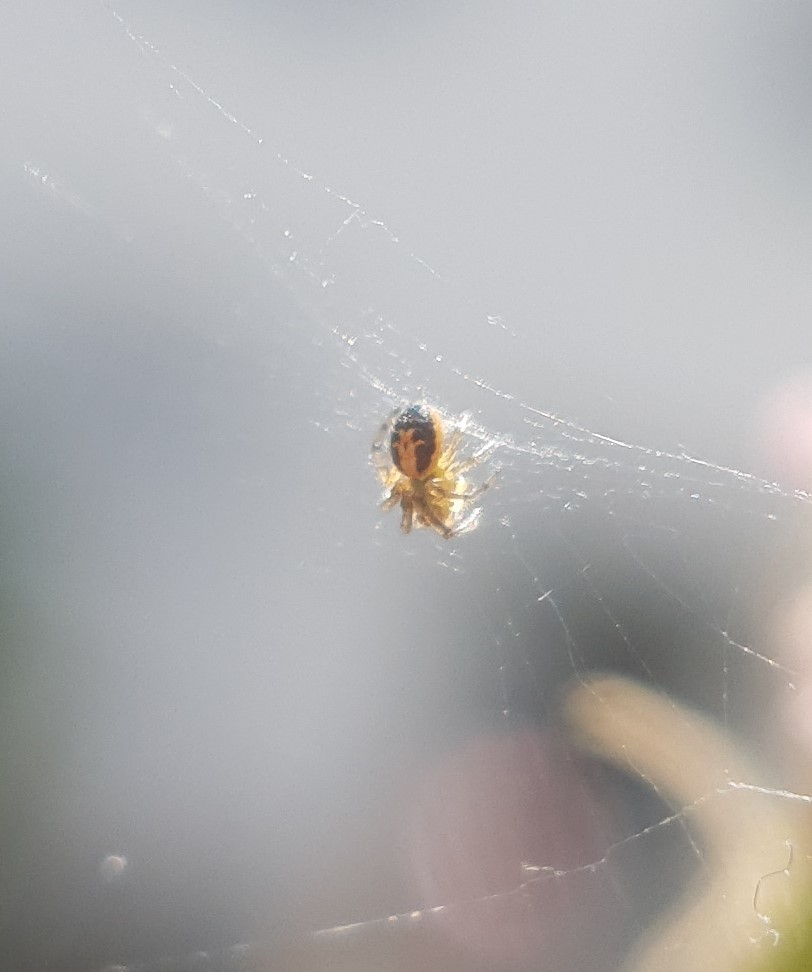
(c) Brenda Black, some rights reserved (CC BY) · licence
Family: Araneidae · Class: Arachnida · Order: Araneae
Zygiella x-notata (Silver-sided Sector Spider) is a California animal in the Araneidae family.
The silver-sided sector spider is a small orb weaver spider with sexually dimorphic body sizes. Females measure 7.4 to 8.7 mm (0.29 to 0.34 inches) in body length, while males are smaller at 6.0 to 6.5 mm (0.24 to 0.26 inches) (BugGuide 2025). The species exhibits typical orb weaver morphology with a rounded abdomen and relatively long legs adapted for web construction. Zygiella x-notata is a European species introduced to North America, where it has established populations from New England south to Virginia and west to the Pacific Coast, including British Columbia (BugGuide 2025). In California, this species has successfully colonized urban and suburban environments throughout the state's coastal and interior regions. The species demonstrates significant adaptability to human-modified landscapes. This spider shows a strong preference for anthropogenic structures and is commonly found on buildings, bridges, window frames, and other artificial surfaces (BugGuide 2025). Unlike many orb weavers that inhabit natural vegetation, Z. x-notata has specialized in exploiting urban microhabitats. The species constructs webs in protected areas such as building corners, under eaves, and in similar sheltered locations that provide protection from weather and disturbance. The silver-sided sector spider constructs distinctive orb webs that are easily recognizable by their incomplete design. These webs characteristically have viscid spiral threads missing from a definite sector between two radii in the upper portion, creating an open area where a strong signal line extends from the web's hub to the spider's retreat (BugGuide 2025). This architectural feature distinguishes Zygiella webs from those of other orb weavers. The spider typically positions itself in a silken retreat connected to the web by the signal line, allowing it to detect vibrations from trapped prey. When prey becomes entangled, the spider quickly moves along the signal line to subdue and consume the captured insect. The species exhibits typical orb weaver feeding behavior, capturing flying insects in its sticky web. Reproductive timing and specific breeding behaviors have not been extensively documented in North American populations, though the species likely follows seasonal patterns similar to other orb weavers, with mating occurring in late summer or early fall. Zygiella x-notata has no federal or state conservation status, as it is an introduced species that has successfully established itself across much of North America. The species faces no apparent conservation threats and continues to expand its range through human-mediated dispersal. Its ability to thrive in urban environments suggests that ongoing development and urbanization may actually benefit this species by creating additional suitable habitat. The spider's association with human structures makes it more likely to be encountered by the public than many native species, though it poses no threat to humans and may provide beneficial pest control services in urban environments.
Classification
Class: Arachnida · Order: Araneae · Family: Araneidae
Frequently asked questions
How is Zygiella x-notata classified?
Zygiella x-notata belongs to class Arachnida, order Araneae, family Araneidae.
What family does Zygiella x-notata belong to?
Zygiella x-notata is in the Araneidae family.
What is Zygiella x-notata?
The silver-sided sector spider is a small orb weaver spider with sexually dimorphic body sizes.
Is Zygiella x-notata found in California?
Yes. Zygiella x-notata is recorded in California in The California Species Project's catalogue.
Related species
Other California species in the same genus, family, or bioregion.
Data from The California Species Project — 14,000+ California species with verified data from CNPS, CDFW, USFWS, and more.