Abies amabilis
Pacific silver fir, Pacific Silver Fir, Pacific silver fir, Pacific silver fir
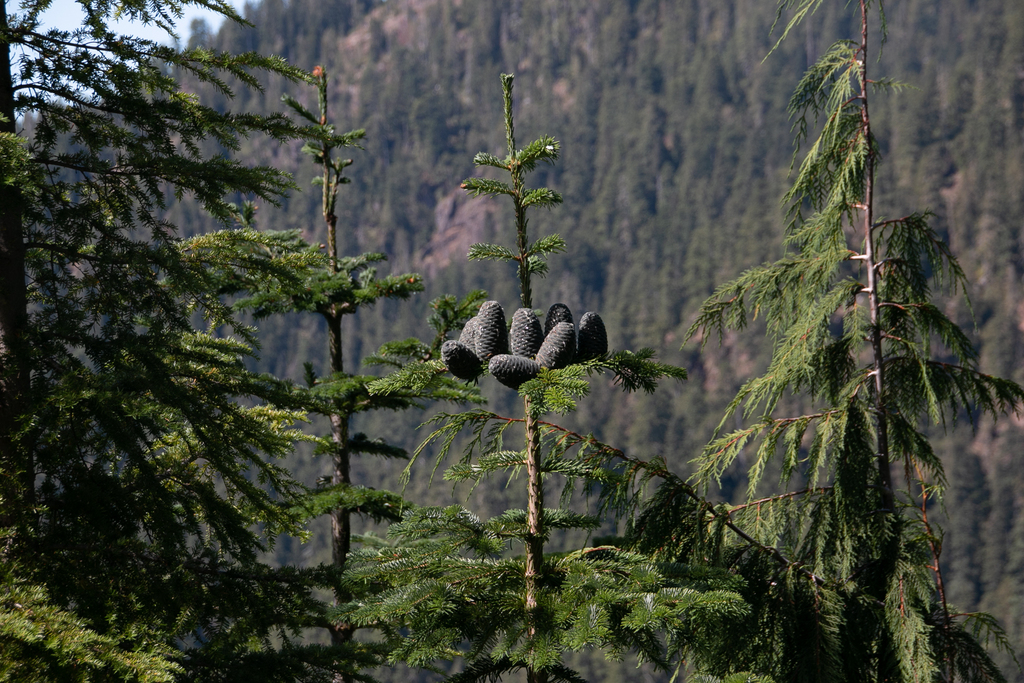
(c) Mara Christensen, some rights reserved (CC BY) · licence
Family: Pinaceae · Type: Tree · Native
Conservation status: CNPS 2B.3
Abies amabilis (Pacific silver fir) is a native California tree in the Pinaceae family, recognized by very limited range, needles not 2-ranked.
Pacific silver fir is a native conifer found in western Siskiyou County in the Klamath Ranges within subalpine forest at elevations of 1,700 to 2,140 meters. A distinctive tree with a steeple-like mature crown, it produces small resinous buds and ash-gray bark that becomes increasingly scaly with age. Growing to a maximum height of 75 meters with a trunk up to 2.6 meters wide, this fir has dark green needles that spread in all directions, approximately 3 centimeters long with notched or blunt tips. Its needles are particularly notable for their uniform length and dark green coloration, with subtle grooves on the upper surface. Seed cones are compact, measuring less than 15 centimeters in length with bracts fully enclosed within the cone structure.
Identification and appearance
Key characters: Co-occurs with 6 species; very limited range, needles not 2-ranked
Habitat and range
Habitat: Subalpine forest
Elevation: 1700-2140 m
California counties: Siskiyou, Mendocino, San Bernardino
Outside California: to British Columbia
Conservation status
CNPS 2B.3
How to tell it apart
vs Pseudotsuga: Fir cones stand upright and disintegrate on tree; Douglas-fir cones hang down with pitchfork bracts and fall intact.; vs Pinus: Fir needles attach individually to smooth twigs; pine needles come bundled in groups of 2-5.; vs Picea: Fir twigs are smooth after needle drop; spruce twigs have rough, persistent peg-like bumps.; vs Sequoia: Fir has individual flat needles and upright cones; redwood has flat sprays of scale-like leaves and small round cones.; vs Cedrus: Fir needles attach individually to smooth twigs; cedar needles grow in dense rosettes on short shoots with barrel-shaped cones.
Frequently asked questions
Is Abies amabilis native to California?
Yes. Abies amabilis is native to California (recorded as native).
Where in California does Abies amabilis grow?
Abies amabilis occurs in Siskiyou, Mendocino, San Bernardino, at elevations of 1700-2140 m.
What plant family does Abies amabilis belong to?
Abies amabilis is in the Pinaceae family, genus Abies.
Is Abies amabilis rare or endangered?
Abies amabilis carries California Rare Plant Rank 2B.3, state rank S2.
What habitat does Abies amabilis grow in?
Abies amabilis grows in Subalpine forest.
Related species
Other California species in the same genus, family, or bioregion.
Sources: Jepson eFlora · CNPS Rare Plant Inventory · Index of California Plant Names · CalPhotos · CDFW CNDDB
Last updated 2026-10-07
Data from The California Species Project — 14,000+ California species with verified data from CNPS, CDFW, USFWS, Cal-IPC, and more.