Abies magnifica var. shastensis
Shasta red fir
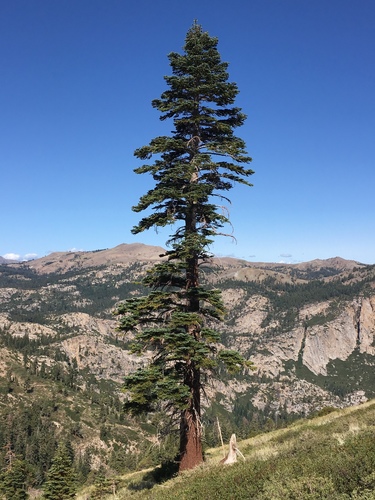
Photo: parent species Abies magnifica · (c) Matt Berger, some rights reserved (CC BY), uploaded by Matt Berger · licence
Family: Pinaceae · Type: Tree · Native
Abies magnifica var. shastensis (Shasta red fir) is a native California tree in the Pinaceae family, recognized by var. magnifica by exserted, reflexed bracts.
Shasta red fir is a native conifer found in the Klamath Ranges, high Cascade Range, and southern Sierra Nevada Mountains in upper mixed-conifer to subalpine forests at elevations of 1,350 to 2,800 meters. Although the Jepson description lacks flowering details, this tree produces distinctive seed cones 15 to 20 centimeters long with uniquely reflexed bracts that cover less than 25 percent of the cone surface. Growing as a large coniferous tree with a pyramidal form, it develops from seedlings with 5 to 8 cotyledons into a majestic forest species. Its branches are typically arranged in horizontal whorls with dense, bluish-green needle-like leaves characteristic of high-elevation conifers. The tree's seed cones demonstrate an intricate architectural pattern with partially exposed bracts, highlighting its distinctive reproductive structures.
Identification and appearance
Key characters: Co-occurs with 6 species; distinguished from var. magnifica by exserted, reflexed bracts
Habitat and range
Habitat: Upper mixed-conifer to subalpine forests
Elevation: 1350-2800 m
California counties: Inyo, Siskiyou, Tulare, Glenn, Tehama, Lake, El Dorado, Trinity, Shasta, Mariposa, Colusa, Humboldt, Fresno, Madera, Kern, Mendocino
Outside California: southern Oregon (Cascade Ranges)
How to tell it apart
vs Pseudotsuga: Fir cones stand upright and disintegrate on tree; Douglas-fir cones hang down with pitchfork bracts and fall intact.; vs Pinus: Fir needles attach individually to smooth twigs; pine needles come bundled in groups of 2-5.; vs Picea: Fir twigs are smooth after needle drop; spruce twigs have rough, persistent peg-like bumps.; vs Sequoia: Fir has individual flat needles and upright cones; redwood has flat sprays of scale-like leaves and small round cones.; vs Cedrus: Fir needles attach individually to smooth twigs; cedar needles grow in dense rosettes on short shoots with barrel-shaped cones.
Frequently asked questions
Is Abies magnifica var. shastensis native to California?
Yes. Abies magnifica var. shastensis is native to California (recorded as native).
Where in California does Abies magnifica var. shastensis grow?
Abies magnifica var. shastensis occurs in Inyo, Siskiyou, Tulare, Glenn, Tehama, Lake, El Dorado, Trinity and other counties, at elevations of 1350-2800 m.
What plant family does Abies magnifica var. shastensis belong to?
Abies magnifica var. shastensis is in the Pinaceae family, genus Abies.
What habitat does Abies magnifica var. shastensis grow in?
Abies magnifica var. shastensis grows in Upper mixed-conifer to subalpine forests.
Related species
Other California species in the same genus, family, or bioregion.
Sources: Jepson eFlora · Index of California Plant Names · CalPhotos
Last updated 2026-10-07
Data from The California Species Project — 14,000+ California species with verified data from CNPS, CDFW, USFWS, Cal-IPC, and more.