Acacia longifolia
Sydney golden wattle
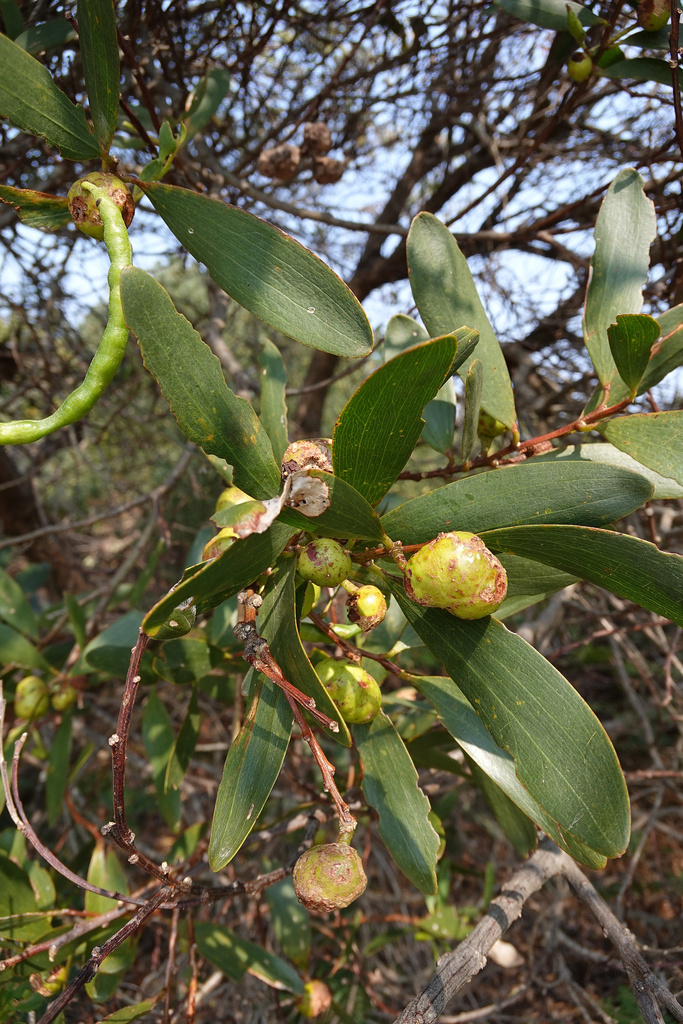
(c) Jon Sullivan, some rights reserved (CC BY) · licence
Family: Fabaceae · Type: Shrub / Tree · Not Native
Conservation status: Cal-IPC Yes
Acacia longifolia (Sydney golden wattle) is a non-native California shrub / tree in the Fabaceae family, recognized by simple leaves and spike inflorescences distinguish it from most others.
Sydney golden wattle is a naturalized shrub found in coastal California regions including the Central Coast, San Francisco Bay Area, Southern California, San Gabriel Mountains, and Peninsular Ranges in disturbed places, especially sandy coastal areas at elevations below 150 meters. Flowering from January to April, this plant produces cream or bright yellow flowers in short spikes 2 to 5 centimeters long. Growing as a small shrub or tree up to 10 meters tall with angled twigs, it forms a dense, multi-stemmed structure. Its simple leaves are narrowly elliptic to lance-linear, 5 to 15 centimeters long and 10 to 25 millimeters wide, with 2 to 4 longitudinal veins. The fruit is a leathery, cylindric pod 5 to 15 centimeters long, ranging from light to dark brown in color.
Identification and appearance
Key characters: 13 sympatric species; simple leaves and spike inflorescences distinguish it from most others
Habitat and range
Habitat: Uncommon. Disturbed places, especially sandy coastal areas
Elevation: < 150 m
California counties: Los Angeles, San Diego, Orange, Riverside, Monterey, San Luis Obispo, Santa Cruz, Solano, San Francisco, Santa Barbara, Ventura, San Bernardino, Marin, Alameda, Contra Costa, Mono, Sacramento, Santa Clara, San Mateo, Yolo
Outside California: native to southeastern Australia, New Guinea, Kei Islands
Bloom period
Acacia longifolia blooms Jan-Apr.
Conservation status
Cal-IPC Yes
How to tell it apart
vs Salix: Acacia has yellow ball-shaped flowers; Salix has catkins with small individual flowers and visible scales.; vs Paraserianthes: Acacia has simple blade-like leaves; Paraserianthes has twice-compound feathery leaves.; vs Eucalyptus: Acacia has yellow ball flowers; Eucalyptus has white to cream flowers with prominent stamens from a cap.; vs Vachellia: Acacia has simple blade-like leaves and no spines; Vachellia has feathery leaves and paired spines.; vs Quercus: Acacia has yellow fuzzy ball flowers; Quercus has separate male catkins and tiny female flowers.
Frequently asked questions
Is Acacia longifolia native to California?
No. Acacia longifolia is not native to California (recorded as not native).
When does Acacia longifolia bloom?
Acacia longifolia blooms Jan-Apr.
Where in California does Acacia longifolia grow?
Acacia longifolia occurs in Los Angeles, San Diego, Orange, Riverside, Monterey, San Luis Obispo, Santa Cruz, Solano and other counties, at elevations of < 150 m.
What plant family does Acacia longifolia belong to?
Acacia longifolia is in the Fabaceae family, genus Acacia.
Is Acacia longifolia invasive in California?
Acacia longifolia is listed by Cal-IPC with an invasiveness rating of Yes.
Related species
Other California species in the same genus, family, or bioregion.
Sources: Jepson eFlora · Index of California Plant Names · CalPhotos
Last updated 2026-10-07
Data from The California Species Project — 14,000+ California species with verified data from CNPS, CDFW, USFWS, Cal-IPC, and more.