Acaena californica
California acaena
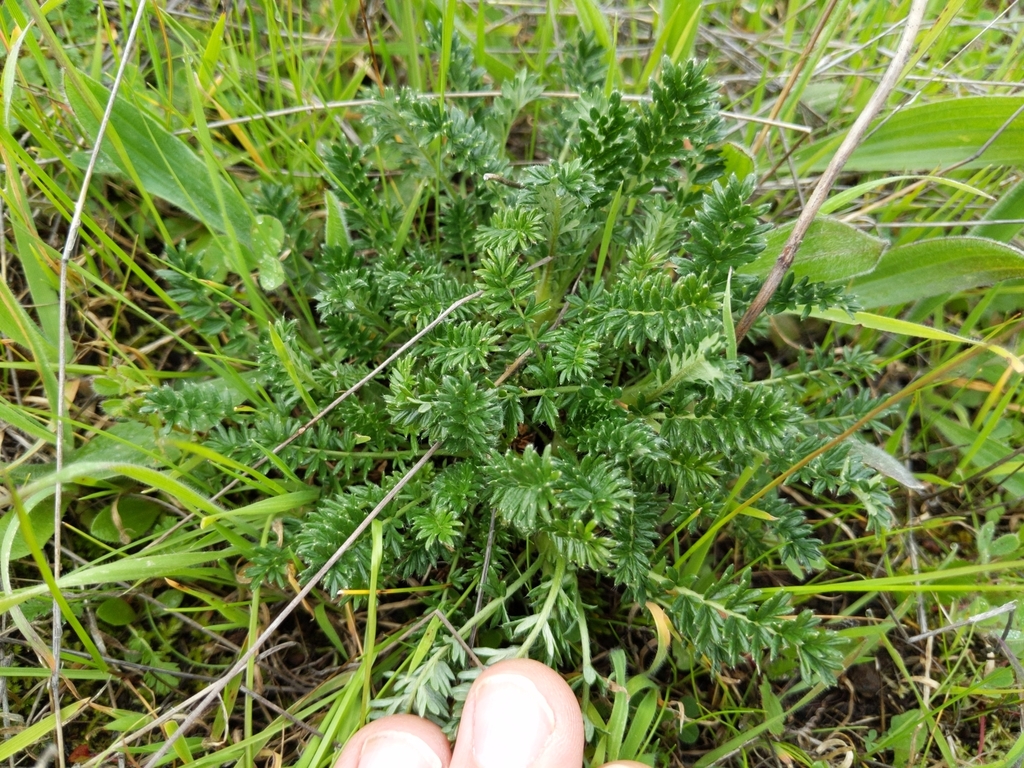
(c) Ken-ichi Ueda, some rights reserved (CC BY) · licence
Family: Rosaceae · Type: Perennial · Native
Acaena californica (California acaena) is a native California perennial in the Rosaceae family, recognized by deeply dissected leaflets, short prickles, and purple-black stamens.
California acaena is a California native perennial found in southern North Coast, Central Coast, western San Francisco Bay, and southern Coastal Range bioregions in coastal grassland and open rocky slopes at elevations of 50 to 400 meters. Flowering from March to May, this plant produces small purple-black flowers in dense spikes 10 to 20 millimeters wide. Growing with stems 10 to 60 centimeters tall and 3 to 5 millimeters in diameter, it forms spreading clusters with distinctive branching. Its compound leaves have 5 to 8 leaflets on each side, each leaflet pinnately dissected into 3 to 8 narrow lance-linear segments approximately 4 to 15 millimeters long. The fruit develops with a ridged obovate hypanthium body bearing multiple prickles, with the longest prickles generally 1 to 3 millimeters in length.
Identification and appearance
Key characters: 2 sympatric species; key features are deeply dissected leaflets, short prickles, and purple-black stamens
Habitat and range
Habitat: Coastal grassland, open, rocky slopes
Elevation: 50-400 m
California counties: San Mateo, Sonoma, San Francisco, Marin, Monterey, Tulare, San Luis Obispo, Contra Costa, Mendocino, San Benito, Santa Cruz, Alameda, Santa Barbara, Solano, Napa
Bloom period
Acaena californica blooms Mar-May.
How to tell it apart
vs Sanguisorba: Acaena fruits are covered in hooked spines that stick to you; Sanguisorba fruits are smooth.; vs Achillea: Acaena has compound leaves with distinct leaflets; Achillea leaves are finely dissected into tiny segments.; vs Horkelia: Acaena has spiny burr fruits; Horkelia has smooth dry seeds without spines.; vs Aphanes: Acaena has large pinnate leaves with distinct leaflets; Aphanes has tiny palm-lobed leaves.; vs Poteridium: Acaena fruits have hooked spines; Poteridium fruits are smooth and four-angled.
Frequently asked questions
Is Acaena californica native to California?
Yes. Acaena californica is native to California (recorded as native).
When does Acaena californica bloom?
Acaena californica blooms Mar-May.
Where in California does Acaena californica grow?
Acaena californica occurs in San Mateo, Sonoma, San Francisco, Marin, Monterey, Tulare, San Luis Obispo, Contra Costa and other counties, at elevations of 50-400 m.
What plant family does Acaena californica belong to?
Acaena californica is in the Rosaceae family, genus Acaena.
What habitat does Acaena californica grow in?
Acaena californica grows in Coastal grassland, open, rocky slopes.
Related species
Other California species in the same genus, family, or bioregion.
Sources: Jepson eFlora · Index of California Plant Names · CalPhotos
Last updated 2026-09-30
Data from The California Species Project — 14,000+ California species with verified data from CNPS, CDFW, USFWS, Cal-IPC, and more.