Acanthomintha lanceolata
Santa clara thornmint, Santa Clara thorn-mint, Santa Clara thorn-mint
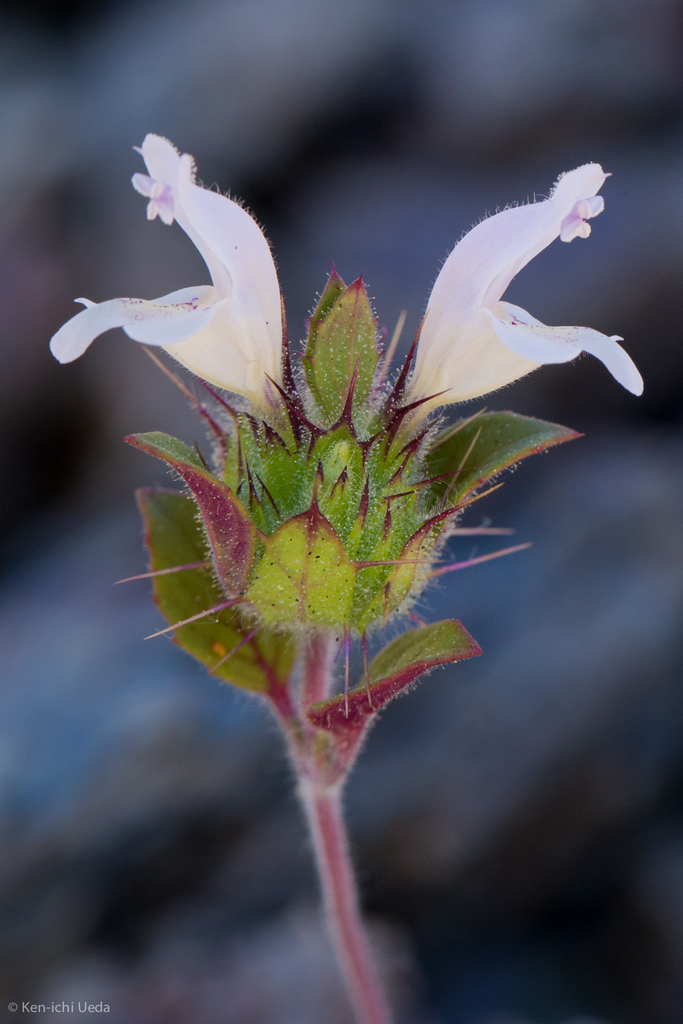
(c) Ken-ichi Ueda, some rights reserved (CC BY), uploaded by Ken-ichi Ueda · licence
Family: Lamiaceae · Type: Herb · Native
Conservation status: CNPS 4.2
Acanthomintha lanceolata (Santa clara thornmint) is a native California herb in the Lamiaceae family, recognized by distinctive smell, glandular hairs, and large flowers.
Santa clara thornmint is a native annual found in the San Francisco Bay and south-central coastal ranges of California in woodland, chaparral, and rocky slopes at elevations below 1,200 meters. Flowering from March to June, this plant produces white flowers occasionally pink-tipped, with lips 8 to 10 millimeters long nestled in glandular bracts with distinctive marginal spines. Growing with soft-hairy stems 10 to 30 centimeters tall that become conspicuously glandular toward the top, it has a distinctively ill-smelling character. Its lance-oblong to ovate leaves 10 to 20 millimeters long have margins that range from entire to serrate or spiny, with a notable glandular texture. The plant's delicate white flowers and spiny bracts make it a unique inhabitant of California's rocky and woodland landscapes.
Identification and appearance
Key characters: 3 sympatric species; distinguished by distinctive smell, glandular hairs, and large flowers
Habitat and range
Habitat: Woodland, chaparral, talus, rocky slopes, outcrops, occasionally serpentine
Elevation: < 1200 m
California counties: Alameda, Merced, Fresno, Monterey, Stanislaus, Santa Clara, San Benito, San Joaquin, Ventura
Bloom period
Acanthomintha lanceolata blooms Mar-Jun.
Conservation status
CNPS 4.2
How to tell it apart
vs Lycopus: Acanthomintha has spiny flower bracts and grows in dry grasslands, while Lycopus lacks spines and grows in wetlands.; vs Salvia: Acanthomintha has prominent spiny-margined bracts beneath flowers, while Salvia has plain bracts.; vs Monarda: Acanthomintha is annual with spiny bracts, while Monarda is perennial with smooth bracts.; vs Hedeoma: Acanthomintha is annual with spiny bracts, while Hedeoma is perennial with smooth bracts and swollen calyx.; vs Pogogyne: Acanthomintha has spiny-margined bracts, while Pogogyne has smooth bracts and densely head-like flower clusters.
Frequently asked questions
Is Acanthomintha lanceolata native to California?
Yes. Acanthomintha lanceolata is native to California (recorded as native).
When does Acanthomintha lanceolata bloom?
Acanthomintha lanceolata blooms Mar-Jun.
Where in California does Acanthomintha lanceolata grow?
Acanthomintha lanceolata occurs in Alameda, Merced, Fresno, Monterey, Stanislaus, Santa Clara, San Benito, San Joaquin and other counties, at elevations of < 1200 m.
What plant family does Acanthomintha lanceolata belong to?
Acanthomintha lanceolata is in the Lamiaceae family, genus Acanthomintha.
Is Acanthomintha lanceolata rare or endangered?
Acanthomintha lanceolata carries California Rare Plant Rank 4.2, state rank S4.
Related species
Other California species in the same genus, family, or bioregion.
Sources: Jepson eFlora · CNPS Rare Plant Inventory · Index of California Plant Names · CalPhotos · CDFW CNDDB
Last updated 2026-10-07
Data from The California Species Project — 14,000+ California species with verified data from CNPS, CDFW, USFWS, Cal-IPC, and more.