Actaea rubra
Bearberry
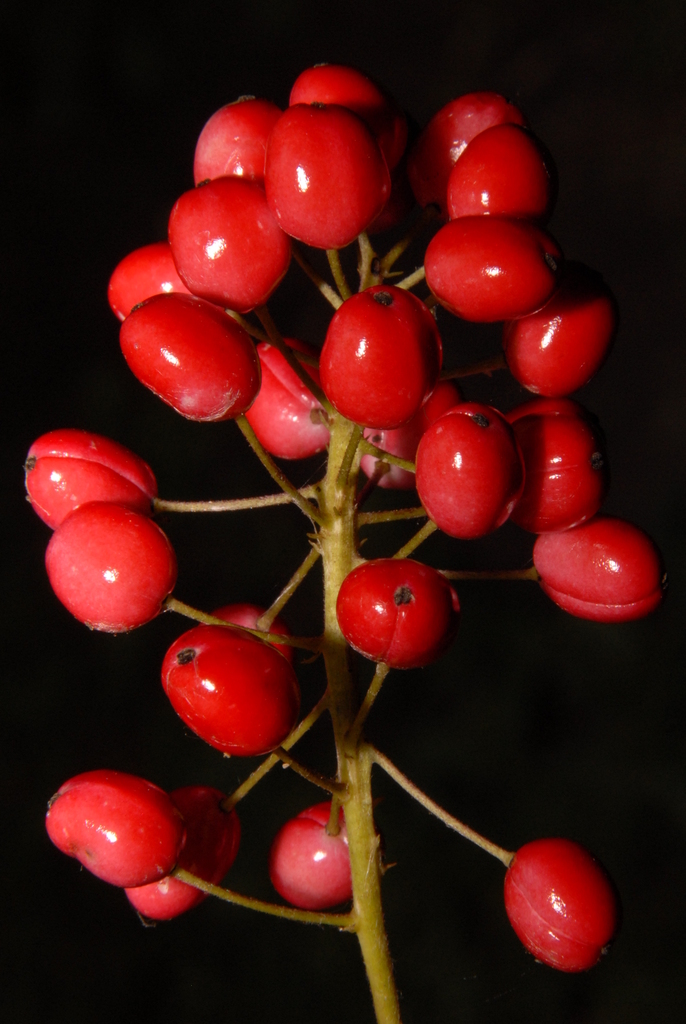
(c) Brian Finzel, some rights reserved (CC BY-SA), uploaded by Brian Finzel · licence
Family: Ranunculaceae · Type: Herb · Native
Actaea rubra (Bearberry) is a native California herb in the Ranunculaceae family, recognized by Northern genus with one species barely reaching California's mountain forests.
Bearberry is a California native perennial found in northwestern California, the Cascade Range, Sierra Nevada, San Francisco Bay Area, southern coastal ranges, and San Bernardino Mountains in deep soils of mixed-evergreen and conifer forests at elevations below 2,800 meters. Flowering from May to September, this plant produces white flowers with delicate white petals and sepals, arranged in small clusters. Growing 20 to 100 centimeters tall with few-branched stems that are sparsely hairy, it develops a distinctive multi-lobed leaf structure. Its complex leaves are divided into 2 to 3 ternate sections with leaflets 2 to 9 centimeters long, featuring toothed edges and varying shapes from lanceolate to widely ovate. The fruit develops as a shiny red or white berry 5 to 10 millimeters long, adding visual interest to the plant's woodland habitat.
Identification and appearance
Key characters: Northern genus with one species barely reaching California's mountain forests
Habitat and range
Habitat: Deep soils, moist, open to shaded sites, mixed-evergreen or conifer forests
Elevation: < 2800 m
California counties: Humboldt, Alameda, San Bernardino, Inyo, Fresno, Tulare, El Dorado, Mendocino, Mono, Modoc, Butte, Calaveras, Contra Costa, Del Norte, Glenn, Lassen, Marin, Mariposa, Nevada, Sierra, Monterey, Plumas, San Luis Obispo, San Mateo, Santa Clara, Santa Cruz, Siskiyou, Sonoma, Trinity, Tuolumne, Placer, Sacramento, Colusa, Tehama, Alpine, Napa, Lake, Shasta, Madera
Outside California: to Alaska, northeastern North America
Bloom period
Actaea rubra blooms May-Sep.
How to tell it apart
vs Rubus: Actaea has white flower spikes and smooth berries; blackberry has pink-white flowers and aggregate fruits.; vs Sambucus: Actaea has leaves divided into threes with large toothed leaflets; elderberry has pinnate leaves with opposite leaflets.; vs Lonicera: Actaea has compound leaves and berry spikes; honeysuckle has simple opposite leaves and tubular flowers.; vs Maianthemum: Actaea has 2-3 times compound leaves; false Solomon's seal has simple undivided leaves.; vs Limnanthes: Actaea has coarsely toothed compound leaflets; meadowfoam has thread-like dissected leaf segments.
Frequently asked questions
Is Actaea rubra native to California?
Yes. Actaea rubra is native to California (recorded as native).
When does Actaea rubra bloom?
Actaea rubra blooms May-Sep.
Where in California does Actaea rubra grow?
Actaea rubra occurs in Humboldt, Alameda, San Bernardino, Inyo, Fresno, Tulare, El Dorado, Mendocino and other counties, at elevations of < 2800 m.
What plant family does Actaea rubra belong to?
Actaea rubra is in the Ranunculaceae family, genus Actaea.
What habitat does Actaea rubra grow in?
Actaea rubra grows in Deep soils, moist, open to shaded sites, mixed-evergreen or conifer forests.
Related species
Other California species in the same genus, family, or bioregion.
Sources: Jepson eFlora · Index of California Plant Names · CalPhotos
Last updated 2026-10-07
Data from The California Species Project — 14,000+ California species with verified data from CNPS, CDFW, USFWS, Cal-IPC, and more.