Adelinia grandis
Adelinia
no rights reserved · CC0
Family: Boraginaceae · Type: Herb · Native
Adelinia grandis (Adelinia) is a native California herb in the Boraginaceae family, recognized by Recently segregated from Cynoglossum, Pacific Northwest endemic genus.
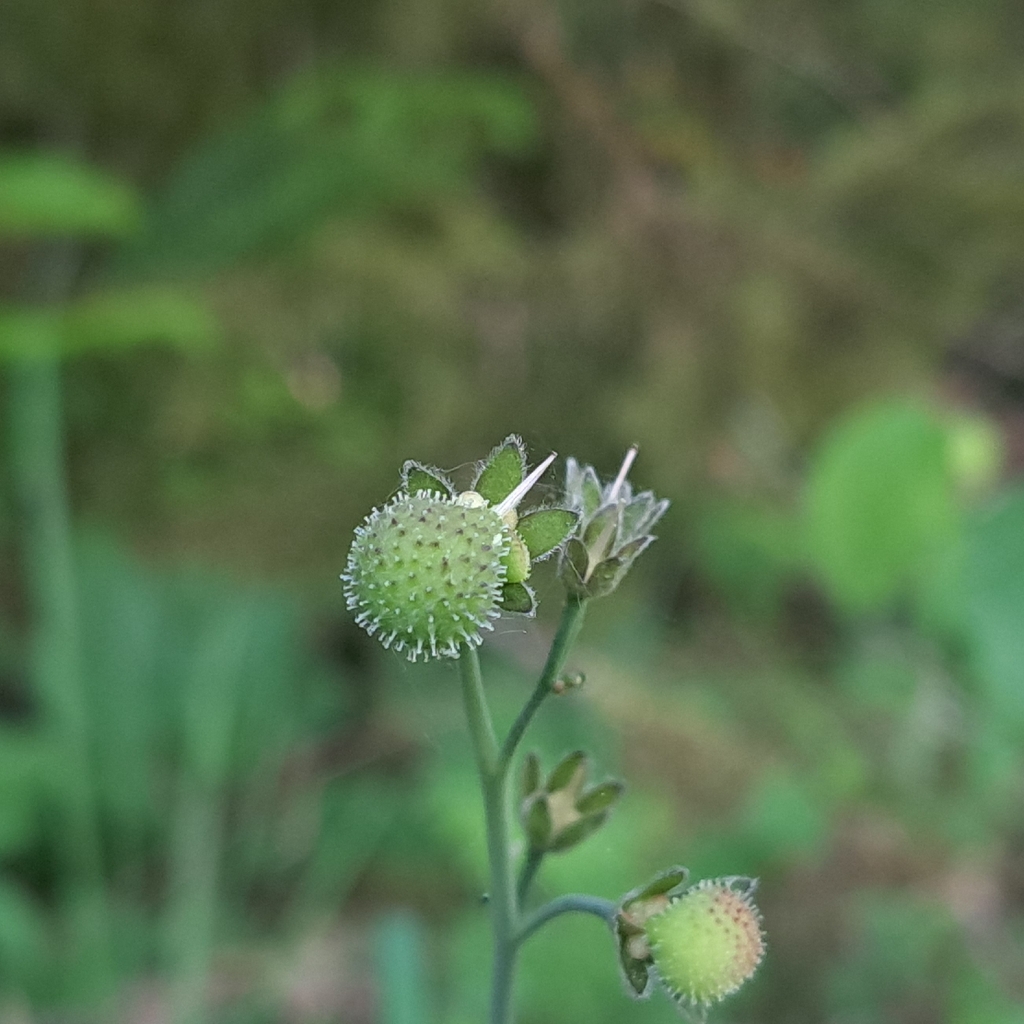
Adelinia is a California native perennial herb found in northwestern California, the Cascade Range, Sierra Nevada, San Francisco Bay Area, southern Coast Ranges, and Peninsular Ranges in chaparral and woodland habitats at elevations of 10 to 1,700 meters. Flowering from February to May, this plant produces blue flowers with white appendages and violet tube, approximately 8 to 12 millimeters long with lobes spreading to 10 to 15 millimeters in diameter. Growing with a single erect stem 30 to 90 centimeters tall that is glaucous and glabrous, it develops distinctive basal leaves 8 to 15 centimeters long and 3 to 10 centimeters wide, which are ovate to elliptic with a truncate or heart-shaped base. Its leaves are notably hairy on the underside while nearly glabrous on the upper surface, with a petiole 8 to 15 centimeters long. The fruit consists of four nutlets, each approximately 5 to 6 millimeters in diameter, with short barbed prickles and an ascending-spreading arrangement.
Identification and appearance
Key characters: Recently segregated from Cynoglossum, Pacific Northwest endemic genus
Habitat and range
Habitat: Chaparral, woodland
Elevation: 10-1700 m
California counties: Humboldt, Mendocino, San Mateo, Santa Clara, Contra Costa, Glenn, Fresno, Lake, Calaveras, Tulare, Tuolumne, Amador, Sonoma, San Luis Obispo, Napa, Trinity, Alameda, Placer, Kern, Butte, Marin, El Dorado, Siskiyou, Santa Cruz, Colusa, Monterey, Nevada, San Joaquin, Shasta, Tehama, Merced, Solano, Mariposa, Yolo, Del Norte, Los Angeles, Yuba, Sacramento
Outside California: to British Columbia
Bloom period
Adelinia grandis blooms Feb-May.
How to tell it apart
vs Cynoglossum: Adelinia is glabrous and glaucous with a bare lower stem and few large basal leaves, its blue flowers borne well above the foliage; Cynoglossum is soft-hairy throughout with leafy stems and dull reddish-purple flowers.; vs Andersonglossum: Adelinia is nearly hairless and glaucous with leaves clustered low; Andersonglossum is rough spreading-hairy, not glaucous, with many stem leaves.; vs Hackelia: Adelinia bears bur nutlets with prickles over the whole back; Hackelia (stickseed) nutlets have prickles only along the margins, forming a fringe.; vs Mertensia: Adelinia has flat, rotate blue flowers with distinct throat appendages and bur fruit; Mertensia (bluebells) has nodding tubular-bell flowers and smooth nutlets.; vs Myosotis: Adelinia is a tall glaucous plant with large basal leaves; Myosotis is a small hairy plant with tiny flowers in coiled racemes and smooth nutlets.
Frequently asked questions
Is Adelinia grandis native to California?
Yes. Adelinia grandis is native to California (recorded as native).
When does Adelinia grandis bloom?
Adelinia grandis blooms Feb-May.
Where in California does Adelinia grandis grow?
Adelinia grandis occurs in Humboldt, Mendocino, San Mateo, Santa Clara, Contra Costa, Glenn, Fresno, Lake and other counties, at elevations of 10-1700 m.
What plant family does Adelinia grandis belong to?
Adelinia grandis is in the Boraginaceae family, genus Adelinia.
What habitat does Adelinia grandis grow in?
Adelinia grandis grows in Chaparral, woodland.
Related species
Other California species in the same genus, family, or bioregion.
Sources: Jepson eFlora · Index of California Plant Names · CalPhotos
Last updated 2026-10-07
Data from The California Species Project — 14,000+ California species with verified data from CNPS, CDFW, USFWS, Cal-IPC, and more.