Adenostoma fasciculatum
Chamise, greasewood, Greasewood
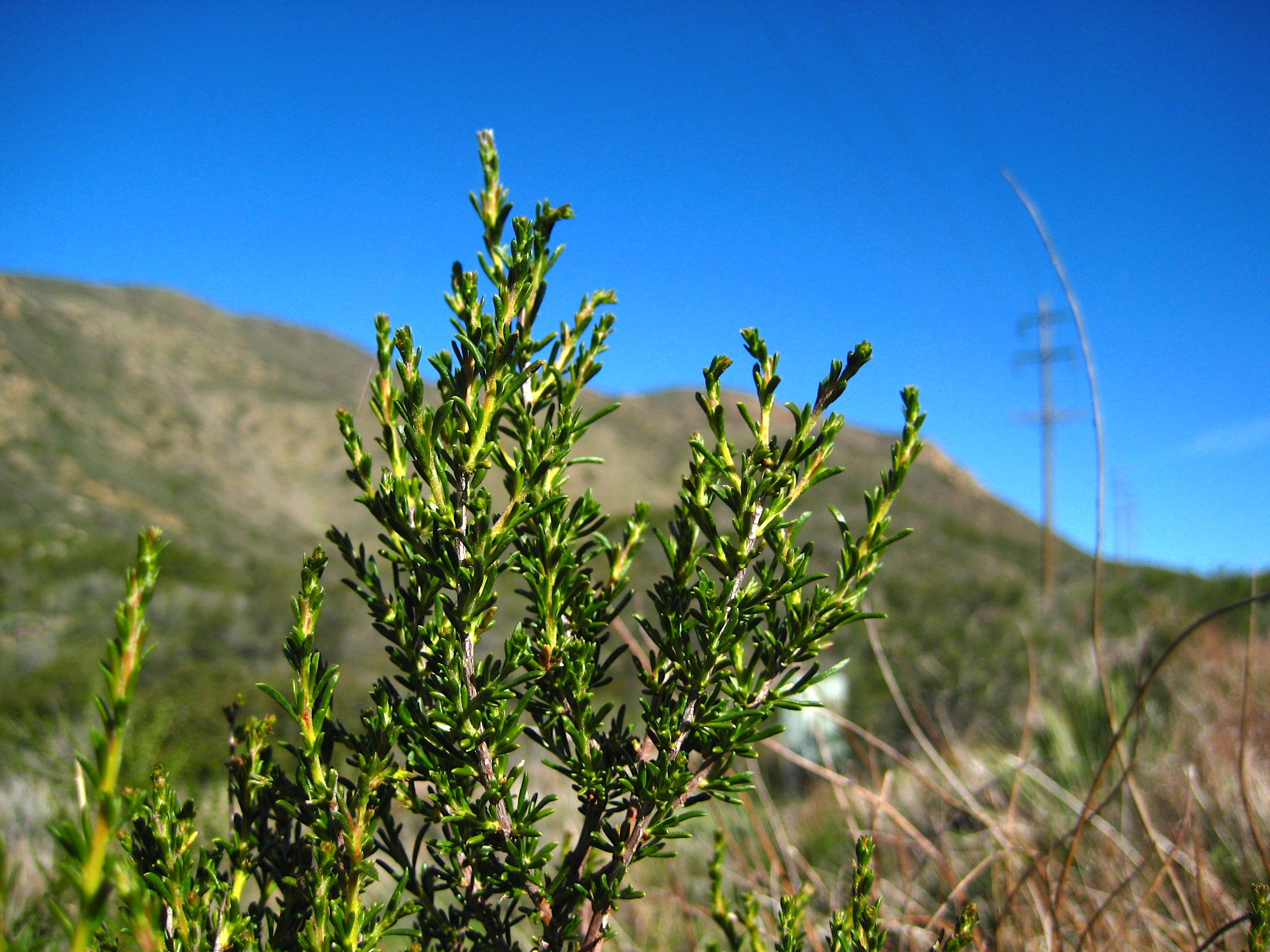
Photo by Chez Brungraber
Family: Rosaceae · Type: Shrub · Native
Adenostoma fasciculatum (Chamise) is a native California shrub in the Rosaceae family, recognized by 1 congener (*A. sparsifolium*); leaves clustered in bundles, bark gray-brown & firm.
Chamise is a California native shrub found in coastal mountain ranges and interior foothills in chaparral and woodland habitats at elevations of 100 to 1,500 meters. Flowering from May to July, this plant produces white to cream-colored flowers in dense clusters less than 4 centimeters long. Growing as a multi-branched shrub up to 4 meters tall with a distinctive gray-brown trunk and compact form, it develops a burled base with numerous stiff, sickle-shaped branches. Its leaves are small, clustered tightly along branches, stiff and glabrous, creating a dense, compact silhouette. The fruit is a small, ribbed obovoid structure that remains closely attached to the plant's tight branching pattern.
Identification and appearance
Key characters: 1 congener (*A. sparsifolium*); leaves clustered in bundles, bark gray-brown & firm
Habitat and range
California counties: Los Angeles, Santa Barbara, Kern, San Luis Obispo, Riverside, San Diego, Monterey, Tulare, Tuolumne, Orange, San Bernardino, Contra Costa, Ventura, Imperial, Santa Cruz, Glenn, El Dorado, Lake, Tehama, Solano, San Benito, Santa Clara, San Mateo, Placer, Sonoma, Amador, Napa, Marin, Mariposa, Mendocino, Butte, Calaveras, Shasta, Trinity, Yolo, Alameda, Colusa, Fresno, Humboldt, Yuba, Sacramento, Stanislaus
How to tell it apart
vs Eriogonum: Adenostoma has bundled needle-like leaves and rose family flowers; buckwheats have broader leaves and ball-like flower heads.; vs Baccharis: Adenostoma has bundled linear leaves; Baccharis has wider single leaves and yellow to white brush-like flower heads.; vs Ceanothus: Adenostoma has tiny bundled needles; Ceanothus has broader single leaves and blue to white dense flower clusters.; vs Artemisia: Adenostoma has bundled needles and white flower panicles; sagebrush has feathery gray foliage and yellow flower heads.; vs Ericameria: Adenostoma has white flowers and bundled needles; goldenbush has yellow flowers and non-bundled narrow leaves.
Frequently asked questions
Is Adenostoma fasciculatum native to California?
Yes. Adenostoma fasciculatum is native to California (recorded as native).
Where in California does Adenostoma fasciculatum grow?
Adenostoma fasciculatum occurs in Los Angeles, Santa Barbara, Kern, San Luis Obispo, Riverside, San Diego, Monterey, Tulare and other counties.
What plant family does Adenostoma fasciculatum belong to?
Adenostoma fasciculatum is in the Rosaceae family, genus Adenostoma.
Related species
Other California species in the same genus, family, or bioregion.
Sources: Jepson eFlora · Index of California Plant Names · CalPhotos
Last updated 2026-10-07
Data from The California Species Project — 14,000+ California species with verified data from CNPS, CDFW, USFWS, Cal-IPC, and more.