Adenostoma fasciculatum var. fasciculatum
Chamise
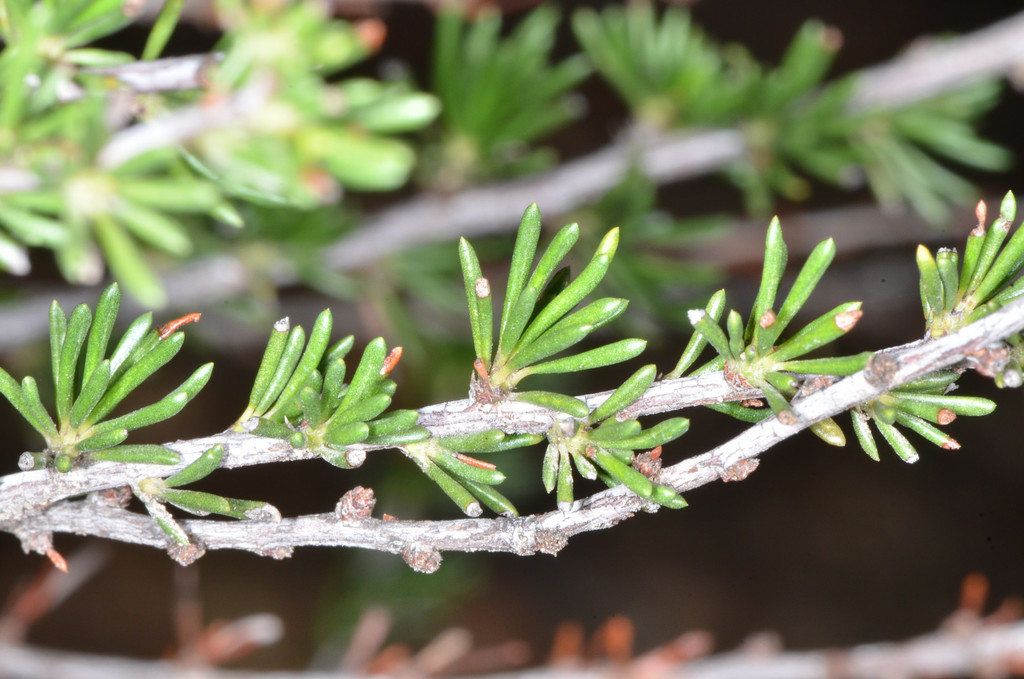
(c) dloarie, some rights reserved (CC BY), uploaded by dloarie · licence
Family: Rosaceae · Type: Shrub · Native
Adenostoma fasciculatum var. fasciculatum (Chamise) is a native California shrub in the Rosaceae family, recognized by growth form, leaf tip shape, and geographic distribution.
Chamise is a California native shrub found in northern California Coast Ranges, Cascade Range foothills, Sierra Nevada, central and southwestern California in dry chaparral slopes and ridges at elevations to 1,830 meters. Flowering from May to June, this plant produces small white flowers in dense, open clusters up to 17 centimeters long. Growing up to 4 meters tall with erect to ascending branches and smooth, slender twigs, it forms a dense, upright shrub with a characteristic shape. Its leaves are narrow and sharp-pointed, generally linear to oblanceolate, measuring 5 to 13 millimeters long and giving the plant a fine, needle-like texture. In dense chaparral landscapes, chamise creates distinctive uniform stands that are highly adapted to California's dry, fire-prone environments.
Identification and appearance
Key characters: 4 sympatric species; distinguished by growth form, leaf tip shape, and geographic distribution
Habitat and range
Habitat: dry slopes, ridges, chaparral
Elevation: < 1830 m
California counties: San Luis Obispo, San Diego, Kern, Riverside, San Bernardino, Los Angeles, Marin, San Benito, Napa, Santa Clara, Tulare, Santa Barbara, Santa Cruz, Orange, Lake, Ventura, Monterey, San Mateo, Shasta, Mariposa, Calaveras, Butte, Inyo, Contra Costa, Sonoma, Glenn
Outside California: southwestern Oregon, Baja California
Bloom period
Adenostoma fasciculatum var. fasciculatum blooms May-Jun.
How to tell it apart
vs Eriogonum: Adenostoma has bundled needle-like leaves and rose family flowers; buckwheats have broader leaves and ball-like flower heads.; vs Baccharis: Adenostoma has bundled linear leaves; Baccharis has wider single leaves and yellow to white brush-like flower heads.; vs Ceanothus: Adenostoma has tiny bundled needles; Ceanothus has broader single leaves and blue to white dense flower clusters.; vs Artemisia: Adenostoma has bundled needles and white flower panicles; sagebrush has feathery gray foliage and yellow flower heads.; vs Ericameria: Adenostoma has white flowers and bundled needles; goldenbush has yellow flowers and non-bundled narrow leaves.
Frequently asked questions
Is Adenostoma fasciculatum var. fasciculatum native to California?
Yes. Adenostoma fasciculatum var. fasciculatum is native to California (recorded as native).
When does Adenostoma fasciculatum var. fasciculatum bloom?
Adenostoma fasciculatum var. fasciculatum blooms May-Jun.
Where in California does Adenostoma fasciculatum var. fasciculatum grow?
Adenostoma fasciculatum var. fasciculatum occurs in San Luis Obispo, San Diego, Kern, Riverside, San Bernardino, Los Angeles, Marin, San Benito and other counties, at elevations of < 1830 m.
What plant family does Adenostoma fasciculatum var. fasciculatum belong to?
Adenostoma fasciculatum var. fasciculatum is in the Rosaceae family, genus Adenostoma.
What habitat does Adenostoma fasciculatum var. fasciculatum grow in?
Adenostoma fasciculatum var. fasciculatum grows in dry slopes, ridges, chaparral.
Related species
Other California species in the same genus, family, or bioregion.
Sources: Jepson eFlora · Index of California Plant Names · CalPhotos
Last updated 2026-10-07
Data from The California Species Project — 14,000+ California species with verified data from CNPS, CDFW, USFWS, Cal-IPC, and more.