Aegilops cylindrica
Jointed goat grass
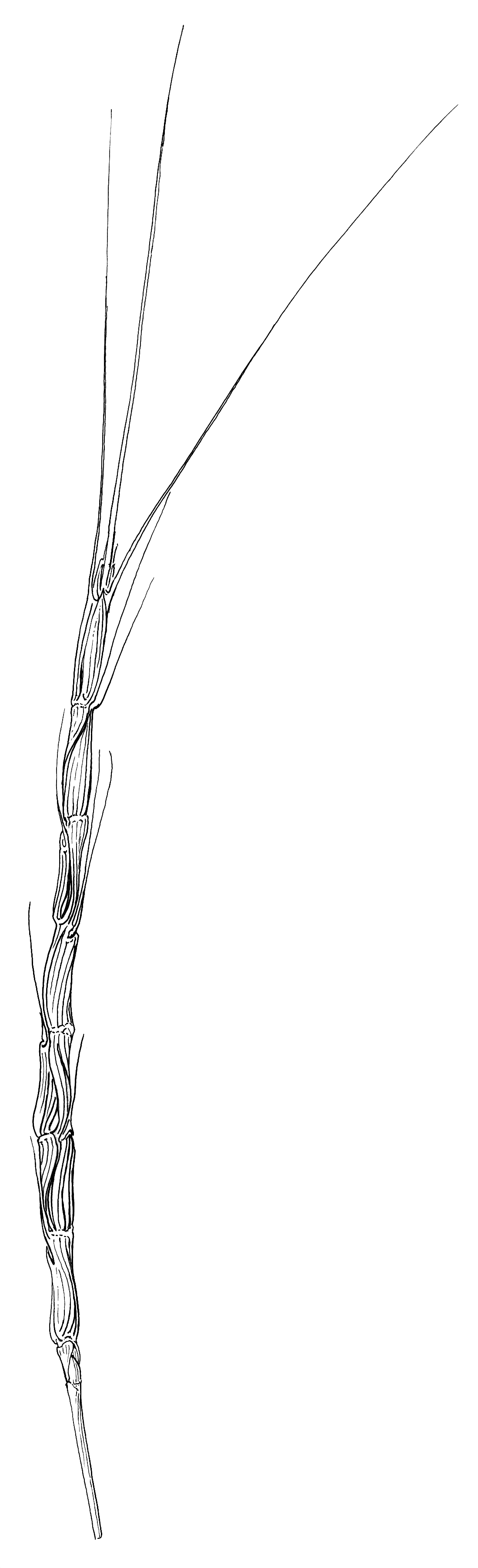
Albert Spear Hitchcock (1865–1935), Mary Agnes Chase (1869–1963), A. H. Baldwin, (Miss) M. D. Baker, Mary Wright Gill, Frank Lamson-Scribner, W. R. Scholl, Theodore Holm, Leta Hughey, Benjamin Y. Morrison, Mrs. George M. Mullett, Frances Carnes Weintraub, Edna May Whitehorn, or possibly another illustrator. (via Wikimedia Commons) · CC0
Family: Poaceae · Type: Grass · Not Native
Conservation status: Cal-IPC Yes
Aegilops cylindrica (Jointed goat grass) is a non-native California grass in the Poaceae family, recognized by spikelets partly sunken in axis.
Jointed goat grass is a naturalized annual found in the northern California Coast Ranges, Sacramento Valley, southwestern California, and northern California mountains in disturbed, dry sites and cultivated fields. Flowering from May to July, this grass produces narrow, cylindrical spikelets in compact clusters 2 to 12 centimeters long. Growing with erect stems 14 to 50 centimeters tall, it develops narrow leaf blades 3 to 15 centimeters long and only 2 to 5 millimeters wide. Its distinctive spikelets feature glumes with short to moderate awns, with the distal spikelets bearing dramatic awns 3 to 6 centimeters long. The plant's unique spike-like inflorescence breaks apart when mature, with spikelets partially sunken into its central axis.
Identification and appearance
Key characters: 2 sympatric species; key feature is spikelets partly sunken in axis
Habitat and range
Habitat: Disturbed, dry sites, cultivated fields
California counties: El Dorado, Butte, San Bernardino, San Diego, Santa Barbara, Siskiyou, Riverside, Marin, Lassen, Colusa, Santa Clara, San Joaquin, Modoc, Shasta, Plumas, Ventura, Yolo, Santa Cruz
Outside California: to Washington, Great Plains, Mexico, native to Mediterranean Europe, western Asia
Bloom period
Aegilops cylindrica blooms May-Jul.
Conservation status
Cal-IPC Yes
How to tell it apart
vs Taeniatherum: Aegilops has 2-5 florets per spikelet; Taeniatherum has 2 florets with all parts awned.; vs Elymus: Aegilops has awned glumes but awnless lemmas; Elymus has awned lemmas.; vs Stenotaphrum: Aegilops is annual and tufted; Stenotaphrum is perennial with thick stolons.; vs Scribneria: Aegilops has awned glumes; Scribneria glumes are awnless.; vs Parapholis: Aegilops has prominent bristles on glumes; Parapholis completely lacks awns.
Frequently asked questions
Is Aegilops cylindrica native to California?
No. Aegilops cylindrica is not native to California (recorded as not native).
When does Aegilops cylindrica bloom?
Aegilops cylindrica blooms May-Jul.
Where in California does Aegilops cylindrica grow?
Aegilops cylindrica occurs in El Dorado, Butte, San Bernardino, San Diego, Santa Barbara, Siskiyou, Riverside, Marin and other counties.
What plant family does Aegilops cylindrica belong to?
Aegilops cylindrica is in the Poaceae family, genus Aegilops.
Is Aegilops cylindrica invasive in California?
Aegilops cylindrica is listed by Cal-IPC with an invasiveness rating of Yes.
Related species
Other California species in the same genus, family, or bioregion.
Sources: Jepson eFlora · Index of California Plant Names · CalPhotos
Last updated 2026-10-07
Data from The California Species Project — 14,000+ California species with verified data from CNPS, CDFW, USFWS, Cal-IPC, and more.