Aegilops triuncialis
Barbed goat grass
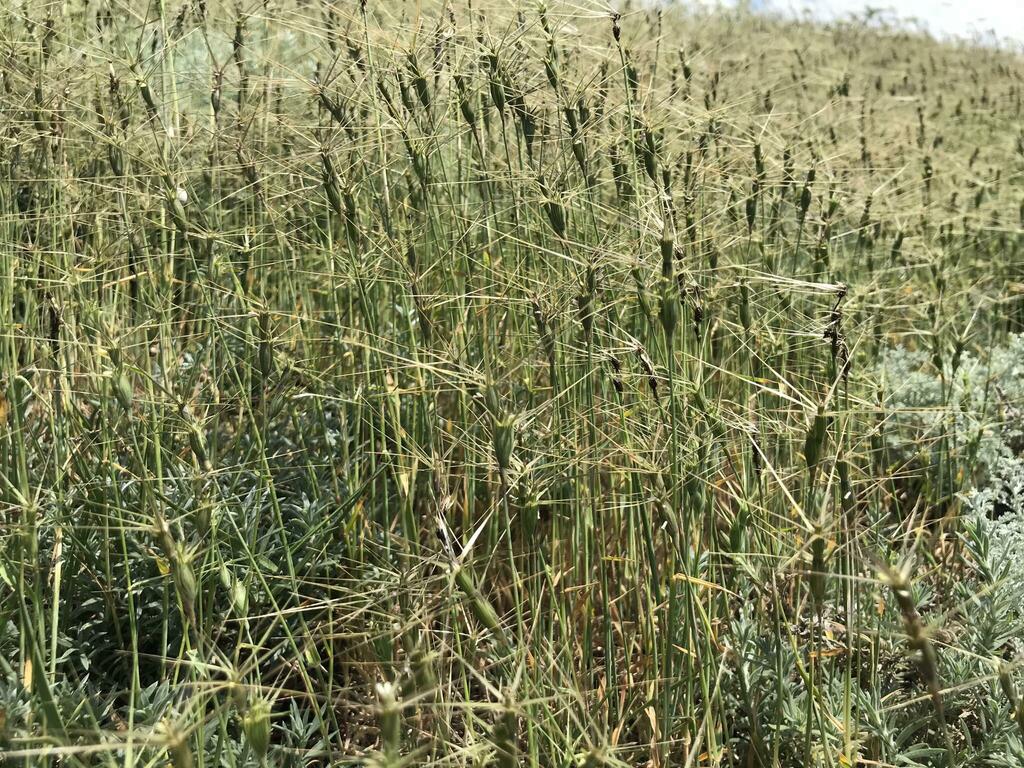
(c) Наталья Пикалова, some rights reserved (CC BY) · licence
Family: Poaceae · Type: Grass · Not Native
Conservation status: Cal-IPC Yes
Aegilops triuncialis (Barbed goat grass) is a non-native California grass in the Poaceae family, recognized by lance-ovate spikelets and long 4-8 cm awns.
Barbed goat grass is a naturalized annual grass found in southern North Coast Ranges, California Rocky Forest, northern and central Sierra Nevada Foothills, Sacramento Valley, and northern Central Western California in disturbed sites, cultivated fields, and roadsides at elevations below 1,000 meters. Flowering from May to July, this grass produces pale green to tan spikelets with distinctively long, barbed awns up to 8 centimeters long. Growing with slender stems 17 to 45 centimeters tall, it forms compact, cylindrical clusters that break apart at the base of the spikelets when mature. Its leaf blades are narrow, measuring 1.5 to 7 centimeters long and only 2 to 3 millimeters wide, with lance-ovate fertile spikelets featuring 3 to 5 florets. The plant's most distinctive feature is its multiple-awned spikelets, with glumes bearing 2 to 3 sharp, spreading awns that can extend up to 10 millimeters from the lemma.
Identification and appearance
Key characters: 3 sympatric species; key features are lance-ovate spikelets and long 4-8 cm awns
Habitat and range
Habitat: Disturbed sites, cultivated fields, roadsides
Elevation: < 1000 m
California counties: Calaveras, Butte, El Dorado, Marin, Mendocino, Nevada, San Diego, Solano, Tuolumne, San Luis Obispo, Sonoma, Shasta, Los Angeles, Yolo, Yuba, Colusa, Placer, Amador, Sacramento, Napa, San Joaquin, Santa Clara, Contra Costa, Lake, Glenn, Trinity, Alameda, Tehama, Lassen, Stanislaus, Sutter
Outside California: native to Mediterranean Europe, western Asia
Bloom period
Aegilops triuncialis blooms May-Jul.
Conservation status
Cal-IPC Yes
How to tell it apart
vs Taeniatherum: Aegilops has 2-5 florets per spikelet; Taeniatherum has 2 florets with all parts awned.; vs Elymus: Aegilops has awned glumes but awnless lemmas; Elymus has awned lemmas.; vs Stenotaphrum: Aegilops is annual and tufted; Stenotaphrum is perennial with thick stolons.; vs Scribneria: Aegilops has awned glumes; Scribneria glumes are awnless.; vs Parapholis: Aegilops has prominent bristles on glumes; Parapholis completely lacks awns.
Frequently asked questions
Is Aegilops triuncialis native to California?
No. Aegilops triuncialis is not native to California (recorded as not native).
When does Aegilops triuncialis bloom?
Aegilops triuncialis blooms May-Jul.
Where in California does Aegilops triuncialis grow?
Aegilops triuncialis occurs in Calaveras, Butte, El Dorado, Marin, Mendocino, Nevada, San Diego, Solano and other counties, at elevations of < 1000 m.
What plant family does Aegilops triuncialis belong to?
Aegilops triuncialis is in the Poaceae family, genus Aegilops.
Is Aegilops triuncialis invasive in California?
Aegilops triuncialis is listed by Cal-IPC with an invasiveness rating of Yes.
Related species
Other California species in the same genus, family, or bioregion.
Sources: Jepson eFlora · Index of California Plant Names · CalPhotos
Last updated 2026-10-07
Data from The California Species Project — 14,000+ California species with verified data from CNPS, CDFW, USFWS, Cal-IPC, and more.