Aeonium arboreum var. arboreum
Canary Islands aeonium
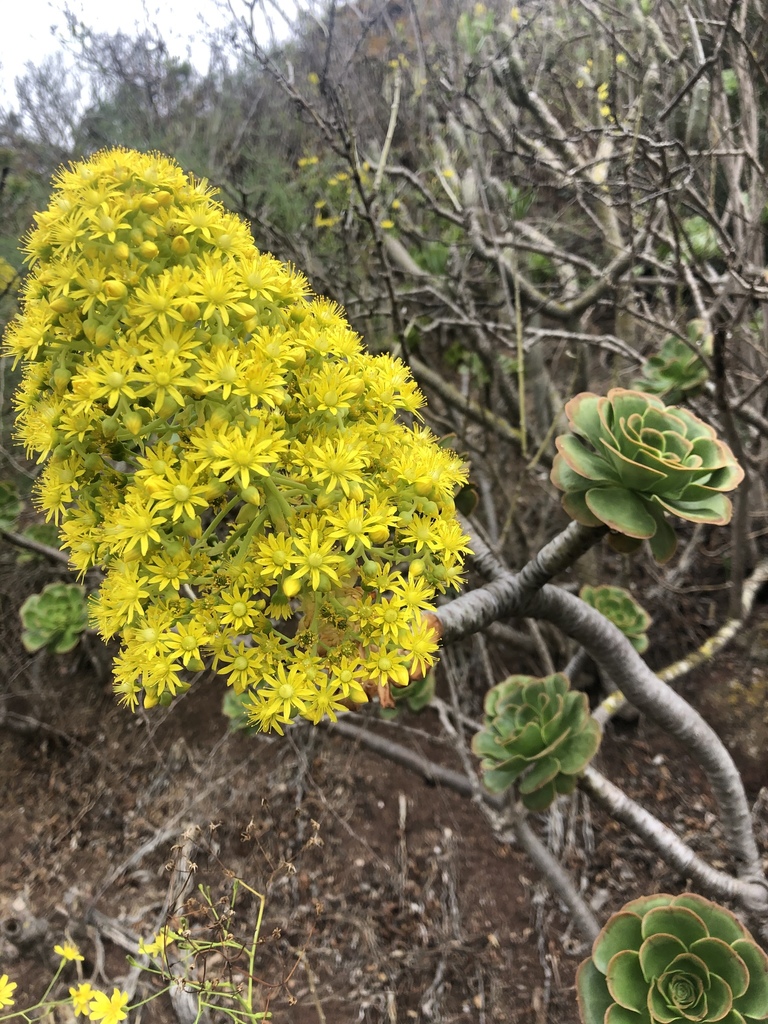
(c) William Stephens, some rights reserved (CC BY), uploaded by William Stephens · licence
Family: Crassulaceae · Type: Shrub · Not Native
Aeonium arboreum var. arboreum (Canary Islands aeonium) is a non-native California shrub in the Crassulaceae family, recognized by . Distinguished by dense rosettes and coastal habitat.
Canary Islands aeonium is a naturalized shrub found in southern California coastal areas at elevations below 100 meters, often persisting in bluffs, dunes, or cultivated landscapes. Flowering from October to April, this succulent produces yellow to pale green flowers in dense, conic clusters approximately 2 centimeters wide. Growing as a subshrub up to one to two meters tall with stems 10 to 40 millimeters in diameter, it forms distinctive leaf rosettes 10 to 20 centimeters across. Its thick, oblong-oblanceolate leaves are 5 to 9 centimeters long and 1.5 to 3 millimeters thick, arranged in dense, architectural clusters. The plant produces distinctive flower clusters with narrow-oblong petals 5 to 7 millimeters long, creating an elegant architectural form typical of succulent gardens.
Identification and appearance
Key characters: Geographically isolated - no sympatric species. Distinguished by dense rosettes and coastal habitat.
Habitat and range
Habitat: Bluffs, dunes, or persisting from cultivation
Elevation: < 100 m
Outside California: native to Canary Islands
Bloom period
Aeonium arboreum var. arboreum blooms Oct-Apr.
How to tell it apart
vs Echeveria: Aeonium has hairy leaf edges and 7-11 petals; Echeveria has smooth leaves and 5 petals.; vs Sedum: Aeonium has tiny hairs on leaf edges; Sedum leaves are completely smooth-edged.; vs Dudleya: Aeonium rosettes sit on woody branch tips; Dudleya rosettes sit directly on ground.; vs Sempervivum: Aeonium is shrubby with rosettes on branches; Sempervivum forms ground-hugging rosette clumps.; vs Crassula: Aeonium forms flat rosettes at branch tips; Crassula has opposite leaves along entire stem.
Frequently asked questions
Is Aeonium arboreum var. arboreum native to California?
No. Aeonium arboreum var. arboreum is not native to California (recorded as not native).
When does Aeonium arboreum var. arboreum bloom?
Aeonium arboreum var. arboreum blooms Oct-Apr.
What plant family does Aeonium arboreum var. arboreum belong to?
Aeonium arboreum var. arboreum is in the Crassulaceae family, genus Aeonium.
What habitat does Aeonium arboreum var. arboreum grow in?
Aeonium arboreum var. arboreum grows in Bluffs, dunes, or persisting from cultivation.
Related species
Other California species in the same genus, family, or bioregion.
Sources: Jepson eFlora · CalPhotos
Last updated 2026-09-30
Data from The California Species Project — 14,000+ California species with verified data from CNPS, CDFW, USFWS, Cal-IPC, and more.