Aesculus californica
California buckeye, California Buckeye
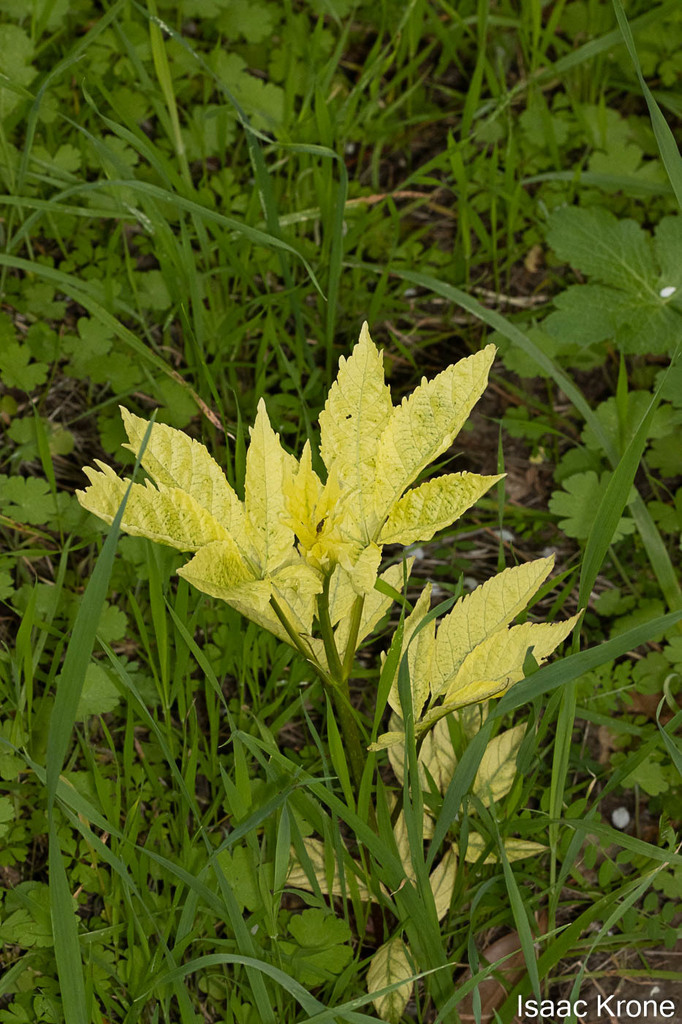
(c) Isaac Krone, some rights reserved (CC BY) · licence
Family: Sapindaceae · Type: Shrub / Tree · Native
Aesculus californica (California buckeye) is a native California shrub / tree in the Sapindaceae family, recognized by California endemic representing a relict population of an otherwise eastern North American genus.
California buckeye is a native shrub found in central and northern California mountains, Coast Ranges, Central Valley foothills, and Transverse Ranges in dry slopes, canyons, and stream borders at elevations below 1,700 meters. Flowering from May to June, this plant produces white to pale rose flowers in erect panicle-like clusters with conspicuous orange-anthered stamens extending beyond the petals. Growing as a broad, rounded shrub 4 to 12 meters tall, it develops a distinctive branching structure with spreading limbs. Its leaves are compound with 5 to 7 lance-oblong leaflets 6 to 17 centimeters long, finely serrated with pointed tips. The fruit is a large rounded capsule 5 to 8 centimeters in diameter, typically containing a single glossy brown seed 2 to 5 centimeters long.
Identification and appearance
Key characters: California endemic representing a relict population of an otherwise eastern North American genus
Habitat and range
Habitat: dry slopes, canyons, borders of streams
Elevation: < 1700 m
California counties: Kern, El Dorado, Lake, Santa Clara, Amador, Nevada, San Mateo, Shasta, Marin, Monterey, Napa, San Joaquin, Tulare, Santa Cruz, Placer, Butte, Fresno, Mendocino, Tuolumne, Alameda, Contra Costa, Sonoma, Los Angeles, Humboldt, San Francisco, Yolo, Madera, Orange, Santa Barbara, San Benito, Tehama, Mariposa, Merced, Solano, Calaveras, Riverside, Yuba, Colusa, Sacramento, Trinity, Stanislaus, San Luis Obispo, San Diego, Glenn, Del Norte
Outside California: southwestern Oregon
Bloom period
Aesculus californica blooms May-Jun(Aug).
How to tell it apart
vs Quercus: Buckeye has compound leaves with separate leaflets; oak leaves are simple and produce acorns.; vs Juglans: Buckeye leaflets radiate from one point; walnut leaflets arrange along a central stem in feather pattern.; vs Sambucus: Buckeye leaflets radiate from one point and twigs are opposite; elderberry leaflets arrange feather-like and twigs alternate.; vs Acer: Buckeye has compound leaves with separate leaflets; maple leaves are simple and lobed or have 3 parts.; vs Prunus: Buckeye has palmately compound leaves; stone fruits have simple leaves and produce fleshy drupes.
Frequently asked questions
Is Aesculus californica native to California?
Yes. Aesculus californica is native to California (recorded as native).
When does Aesculus californica bloom?
Aesculus californica blooms May-Jun(Aug).
Where in California does Aesculus californica grow?
Aesculus californica occurs in Kern, El Dorado, Lake, Santa Clara, Amador, Nevada, San Mateo, Shasta and other counties, at elevations of < 1700 m.
What plant family does Aesculus californica belong to?
Aesculus californica is in the Sapindaceae family, genus Aesculus.
What habitat does Aesculus californica grow in?
Aesculus californica grows in dry slopes, canyons, borders of streams.
Related species
Other California species in the same genus, family, or bioregion.
Sources: Jepson eFlora · Index of California Plant Names · CalPhotos
Last updated 2026-10-07
Data from The California Species Project — 14,000+ California species with verified data from CNPS, CDFW, USFWS, Cal-IPC, and more.