Agrimonia gryposepala
Common agrimony, Common Agrimony
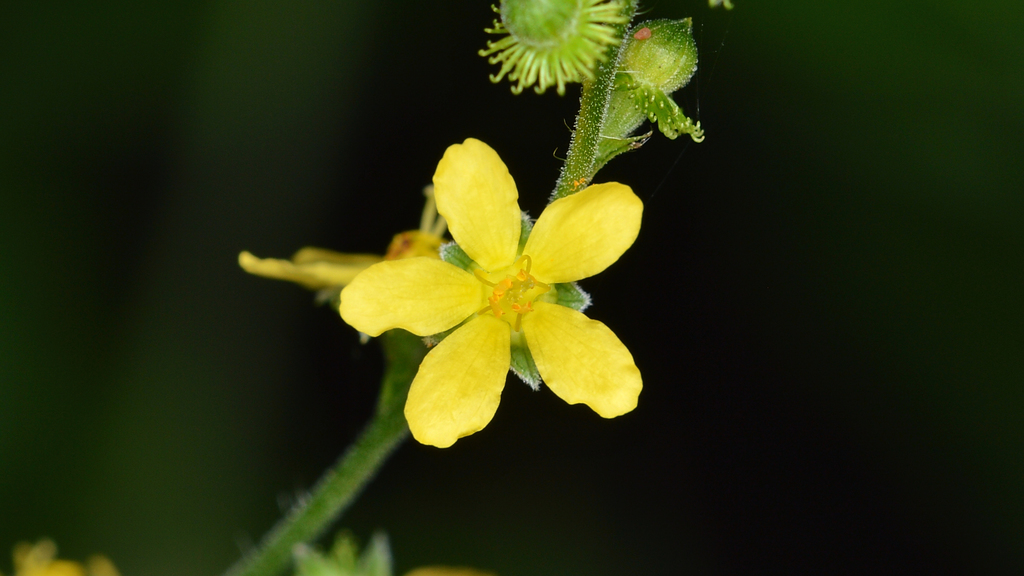
(c) Ryan Hodnett, some rights reserved (CC BY-SA) · licence
Family: Rosaceae · Type: Herb · Native
Agrimonia gryposepala (Common agrimony) is a native California herb in the Rosaceae family, recognized by key differences in fruit sepal tip morphology and bristle arrangement.
Common agrimony is a California native perennial found in northwestern California, the northern Sierra Nevada, northern Sierra Nevada foothills, Sierra Nevada, San Bernardo Mountains, and Peninsular Ranges in moist woodland habitats at elevations of 100 to 1,700 meters. Flowering from June to September, this plant produces small yellow flowers in elongated clusters 9 to 43 centimeters long with multiple flower heads. Growing with slender stems 25 to 130 centimeters tall that are covered with short-stalked glands, it has an upright, somewhat branching habit. Its compound leaves are large, typically 10 to 25 centimeters long, with 3 to 11 leaflets that are elliptic to diamond-shaped, covered in coarse straight hairs and dotted with glandular surfaces. The fruit develops a hooked bristly hypanthium 2.5 to 6 millimeters long, with bristles arranged in 4 to 5 distinctive rows.
Identification and appearance
Key characters: 1 sympatric species; key differences in fruit sepal tip morphology and bristle arrangement
Habitat and range
Habitat: Moist places, generally in woodland
Elevation: 100-1700 m
California counties: Butte, Placer, Lake, El Dorado, San Diego, San Bernardino, Mendocino, Nevada, Sonoma, Yuba, Shasta, Trinity, Napa, Humboldt, Plumas
Outside California: to eastern North America, mountains of Mexico, Guatemala
Bloom period
Agrimonia gryposepala blooms Jun-Sep.
How to tell it apart
vs Geum: Agrimonia carries small yellow flowers along a slender spike-like raceme and a top-shaped fruit ringed with hooked bristles; Geum has larger, few, saucer-shaped flowers and a rounded head of plumed or hooked achenes.; vs Drymocallis: Agrimonia has interrupted-pinnate leaves (large leaflets alternating with tiny ones) and a bur fruit; Drymocallis bears its flowers in open glandular cymes with dry, non-bur fruit.; vs Acaena: Both make hooked burs, but Agrimonia is an erect leafy-stemmed herb with a tall flower spike; Acaena is a low mat-former with flowers in dense round heads.; vs Aruncus: Agrimonia is modest with yellow flowers and burred fruit; Aruncus (goatsbeard) is large with 2--3-pinnate leaves and huge plumes of tiny white flowers.; vs Sanguisorba: Agrimonia scatters its flowers along an elongate raceme with hooked fruit; Sanguisorba (burnet) packs petal-less flowers into a dense oblong head.
Frequently asked questions
Is Agrimonia gryposepala native to California?
Yes. Agrimonia gryposepala is native to California (recorded as native).
When does Agrimonia gryposepala bloom?
Agrimonia gryposepala blooms Jun-Sep.
Where in California does Agrimonia gryposepala grow?
Agrimonia gryposepala occurs in Butte, Placer, Lake, El Dorado, San Diego, San Bernardino, Mendocino, Nevada and other counties, at elevations of 100-1700 m.
What plant family does Agrimonia gryposepala belong to?
Agrimonia gryposepala is in the Rosaceae family, genus Agrimonia.
What habitat does Agrimonia gryposepala grow in?
Agrimonia gryposepala grows in Moist places, generally in woodland.
Related species
Other California species in the same genus, family, or bioregion.
Sources: Jepson eFlora · Index of California Plant Names · CalPhotos
Last updated 2026-10-07
Data from The California Species Project — 14,000+ California species with verified data from CNPS, CDFW, USFWS, Cal-IPC, and more.