Ailanthus altissima
Tree of heaven, Tree Of Heaven
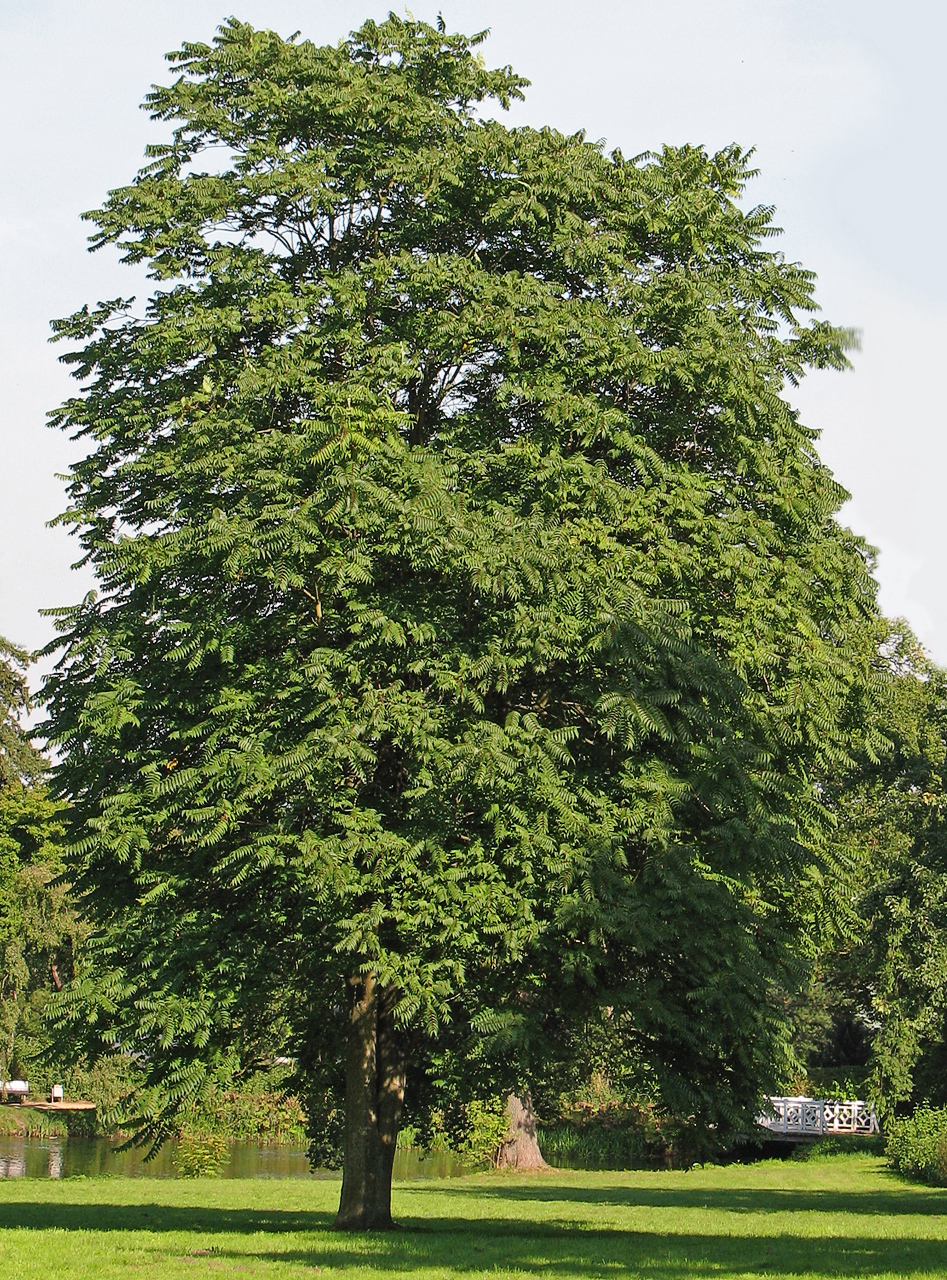
Darkone ( talk · contribs ) (via Wikimedia Commons) · CC BY-SA
Family: Simaroubaceae · Type: Tree · Not Native
Conservation status: Cal-IPC Yes
Ailanthus altissima (Tree of heaven) is a non-native California tree in the Simaroubaceae family, recognized by Chinese genus widely naturalized as an aggressive invasive species.
Tree of heaven is a naturalized shrub found in the Klamath Ranges, northern and central California Coast Ranges, California Rockies, Sierra Nevada, Central Valley, Central Western California, southwestern California, White and Inyo Mountains, and Desert Mountains in disturbed areas, grasslands, oak woodlands, and riparian areas at elevations below 1,860 meters. Flowering in June, this plant produces small greenish-yellow flowers in branched clusters up to 20 centimeters long. Growing to 20 meters tall with young parts slightly glandular and hairy, it develops a spreading, fast-growing form. Its large compound leaves extend 3 to 9 decimeters long, featuring 13 to 25 lance-shaped leaflets with truncate bases and distinctive large glands at the base of each serrated tooth. The fruit develops as a linear or oblong structure less than 5 centimeters long.
Identification and appearance
Key characters: Chinese genus widely naturalized as an aggressive invasive species
Habitat and range
Habitat: Disturbed areas, grassland, oak woodland, riparian areas
Elevation: < 1860 m
California counties: Amador, Kern, Los Angeles, San Bernardino, Tulare, Riverside, Orange, Inyo, San Luis Obispo, Shasta, Santa Clara, Fresno, San Joaquin, Alameda, Lake, San Diego, El Dorado, Placer, Calaveras, Sacramento, Trinity, Sonoma, Monterey, Ventura, Sutter, Butte, Mendocino, Nevada, Marin, Tuolumne, Contra Costa, Solano, Napa, Mariposa, Siskiyou, San Mateo, Humboldt, San Francisco, Yolo, Stanislaus, Santa Cruz
Outside California: widely naturalized in temps, native to China
Bloom period
Ailanthus altissima blooms Jun.
Conservation status
Cal-IPC Yes
How to tell it apart
vs Juglans: Ailanthus leaflets have gland teeth only at base; Juglans leaflets are toothed along entire margin.; vs Pistacia: Ailanthus has gland-tipped teeth at leaflet bases; Pistacia leaflets are completely smooth-edged or finely toothed.; vs Koelreuteria: Ailanthus has simple toothed leaflets; Koelreuteria has doubly compound leaves with deeply lobed leaflets.; vs Fraxinus: Ailanthus leaflets have basal gland teeth; Fraxinus leaflets have regular teeth along margins or are entire.; vs Rhus: Ailanthus has gland teeth only at leaflet base; Rhus leaflets are toothed along entire edge or smooth.
Frequently asked questions
Is Ailanthus altissima native to California?
No. Ailanthus altissima is not native to California (recorded as not native).
When does Ailanthus altissima bloom?
Ailanthus altissima blooms Jun.
Where in California does Ailanthus altissima grow?
Ailanthus altissima occurs in Amador, Kern, Los Angeles, San Bernardino, Tulare, Riverside, Orange, Inyo and other counties, at elevations of < 1860 m.
What plant family does Ailanthus altissima belong to?
Ailanthus altissima is in the Simaroubaceae family, genus Ailanthus.
Is Ailanthus altissima invasive in California?
Ailanthus altissima is listed by Cal-IPC with an invasiveness rating of Yes.
Related species
Other California species in the same genus, family, or bioregion.
Sources: Jepson eFlora · Index of California Plant Names · CalPhotos
Last updated 2026-10-07
Data from The California Species Project — 14,000+ California species with verified data from CNPS, CDFW, USFWS, Cal-IPC, and more.