Albizia julibrissin
Silk tree, mimosa, Mimosa
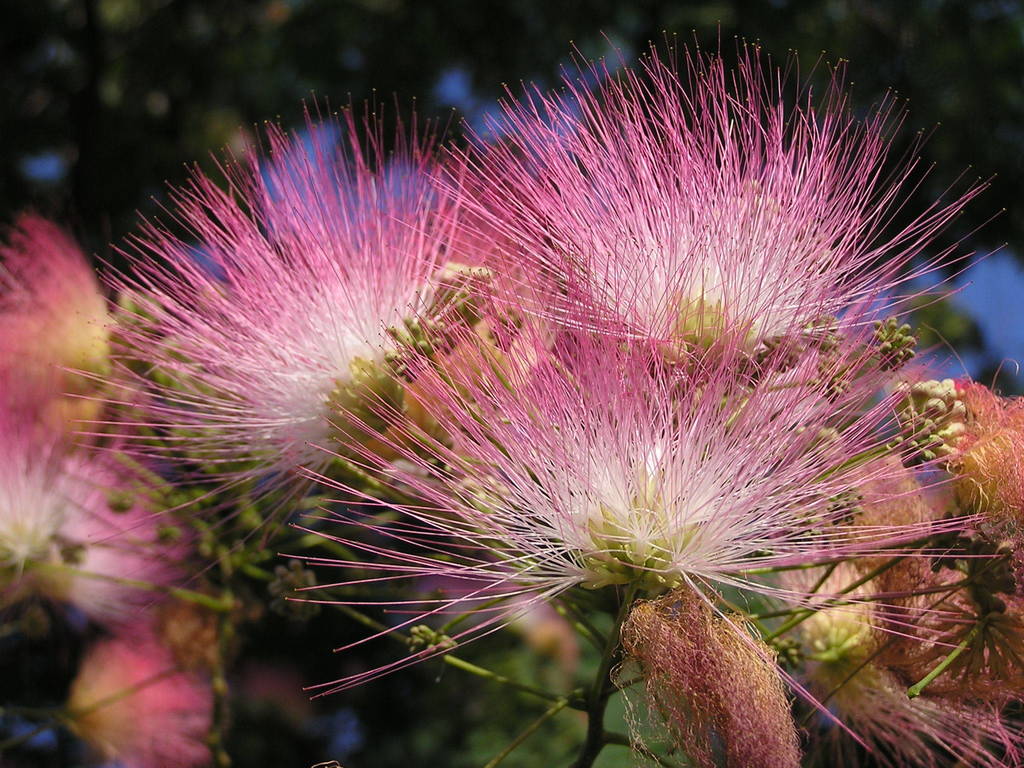
(c) Andrew Butko, some rights reserved (CC BY-SA) · licence
Family: Fabaceae · Type: Shrub / Tree · Not Native
Albizia julibrissin (Silk tree) is a non-native California shrub / tree in the Fabaceae family, recognized by Asian ornamental genus escaped from cultivation in warm temperate areas.
Silk tree is a naturalized tree found in the Sacramento Valley and southwestern California in disturbed coastal and riparian areas at elevations below 500 meters. Flowering from May to July, this tree produces delicate pink to green flowers with feathery, silky stamens. Growing with a broad, spreading crown and reaching up to 10 to 15 meters tall, it has a distinctive deciduous growth habit. Its compound leaves feature 8 to 24 primary leaflets, each with 26 to 60 tiny secondary leaflets less than 1.5 centimeters long. The tree produces elongated gray-brown seed pods 10 to 20 centimeters in length, giving it a distinctive ornamental appearance.
Identification and appearance
Key characters: Asian ornamental genus escaped from cultivation in warm temperate areas
Habitat and range
Habitat: Generally disturbed, coastal, riparian areas
Elevation: < 500 m
California counties: Butte, Los Angeles, San Bernardino, Riverside, Amador, Yolo, Sacramento, Santa Clara, Santa Barbara
Outside California: native to warm temperate, tropical Asia, widely cultivated in tropics, warm temp
Bloom period
Albizia julibrissin blooms May-Jul.
How to tell it apart
vs Paraserianthes: Albizia has pink powder-puff flowers; Paraserianthes has white to cream flowers.; vs Acacia: Albizia has twice-compound feathery leaves; Acacia has simple blade-like leaves (phyllodes).; vs Calliandra: Albizia are valley/coastal trees with petiole glands; Calliandra are desert shrubs without glands.; vs Mimosa: Albizia has spike-like flower clusters; Mimosa has round ball-shaped flower heads.; vs Samanea: Albizia has pink flowers and slowly-opening pods; Samanea has pink-white flowers and thick woody pods.
Frequently asked questions
Is Albizia julibrissin native to California?
No. Albizia julibrissin is not native to California (recorded as not native).
When does Albizia julibrissin bloom?
Albizia julibrissin blooms May-Jul.
Where in California does Albizia julibrissin grow?
Albizia julibrissin occurs in Butte, Los Angeles, San Bernardino, Riverside, Amador, Yolo, Sacramento, Santa Clara and other counties, at elevations of < 500 m.
What plant family does Albizia julibrissin belong to?
Albizia julibrissin is in the Fabaceae family, genus Albizia.
What habitat does Albizia julibrissin grow in?
Albizia julibrissin grows in Generally disturbed, coastal, riparian areas.
Related species
Other California species in the same genus, family, or bioregion.
Sources: Jepson eFlora · Index of California Plant Names · CalPhotos
Last updated 2026-10-07
Data from The California Species Project — 14,000+ California species with verified data from CNPS, CDFW, USFWS, Cal-IPC, and more.