Alcea rosea
Hollyhock
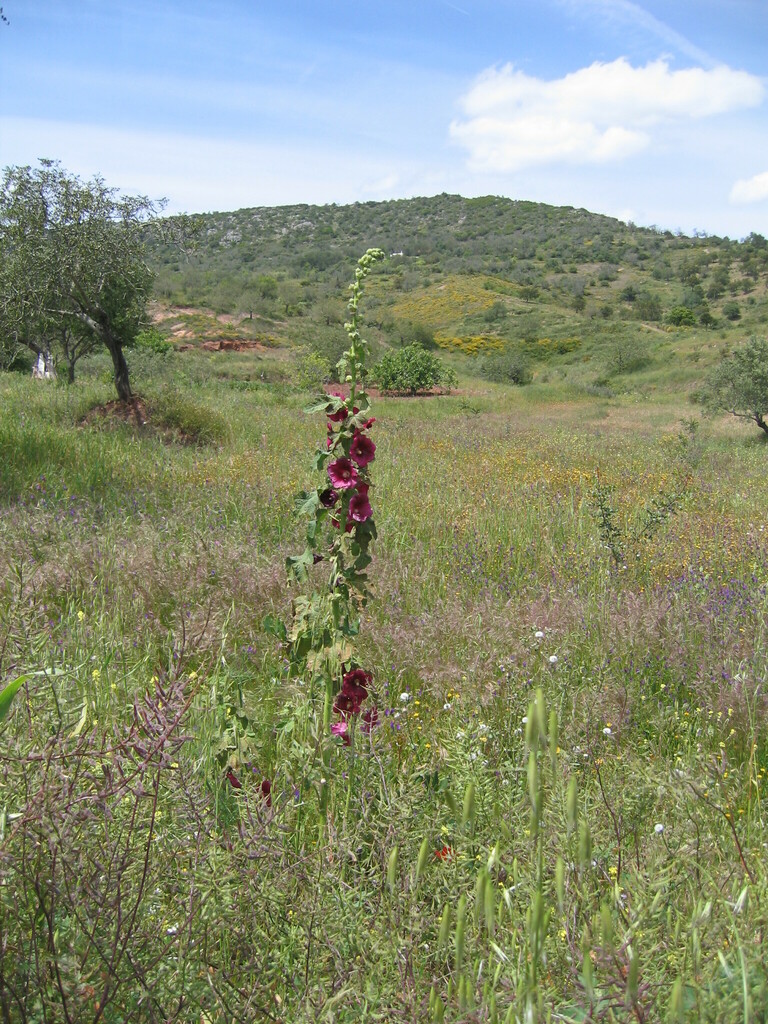
(c) zebedeugalinha, some rights reserved (CC BY) · licence
Family: Malvaceae · Type: Herb · Not Native
Alcea rosea (Hollyhock) is a non-native California herb in the Malvaceae family, recognized by Asian ornamental genus with limited naturalization from garden escapes.
Hollyhock is a naturalized perennial found in the San Francisco Bay Area and southwestern California in disturbed places at elevations below 1,100 meters. Flowering from June to August, this plant produces large showy flowers 8 to 10 centimeters in diameter in colors ranging from white to deep pink and burgundy. Growing with tall, unbranched stems 1 to 2.5 meters high that are initially stellate-hairy and become nearly smooth with age, it develops a robust and stately garden presence. Its large leaves measure 7 to 15 centimeters wide, with a heart-shaped or round blade that is weakly palmate-lobed and covered in stellate hairs. The fruit forms disk-like segments with horseshoe-shaped edges, each approximately 6 millimeters long and lightly winged.
Identification and appearance
Key characters: Asian ornamental genus with limited naturalization from garden escapes
Habitat and range
Habitat: Uncommon. Disturbed places
Elevation: especially < 1100 m
California counties: Los Angeles, San Bernardino, San Diego, Santa Barbara, Tulare, Siskiyou, Alameda, Santa Clara, Placer, Modoc, Ventura, San Joaquin, Yolo, Solano
Outside California: perhaps native to Asia Minor
Bloom period
Alcea rosea blooms Jun-Aug.
How to tell it apart
vs Malva: Alcea has huge flowers (>6 cm) with 5-11 fused bracts; Malva has smaller flowers with 3 separate bracts.; vs Rosa: Alcea has flowers in tall spikes with fused stamens; Rosa has flowers with separate stamens and prickly stems.; vs Pelargonium: Alcea has symmetrical bowl-shaped flowers; Pelargonium has irregular flowers with upper petals different from lower.; vs Gladiolus: Alcea has bowl-shaped mallow flowers spiraling around stem; Gladiolus has tubular flowers in one-sided spike.; vs Petunia: Alcea flowers have many separate petals and fused stamens; Petunia has funnel-shaped fused petals.
Frequently asked questions
Is Alcea rosea native to California?
No. Alcea rosea is not native to California (recorded as not native).
When does Alcea rosea bloom?
Alcea rosea blooms Jun-Aug.
Where in California does Alcea rosea grow?
Alcea rosea occurs in Los Angeles, San Bernardino, San Diego, Santa Barbara, Tulare, Siskiyou, Alameda, Santa Clara and other counties, at elevations of especially < 1100 m.
What plant family does Alcea rosea belong to?
Alcea rosea is in the Malvaceae family, genus Alcea.
What habitat does Alcea rosea grow in?
Alcea rosea grows in Uncommon. Disturbed places.
Related species
Other California species in the same genus, family, or bioregion.
Sources: Jepson eFlora · Index of California Plant Names · CalPhotos
Last updated 2026-10-07
Data from The California Species Project — 14,000+ California species with verified data from CNPS, CDFW, USFWS, Cal-IPC, and more.