Aliciella triodon
Coyote gilia, Coyote Gilia, coyote gilia, coyote gilia
(c) Matt Berger, some rights reserved (CC BY), uploaded by Matt Berger · licence
Family: Polemoniaceae · Type: Herb · Native
Conservation status: CNPS 2B.2
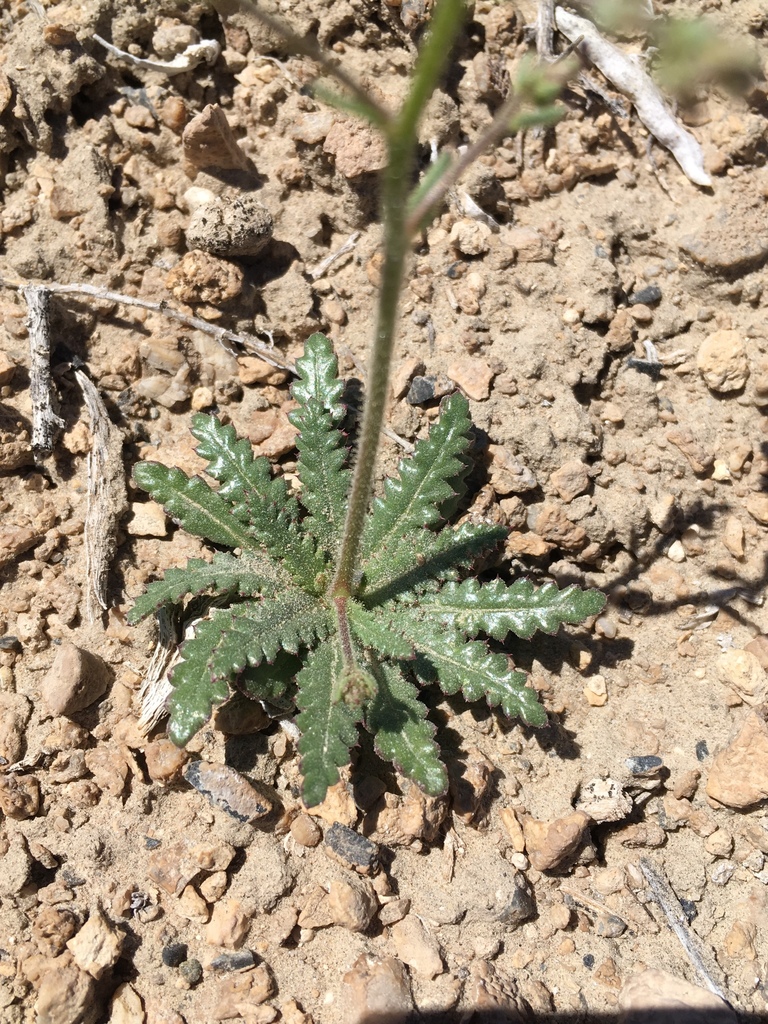
Aliciella triodon (Coyote gilia) is a native California herb in the Polemoniaceae family, recognized by 3-toothed petal lobes.
Coyote gilia is a rare (CNPS 2B.2) California native annual found in the eastern Desert Mountains, specifically the Clark Mountain Range, in open, sandy or rocky areas, sagebrush scrub, and juniper woodland at elevations of 1,200 to 1,700 meters. Flowering from April to May, this delicate plant produces thread-like stems with flowers featuring a unique purple and yellow corolla, with white-tipped lobes that have three distinctive teeth. Growing 5 to 13 centimeters tall with spreading branches, it develops slender, thread-like stems that emerge from a glandular-puberulent base. Its leaves are particularly distinctive, with basal leaves 5 to 20 millimeters long, ranging from oblanceolate to obovate, and often featuring spreading, short-pointed lobes, while upper leaves remain linear and entire. The plant produces numerous small, narrowly ovoid fruits measuring 3 to 4 millimeters in length.
Identification and appearance
Key characters: 6 sympatric species; 3-toothed petal lobes are diagnostic
Habitat and range
Habitat: Open, sandy or rocky areas, sagebrush scrub, juniper woodland
Elevation: 1200-1700 m
California counties: Lassen, San Bernardino, Inyo, Mono
Outside California: to Colorado, New Mexico
Bloom period
Aliciella triodon blooms Apr-May.
Conservation status
CNPS 2B.2
How to tell it apart
vs Gilia: Aliciella has wheel-shaped flowers with spreading lobes; Gilia has funnel-shaped flowers with a tube.; vs Phacelia: Aliciella leaves are cleanly feather-divided; Phacelia leaves are more irregularly lobed or toothed.; vs Linanthus: Aliciella smells skunky when crushed; Linanthus lacks this odor.; vs Lathrocasis: Aliciella has deeply divided compound leaves; Lathrocasis has simple, undivided leaves.; vs Allophyllum: Aliciella has wheel-shaped flowers; Allophyllum has funnel-shaped flowers and long fuzzy hairs.
Frequently asked questions
Is Aliciella triodon native to California?
Yes. Aliciella triodon is native to California (recorded as native).
When does Aliciella triodon bloom?
Aliciella triodon blooms Apr-May.
Where in California does Aliciella triodon grow?
Aliciella triodon occurs in Lassen, San Bernardino, Inyo, Mono, at elevations of 1200-1700 m.
What plant family does Aliciella triodon belong to?
Aliciella triodon is in the Polemoniaceae family, genus Aliciella.
Is Aliciella triodon rare or endangered?
Aliciella triodon carries California Rare Plant Rank 2B.2, state rank S2.
Related species
Other California species in the same genus, family, or bioregion.
- Aliciella humillima — Smallest aliciella
- Aliciella hutchinsifolia — Desert pale aliciella
- Aliciella latifolia subsp. latifolia — Broad-leaved aliciella
- Aliciella leptomeria — Sand aliciella
- Aliciella lottiae — Lott's aliciella
- Aliciella micromeria — Dainty aliciella
- Allophyllum divaricatum — Trinity Mountains rockcress
- Allophyllum gilioides — Dense false gilia
- Allophyllum gilioides subsp. gilioides
- Allophyllum gilioides subsp. violaceum
Sources: Jepson eFlora · CNPS Rare Plant Inventory · Index of California Plant Names · CalPhotos · CDFW CNDDB
Last updated 2026-10-07
Data from The California Species Project — 14,000+ California species with verified data from CNPS, CDFW, USFWS, Cal-IPC, and more.