Allenrolfea occidentalis
Iodine bush
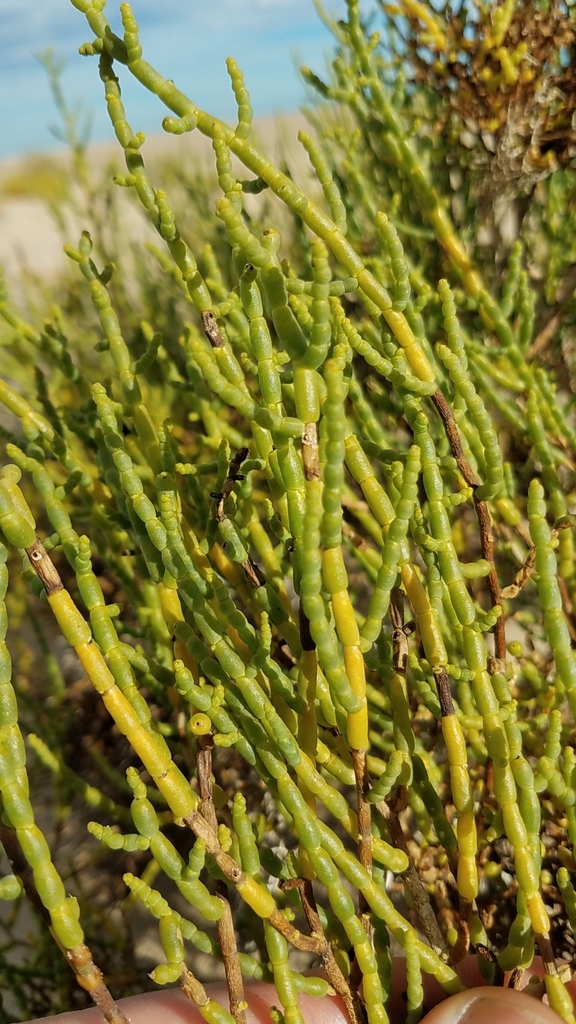
(c) Alan Rockefeller, some rights reserved (CC BY), uploaded by Alan Rockefeller · licence
Family: Chenopodiaceae · Type: Shrub · Native
Allenrolfea occidentalis (Iodine bush) is a native California shrub in the Chenopodiaceae family, recognized by Specialized halophytic genus adapted to highly saline soils of western North America.
Iodine bush is a California native shrub found in the Great Valley, eastern San Francisco Bay, southern Sierra Nevada, and Desert bioregions in alkaline flats and hummocks at elevations below 1,450 meters. Flowering from June to August, this plant produces inconspicuous small flowers in dense cylindrical spikes. Growing 30 to 150 centimeters tall with many-branched stems that are erect or decumbent, it has a woody base with fleshy, jointed branches. Its leaves are tiny, scale-like, and triangular, clasping the stem and measuring just 2 to 4 millimeters long. The fruit is a small, ovoid utricle about 1 millimeter long, containing a red-brown seed.
Identification and appearance
Key characters: Specialized halophytic genus adapted to highly saline soils of western North America
Habitat and range
Habitat: Flats, hummocks, in alkaline soils
Elevation: < 1450 m
California counties: Riverside, Kings, Los Angeles, Fresno, Alameda, Inyo, Imperial, Kern, Contra Costa, San Bernardino, San Diego, Madera, Merced, Mono, San Joaquin, San Luis Obispo, Tulare, San Benito, Glenn, Santa Barbara
Outside California: to Oregon, Idaho, Texas, Mexico
Bloom period
Allenrolfea occidentalis blooms Jun-Aug.
How to tell it apart
vs Salicornia: Allenrolfea has alternate spiraling leaves and is a woody shrub; Salicornia has opposite leaves and is an annual.; vs Arthroceras: Allenrolfea has alternate scale-leaves spiraling around stem; Arthrocnemum has opposite paired scale-leaves.; vs Atriplex: Allenrolfea has jointed succulent stems with tiny alternate scales; Atriplex has obvious scaly triangular leaves.; vs Suaeda: Allenrolfea has jointed stems with tiny alternate scale-leaves; Suaeda has obvious cylindrical succulent leaves.; vs Artemisia: Allenrolfea has jointed succulent stems; Artemisia has soft aromatic divided gray-green leaves.
Frequently asked questions
Is Allenrolfea occidentalis native to California?
Yes. Allenrolfea occidentalis is native to California (recorded as native).
When does Allenrolfea occidentalis bloom?
Allenrolfea occidentalis blooms Jun-Aug.
Where in California does Allenrolfea occidentalis grow?
Allenrolfea occidentalis occurs in Riverside, Kings, Los Angeles, Fresno, Alameda, Inyo, Imperial, Kern and other counties, at elevations of < 1450 m.
What plant family does Allenrolfea occidentalis belong to?
Allenrolfea occidentalis is in the Chenopodiaceae family, genus Allenrolfea.
What habitat does Allenrolfea occidentalis grow in?
Allenrolfea occidentalis grows in Flats, hummocks, in alkaline soils.
Related species
Other California species in the same genus, family, or bioregion.
Sources: Jepson eFlora · Index of California Plant Names · CalPhotos
Last updated 2026-10-07
Data from The California Species Project — 14,000+ California species with verified data from CNPS, CDFW, USFWS, Cal-IPC, and more.