Allionia incarnata var. villosa
Trailing windmills
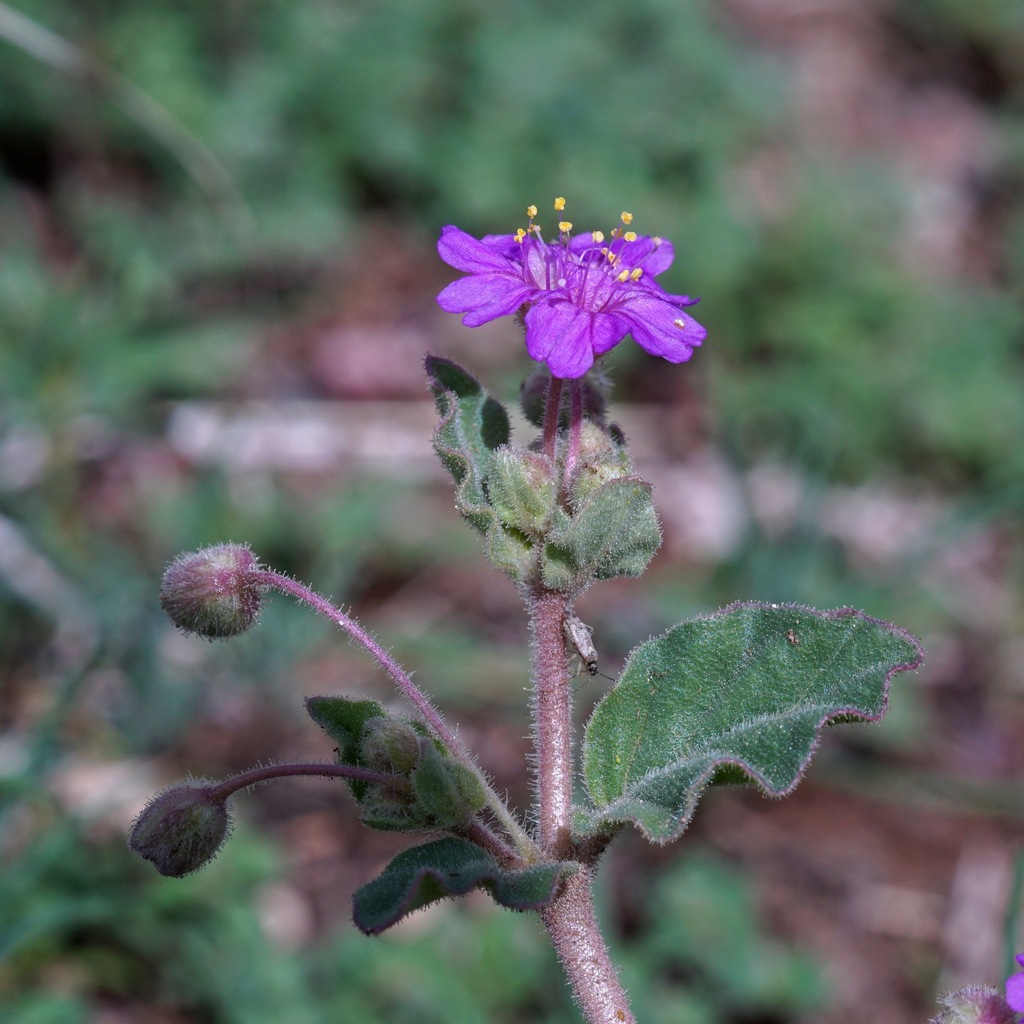
(c) Andrew Tree, some rights reserved (CC BY), uploaded by Andrew Tree · licence
Family: Nyctaginaceae · Type: Herb · Native
Allionia incarnata var. villosa (Trailing windmills) is a native California herb in the Nyctaginaceae family, recognized by 2 sympatric varieties; distinguished by stem hairiness, fruit size, and leaf reduction.
Trailing windmills is a California native perennial found in the Desert bioregion in creosote-bush scrub at elevations of 100 to 1,200 meters. Flowering from March to September, this plant produces small flowers with delicate, trailing form. Growing with sprawling stems 10 to 30 centimeters long that are densely covered in long glandular hairs, it forms a low-spreading ground cover. Its leaves are long and hairy, maintaining similar size and shape from base to stem tip. The fruit is generally 4 to 6 millimeters long, contributing to its distinctive compact growth habit.
Identification and appearance
Key characters: 2 sympatric varieties; distinguished by stem hairiness, fruit size, and leaf reduction
Habitat and range
Habitat: Creosote-bush scrub
Elevation: 100-1200 m
California counties: San Bernardino, Riverside, San Diego, Imperial, Inyo
Outside California: Nevada, Utah, Arizona, New Mexico, Mexico
Bloom period
Allionia incarnata var. villosa blooms Mar-Sep.
How to tell it apart
vs Mirabilis: Allionia has 3 bracts and 3 lopsided flowers blooming together; Mirabilis has 5 bracts and symmetrical flowers.; vs Boerhavia: Allionia has exactly 3 flowers per cluster in cup-like bracts; Boerhavia has loose, open flower clusters.; vs Phacelia: Allionia has 3 asymmetrical flowers in bract cups; Phacelia has coiled flower clusters and 5 separate petals.; vs Abronia: Allionia has 3 asymmetrical flowers per cluster on trailing stems; Abronia has dense rounded pom-pom heads.; vs Tripterocalyx: Allionia has 3 asymmetrical flowers and bilateral fruits; Tripterocalyx has rounded heads with translucent-winged fruits.
Frequently asked questions
Is Allionia incarnata var. villosa native to California?
Yes. Allionia incarnata var. villosa is native to California (recorded as native).
When does Allionia incarnata var. villosa bloom?
Allionia incarnata var. villosa blooms Mar-Sep.
Where in California does Allionia incarnata var. villosa grow?
Allionia incarnata var. villosa occurs in San Bernardino, Riverside, San Diego, Imperial, Inyo, at elevations of 100-1200 m.
What plant family does Allionia incarnata var. villosa belong to?
Allionia incarnata var. villosa is in the Nyctaginaceae family, genus Allionia.
What habitat does Allionia incarnata var. villosa grow in?
Allionia incarnata var. villosa grows in Creosote-bush scrub.
Related species
Other California species in the same genus, family, or bioregion.
Sources: Jepson eFlora · Index of California Plant Names · CalPhotos
Last updated 2026-10-07
Data from The California Species Project — 14,000+ California species with verified data from CNPS, CDFW, USFWS, Cal-IPC, and more.