Allophyllum integrifolium
White allophyllum
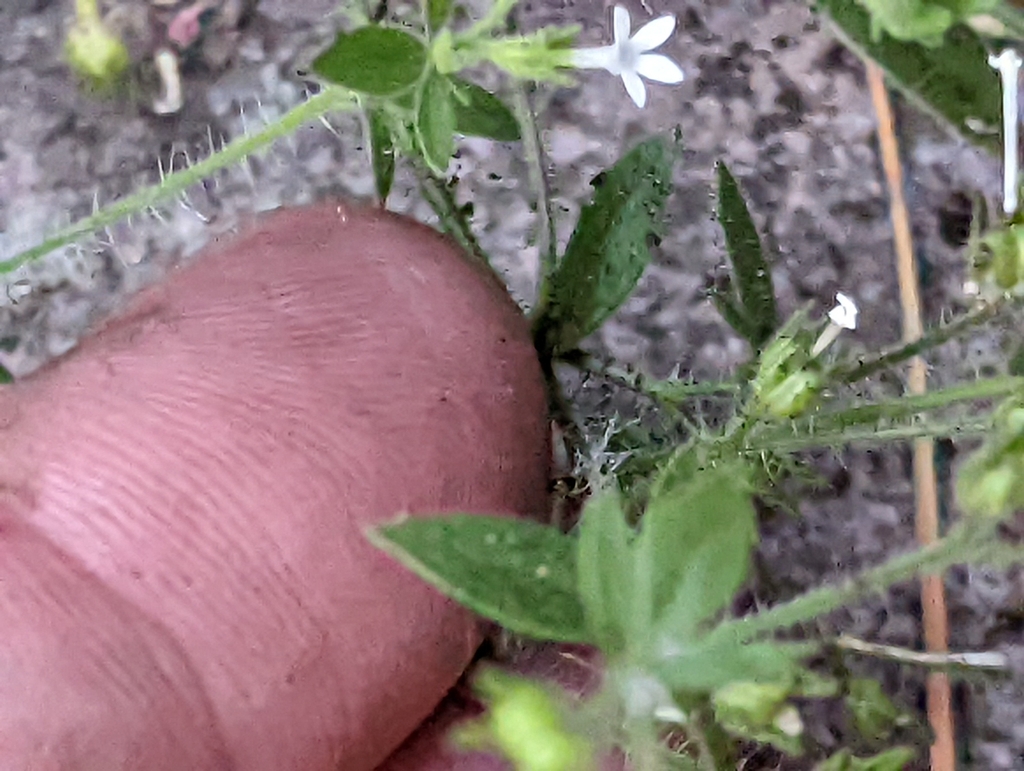
(c) Justin, some rights reserved (CC BY) · licence
Family: Polemoniaceae · Type: Herb · Native
Allophyllum integrifolium (White allophyllum) is a native California herb in the Polemoniaceae family, recognized by high elevation distribution, white flowers, and wide leaf lobes.
White allophyllum is a California native annual found in the Cascade Range, Sierra Nevada Mountains, and Transverse Ranges in open, rocky or sandy, generally moist areas at elevations of 1,300 to 2,700 meters. Flowering from June to August, this plant produces white to pale blue flowers with small 1 to 2 millimeter lobes in loose clusters of 2 to 4 blossoms. Growing with slender stems 10 to 25 centimeters tall that are generally unbranched and adorned with conspicuous long-stalked glands, it appears delicate and understated. Its leaves vary distinctively, with lower leaves entire or coarsely toothed and upper leaves typically having three lobes, with the largest lobes 5 to 15 millimeters wide. The plant produces brown seeds, with one to two seeds per chamber, completing its annual life cycle in California's montane habitats.
Identification and appearance
Key characters: 5 sympatric species; high elevation distribution, white flowers, and wide leaf lobes are diagnostic
Habitat and range
Habitat: Common. Open, rocky or sandy, generally moist areas
Elevation: 1300-2700 m
California counties: El Dorado, Fresno, Plumas, San Bernardino, Los Angeles, Kern, Calaveras, Tuolumne, Amador, Placer, Mariposa, Madera, Tulare, Butte, Shasta, Nevada, Sierra, Mono, Modoc, Lassen, Tehama, Santa Barbara, Alpine, San Luis Obispo, Ventura, Sacramento
Outside California: western Nevada
Bloom period
Allophyllum integrifolium blooms Jun-Aug.
How to tell it apart
vs Gilia: Allophyllum has long fuzzy hairs; Gilia has white cobwebby or sharply bent hairs.; vs Microsteris: Allophyllum has variable long hairs and sticky seeds; Microsteris has short uniform hairs and dry seeds.; vs Eriastrum: Allophyllum is fuzzy-hairy; Eriastrum has woolly-white flower heads.; vs Collomia: Allophyllum has funnel flowers and sticky seeds; Collomia has trumpet flowers and dry seeds.; vs Linanthus: Allophyllum is conspicuously fuzzy with long hairs; Linanthus is less hairy or smooth.
Frequently asked questions
Is Allophyllum integrifolium native to California?
Yes. Allophyllum integrifolium is native to California (recorded as native).
When does Allophyllum integrifolium bloom?
Allophyllum integrifolium blooms Jun-Aug.
Where in California does Allophyllum integrifolium grow?
Allophyllum integrifolium occurs in El Dorado, Fresno, Plumas, San Bernardino, Los Angeles, Kern, Calaveras, Tuolumne and other counties, at elevations of 1300-2700 m.
What plant family does Allophyllum integrifolium belong to?
Allophyllum integrifolium is in the Polemoniaceae family, genus Allophyllum.
What habitat does Allophyllum integrifolium grow in?
Allophyllum integrifolium grows in Common. Open, rocky or sandy, generally moist areas.
Related species
Other California species in the same genus, family, or bioregion.
- Allophyllum sp.
- Allophyllum divaricatum — Trinity Mountains rockcress
- Allophyllum gilioides — Dense false gilia
- Allophyllum gilioides subsp. gilioides
- Allophyllum gilioides subsp. violaceum
- Allophyllum glutinosum — Sticky false gilia
- Collomia diversifolia — Serpentine collomia
- Collomia grandiflora — Large-flowered collomia
- Collomia heterophylla — Variable-leaf collomia
Sources: Jepson eFlora · Index of California Plant Names · CalPhotos
Last updated 2026-10-07
Data from The California Species Project — 14,000+ California species with verified data from CNPS, CDFW, USFWS, Cal-IPC, and more.