Almutaster pauciflorus
Alkali marsh aster, alkali marsh aster, alkali marsh aster
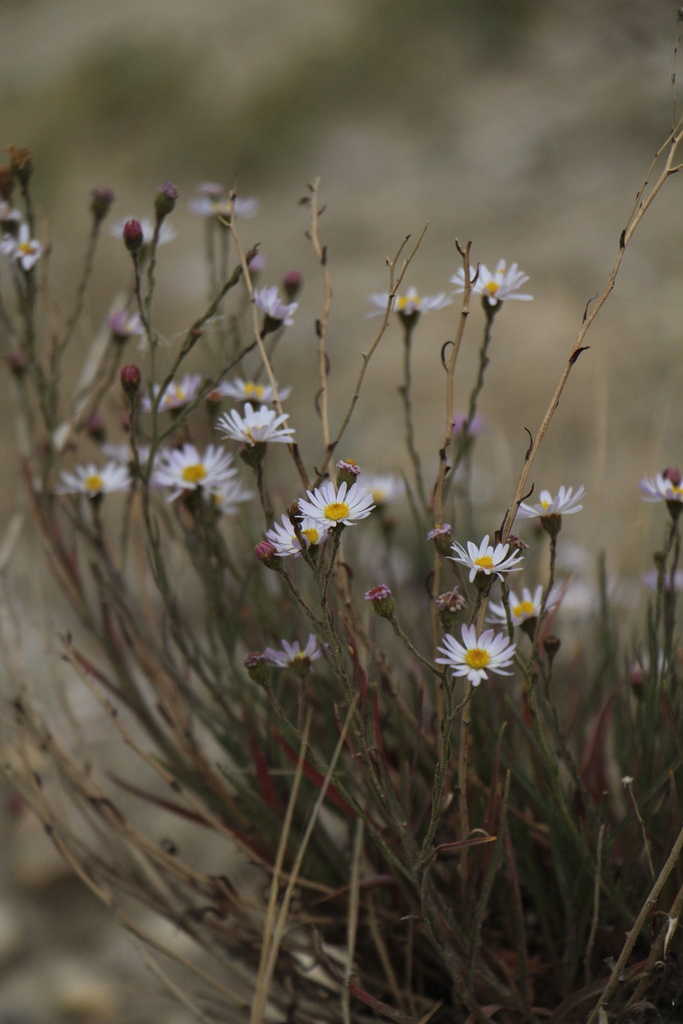
(c) Austin Saunders, some rights reserved (CC BY), uploaded by Austin Saunders · licence
Family: Asteraceae · Type: Herb · Native
Conservation status: CNPS 2B.2
Almutaster pauciflorus (Alkali marsh aster) is a native California herb in the Asteraceae family, recognized by Recently segregated from Symphyotrichum, representing the only North American species of this primarily Asian genus.
Alkali marsh aster is a rare (CNPS 2B.2) California native perennial found in southern Sierra Nevada foothills and northern Mojave Desert in Inyo County, inhabiting damp alkaline places at elevations of 200 to 700 meters. Flowering from June to October, this plant produces white to pale purple ray flowers with yellow disk flowers in radiate heads 4 to 7 millimeters long. Growing with ascending to erect stems 30 to 120 centimeters tall, it has long rhizomes and distally branched stems that are glandular in the upper portions. Its leaves range from basal petioled leaves with widened sheathing bases to smaller cauline leaves that become bract-like in the inflorescence, generally linear and acute. The fruit is a fusiform structure with 7 to 10 fine ribs and a pappus of 25 to 45 bristles.
Identification and appearance
Key characters: Recently segregated from Symphyotrichum, representing the only North American species of this primarily Asian genus
Habitat and range
Habitat: Damp alkaline places
Elevation: 200-700 m
California counties: Inyo, Kern, Riverside
Outside California: to central Canada, Texas, Mexico
Bloom period
Almutaster pauciflorus blooms Jun-Oct.
Conservation status
CNPS 2B.2
How to tell it apart
vs Chaetopappa: Almutaster grows in wet alkaline marshes; Chaetopappa on dry ground.; vs Symphyotrichum: Almutaster has grass-like leaves and sticky glandular bracts; Symphyotrichum has broader leaves without glands.; vs Eurybia: Almutaster in alkaline wetlands with grass-like leaves; Eurybia in woodlands with broader leaves.; vs Sericocarpus: Almutaster heads solitary on long branches; Sericocarpus heads tightly clustered at tips.; vs Machaeranthera: Almutaster has grass-like simple leaves; Machaeranthera has fern-like dissected leaves.
Frequently asked questions
Is Almutaster pauciflorus native to California?
Yes. Almutaster pauciflorus is native to California (recorded as native).
When does Almutaster pauciflorus bloom?
Almutaster pauciflorus blooms Jun-Oct.
Where in California does Almutaster pauciflorus grow?
Almutaster pauciflorus occurs in Inyo, Kern, Riverside, at elevations of 200-700 m.
What plant family does Almutaster pauciflorus belong to?
Almutaster pauciflorus is in the Asteraceae family, genus Almutaster.
Is Almutaster pauciflorus rare or endangered?
Almutaster pauciflorus carries California Rare Plant Rank 2B.2, state rank S1S2.
Related species
Other California species in the same genus, family, or bioregion.
Sources: Jepson eFlora · Index of California Plant Names · CalPhotos · CDFW CNDDB
Last updated 2026-10-07
Data from The California Species Project — 14,000+ California species with verified data from CNPS, CDFW, USFWS, Cal-IPC, and more.