Alnus rhombifolia
White alder
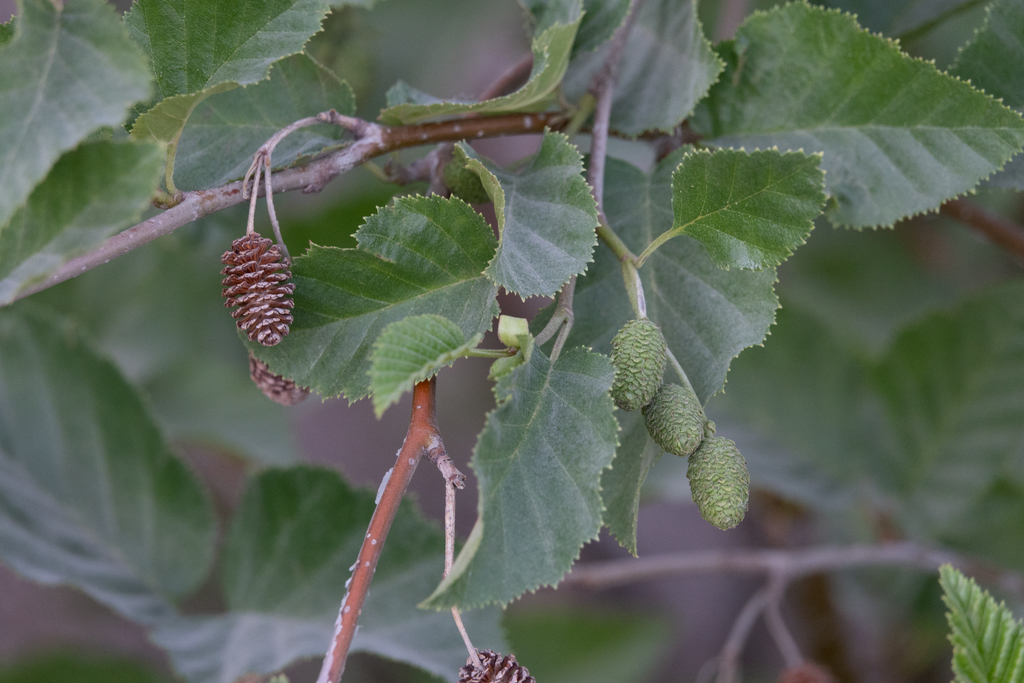
no rights reserved · CC0
Family: Betulaceae · Type: Tree · Native
Alnus rhombifolia (White alder) is a native California tree in the Betulaceae family, recognized by tree habit, flat leaf margins, and smooth leaf venation.
White alder is a California native tree found in the California Floristic Province and marginally in the Mojave Desert, growing along permanent streams at elevations of 100 to 2,400 meters. Flowering from January to April, this tree produces small, inconspicuous flowers typical of its species. Growing to heights of 35 meters with a broad, spreading form, it develops a sturdy trunk and branching structure. Its thick leaves are distinctive, with rounded to tapered bases, green on the upper surface and yellow-green underneath, featuring margins that are nearly flat and a prominent midrib. In riparian environments, white alder plays a crucial role in stabilizing stream banks and providing habitat for local wildlife.
Identification and appearance
Key characters: 5 sympatric species; distinguished by tree habit, flat leaf margins, and smooth leaf venation
Habitat and range
Habitat: Along permanent streams
Elevation: 100-2400 m
California counties: San Diego, Amador, San Bernardino, Alameda, Riverside, San Mateo, Los Angeles, Siskiyou, Monterey, Mendocino, Orange, Plumas, Glenn, Nevada, Santa Barbara, Lake, Placer, Humboldt, Fresno, Sonoma, Kern, Santa Clara, Mariposa, Madera, Contra Costa, Tulare, Marin, Shasta, Trinity, Ventura, El Dorado, Napa, Colusa, Del Norte, San Joaquin, San Luis Obispo, Solano, Sacramento, Stanislaus, Butte, Calaveras, Tuolumne, San Francisco, Yuba, Tehama, San Benito, Sierra, Merced, Alpine, Santa Cruz, Yolo, Mono
Outside California: to Washington, Idaho
Bloom period
Alnus rhombifolia blooms Jan-Apr.
How to tell it apart
vs Corylus: Alnus has tiny winged seeds from persistent woody cones; Corylus has large nuts in papery husks.; vs Populus: Alnus has woody persistent cone-like catkins; Populus has fluffy cottony seeds from capsules.; vs Quercus: Alnus has woody cone-like catkins and toothed leaves; Quercus has acorns in caps and lobed leaves.; vs Betula: Alnus has woody cones that persist after seeds drop; Betula catkins disintegrate completely, releasing papery scales with seeds.; vs Ulmus: Alnus has woody cone-like catkins; Ulmus has flat, round, papery winged fruits.
Frequently asked questions
Is Alnus rhombifolia native to California?
Yes. Alnus rhombifolia is native to California (recorded as native).
When does Alnus rhombifolia bloom?
Alnus rhombifolia blooms Jan-Apr.
Where in California does Alnus rhombifolia grow?
Alnus rhombifolia occurs in San Diego, Amador, San Bernardino, Alameda, Riverside, San Mateo, Los Angeles, Siskiyou and other counties, at elevations of 100-2400 m.
What plant family does Alnus rhombifolia belong to?
Alnus rhombifolia is in the Betulaceae family, genus Alnus.
What habitat does Alnus rhombifolia grow in?
Alnus rhombifolia grows in Along permanent streams.
Related species
Other California species in the same genus, family, or bioregion.
Sources: Jepson eFlora · Index of California Plant Names · CalPhotos
Last updated 2026-10-07
Data from The California Species Project — 14,000+ California species with verified data from CNPS, CDFW, USFWS, Cal-IPC, and more.