Alopecurus saccatus
Pacific foxtail
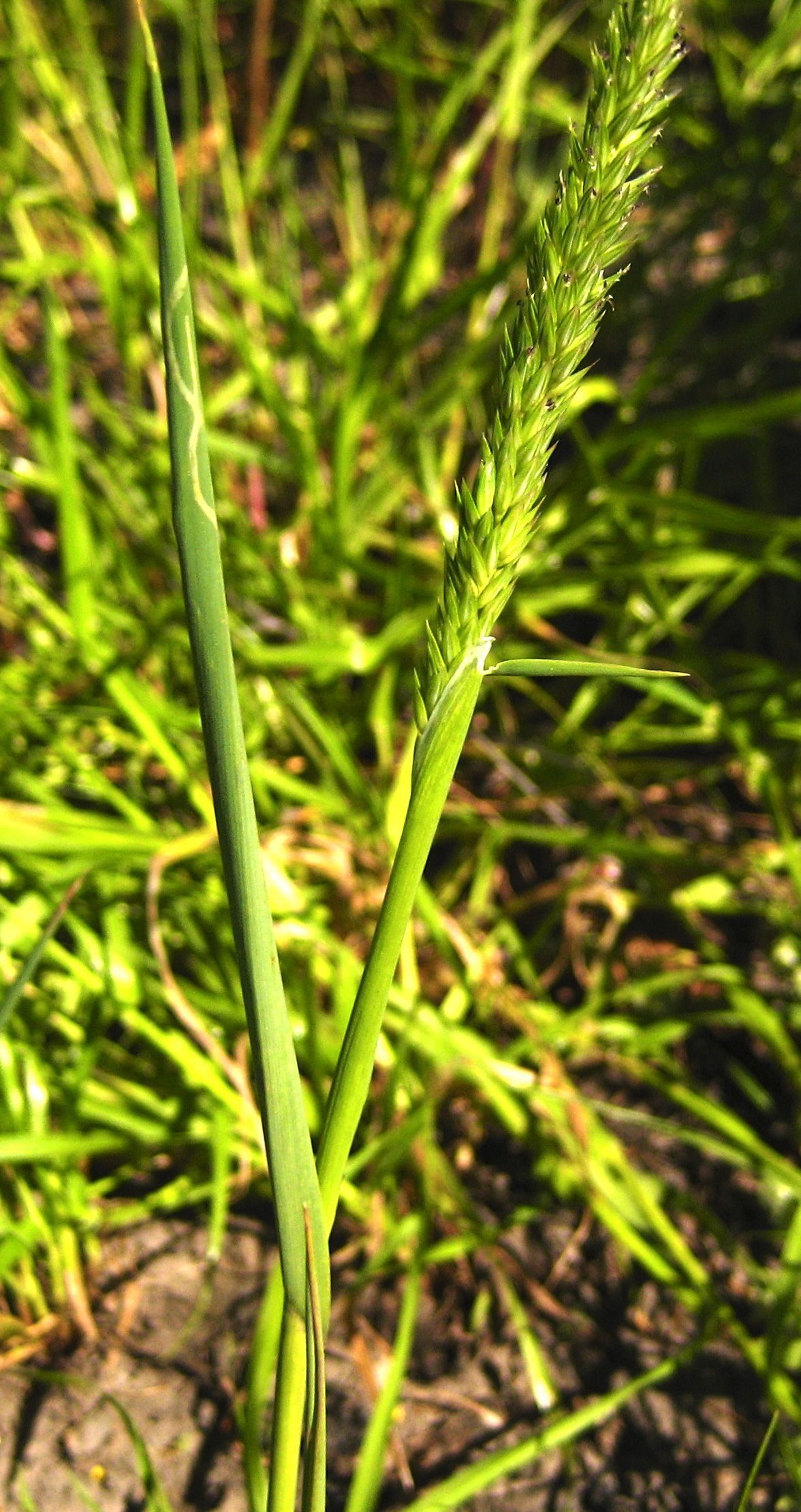
Photo by Chez Brungraber
Family: Poaceae · Type: Grass · Native
Alopecurus saccatus (Pacific foxtail) is a native California grass in the Poaceae family, recognized by inflated upper sheaths and wide inflorescence.
Pacific foxtail is a California native annual found in northern coastal, northern coastal range, Cascade Range, northern and central Sierra Nevada, Central Valley, central western, and southern western California regions in vernal pools and moist, open meadows at elevations below 1,700 meters. Flowering from March to May, this plant produces pale green to whitish flowers in dense, narrow spikes 1.5 to 6.5 centimeters long. Growing with slender stems 12 to 45 centimeters tall, it has distinctively inflated upper leaf sheaths. Its leaves are narrow, measuring 1 to 8 centimeters long and 1 to 4 millimeters wide, with a ligule 1.5 to 5.5 millimeters long. The plant's delicate flower awns are uniquely bent, extending 3 to 5 millimeters beyond the lemma body.
Identification and appearance
Key characters: 6 sympatric species; distinguished by inflated upper sheaths and wide inflorescence
Habitat and range
Habitat: Vernal pools, moist, open meadows
Elevation: < 1700 m
California counties: Santa Barbara, Alameda, Butte, Fresno, Humboldt, Marin, Mendocino, Orange, Placer, Riverside, Sacramento, San Joaquin, San Luis Obispo, San Mateo, Santa Cruz, Solano, Sutter, Tulare, Tuolumne, Ventura, Colusa, Monterey, San Diego, Sonoma, Stanislaus, Yolo, Merced, Modoc, Tehama, Siskiyou, Plumas, Napa, Madera, Lake, Kern, Glenn, Contra Costa, Sierra, Shasta, Yuba, Lassen, San Benito, Amador, San Francisco, Calaveras
Outside California: to Washington
Bloom period
Alopecurus saccatus blooms Mar-May.
How to tell it apart
vs Hordeum: Alopecurus has soft, single bristles; Hordeum has stiff, spreading bristles in groups of three.; vs Phalaris: Alopecurus has bristles from each flower; Phalaris has awnless, egg-shaped spikes.; vs Phleum: Alopecurus has a bristle from each flower; Phleum is awnless with a smoother cylinder.; vs Plantago: Alopecurus is a grass; Plantago has broad, basal leaves and is not a grass.; vs Cenchrus: Alopecurus has a fuzzy cylinder; Cenchrus has spiny burs enclosing seeds.
Frequently asked questions
Is Alopecurus saccatus native to California?
Yes. Alopecurus saccatus is native to California (recorded as native).
When does Alopecurus saccatus bloom?
Alopecurus saccatus blooms Mar-May.
Where in California does Alopecurus saccatus grow?
Alopecurus saccatus occurs in Santa Barbara, Alameda, Butte, Fresno, Humboldt, Marin, Mendocino, Orange and other counties, at elevations of < 1700 m.
What plant family does Alopecurus saccatus belong to?
Alopecurus saccatus is in the Poaceae family, genus Alopecurus.
What habitat does Alopecurus saccatus grow in?
Alopecurus saccatus grows in Vernal pools, moist, open meadows.
Related species
Other California species in the same genus, family, or bioregion.
- Alopecurus sp. — Foxtail
- Alopecurus aequalis — Short-awn foxtail
- Alopecurus aequalis var. aequalis — Shortawn foxtail
- Alopecurus aequalis var. sonomensis — Sonoma alopecurus
- Alopecurus carolinianus — Carolina foxtail
- Alopecurus geniculatus — Water foxtail
- Ammophila arenaria — European beachgrass
- Ammophila sp. — Beachgrass
- Andropogon sp. — Bluestem
Sources: Jepson eFlora · Index of California Plant Names · CalPhotos
Last updated 2026-10-07
Data from The California Species Project — 14,000+ California species with verified data from CNPS, CDFW, USFWS, Cal-IPC, and more.