Aloysia wrightii
Wright's beebrush, Wright's Beebrush, Wright's beebrush, Wright's beebrush
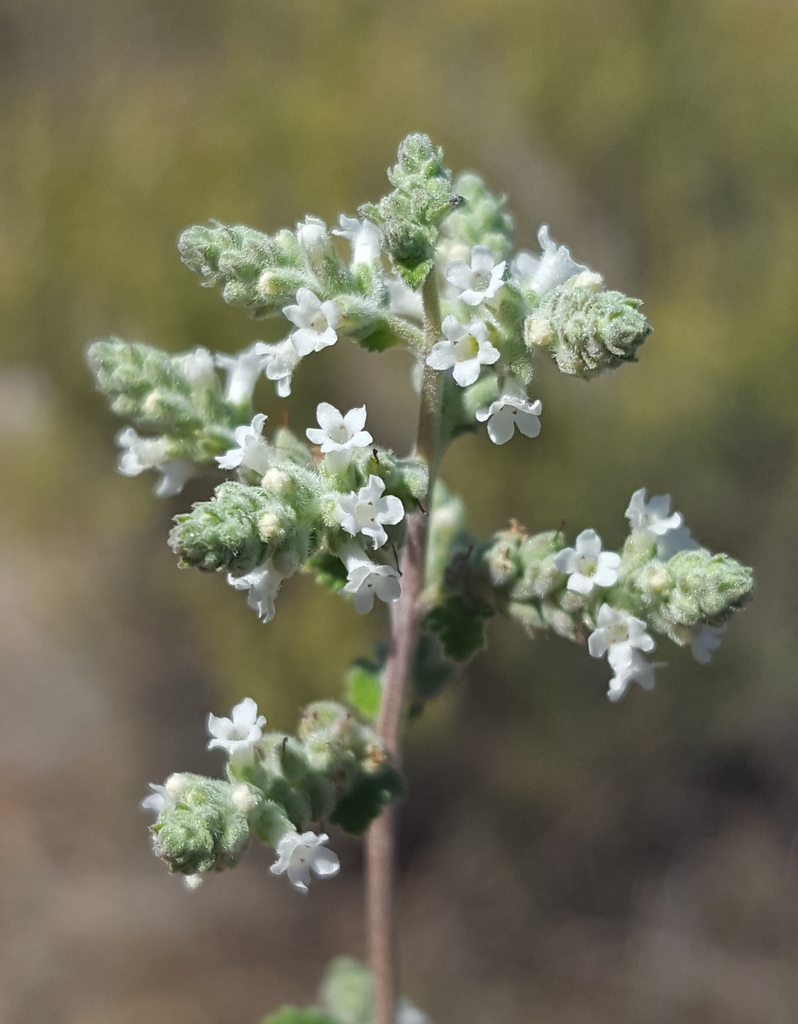
(c) Alex Abair, some rights reserved (CC BY), uploaded by Alex Abair · licence
Family: Verbenaceae · Type: Shrub · Native
Conservation status: CNPS 4.3
Aloysia wrightii (Wright's beebrush) is a native California shrub in the Verbenaceae family, recognized by Represents the northwesternmost extension of a primarily South American genus into California's desert regions.
Wright's beebrush is a California native shrub found in the eastern Mojave Desert Mountains and eastern Colorado Desert in rocky, often limestone slopes within Joshua-tree and pinyon/juniper woodland at elevations of 900 to 1,600 meters. Flowering from August to October, this plant produces white flowers with rounded lobes in small spikes 1.5 to 6 centimeters long. Growing as a rounded shrub less than 2 meters tall with many branches, its twigs are brown with white-colored angles. Its leaves are small, 4 to 17 millimeters long, ovate to nearly round, with edges that are slightly scalloped and densely hairy undersides. The plant's compact, rounded form and white flowers make it a distinctive component of its desert woodland habitat.
Identification and appearance
Key characters: Represents the northwesternmost extension of a primarily South American genus into California's desert regions
Habitat and range
Habitat: Rocky, often limestone, slopes, Joshua-tree or pinyon/juniper woodland
Elevation: 900-1600 m
California counties: San Bernardino, Riverside
Outside California: to Texas, northern Mexico
Bloom period
Aloysia wrightii blooms Aug-Oct.
Conservation status
CNPS 4.3
How to tell it apart
vs Melilotus: Aloysia has tubular flowers in spikes; Melilotus has pea-family flowers with clover-like leaves.; vs Salvia: Aloysia has narrow spikes of tiny white flowers; Salvia has whorled clusters of larger two-lipped flowers.; vs Ceanothus: Aloysia has narrow flower spikes; Ceanothus has dense rounded clusters of flowers.; vs Melissa: Aloysia has narrow spikes in desert; Melissa has whorled flowers with mint-family square stems and lemon scent.; vs Olea: Aloysia has narrow flower spikes; Olea has small clustered flowers and opposite evergreen leaves.
Frequently asked questions
Is Aloysia wrightii native to California?
Yes. Aloysia wrightii is native to California (recorded as native).
When does Aloysia wrightii bloom?
Aloysia wrightii blooms Aug-Oct.
Where in California does Aloysia wrightii grow?
Aloysia wrightii occurs in San Bernardino, Riverside, at elevations of 900-1600 m.
What plant family does Aloysia wrightii belong to?
Aloysia wrightii is in the Verbenaceae family, genus Aloysia.
Is Aloysia wrightii rare or endangered?
Aloysia wrightii carries California Rare Plant Rank 4.3, state rank S4.
Related species
Other California species in the same genus, family, or bioregion.
Sources: Jepson eFlora · CNPS Rare Plant Inventory · Index of California Plant Names · CalPhotos · CDFW CNDDB
Last updated 2026-10-07
Data from The California Species Project — 14,000+ California species with verified data from CNPS, CDFW, USFWS, Cal-IPC, and more.