Alternanthera philoxeroides
Alligator weed
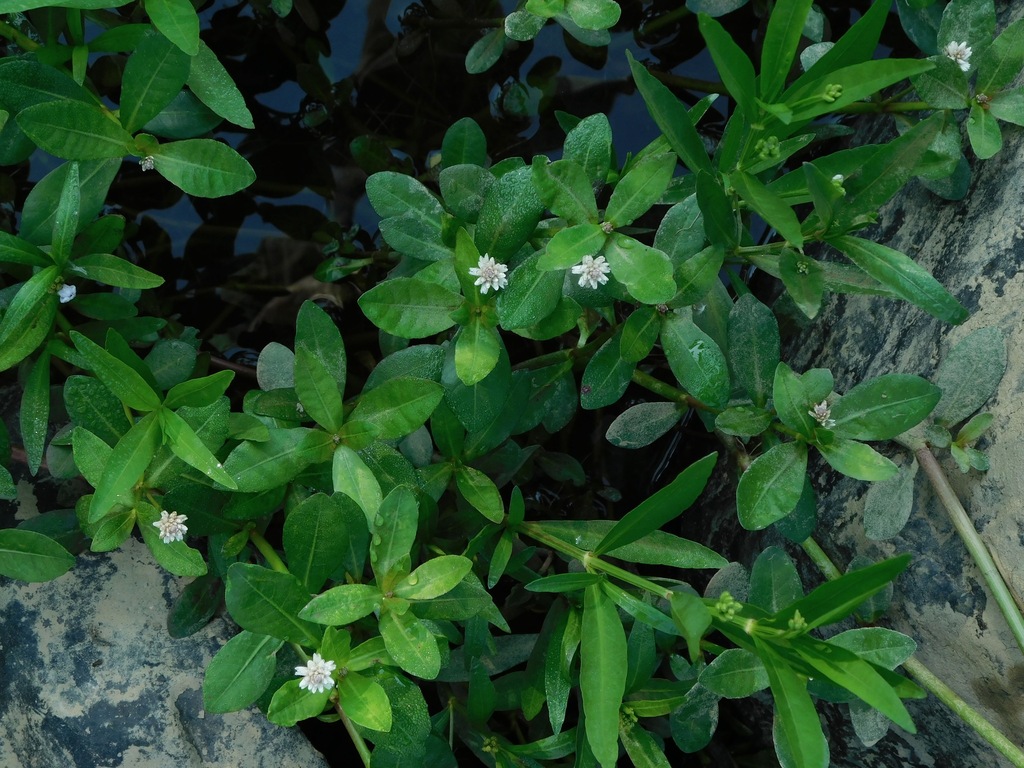
(c) Michael J. Papay, some rights reserved (CC BY), uploaded by Michael J. Papay · licence
Family: Amaranthaceae · Type: Herb · Not Native
Conservation status: Cal-IPC Yes
Alternanthera philoxeroides (Alligator weed) is a non-native California herb in the Amaranthaceae family, recognized by habitat preference (aquatic/semi-aquatic) is most diagnostic, plus larger leaves and spherical vs ovoid inflorescences.
Alligator weed is a naturalized perennial found in the San Joaquin Valley and Southern California coastal regions in shallow water, marshes, and pond edges at elevations below 200 meters. Flowering from May to October, this plant produces small white flowers in spherical clusters approximately 1.2 to 1.7 centimeters in diameter. Growing with prostrate, mat-forming stems 50 to 120 centimeters long that are white-hairy when young and become nearly hairless with age, it spreads extensively through stoloniferous growth. Its leaves are elliptic to obovate, 30 to 130 millimeters long and 5 to 35 millimeters wide, with a wedge-shaped base that may be slightly hairy and an obtuse or acute tip. The plant forms dense mats in wet environments, with young stems featuring distinctive white hairs along leaf axils and stem surfaces.
Identification and appearance
Key characters: 1 sympatric species; habitat preference (aquatic/semi-aquatic) is most diagnostic, plus larger leaves and spherical vs ovoid inflorescences
Habitat and range
Habitat: Shallow water (< 2 m) or wet soils, marshes, edges of ponds
Elevation: < 200 m
Outside California: to southeastern United States, Central America, native to South America
Bloom period
Alternanthera philoxeroides blooms May-Oct.
Conservation status
Cal-IPC Yes
How to tell it apart
vs Ludwigia: Squeeze the stem - Alternanthera has distinctly swollen, puffy hollow stems while Ludwigia stems are solid and slender.; vs Loropetalum: Loropetalum has showy 4-petaled flowers with strap-like petals; Alternanthera has tiny clustered flowers without obvious petals.; vs Epilobium: Epilobium flowers have 4 notched petals and inferior ovaries; Alternanthera has tiny clusters without visible petals.; vs Tradescantia: Tradescantia has showy 3-petaled purple/blue flowers; Alternanthera has inconspicuous white/green flower clusters.; vs Iresine: Both similar but Iresine leaves are typically reddish or purple-tinged; Alternanthera leaves are plain green.
Frequently asked questions
Is Alternanthera philoxeroides native to California?
No. Alternanthera philoxeroides is not native to California (recorded as not native).
When does Alternanthera philoxeroides bloom?
Alternanthera philoxeroides blooms May-Oct.
What plant family does Alternanthera philoxeroides belong to?
Alternanthera philoxeroides is in the Amaranthaceae family, genus Alternanthera.
Is Alternanthera philoxeroides invasive in California?
Alternanthera philoxeroides is listed by Cal-IPC with an invasiveness rating of Yes.
What habitat does Alternanthera philoxeroides grow in?
Alternanthera philoxeroides grows in Shallow water (< 2 m) or wet soils, marshes, edges of ponds.
Related species
Other California species in the same genus, family, or bioregion.
Sources: Jepson eFlora · CalPhotos
Last updated 2026-10-07
Data from The California Species Project — 14,000+ California species with verified data from CNPS, CDFW, USFWS, Cal-IPC, and more.