Amaranthus deflexus
Amaranth
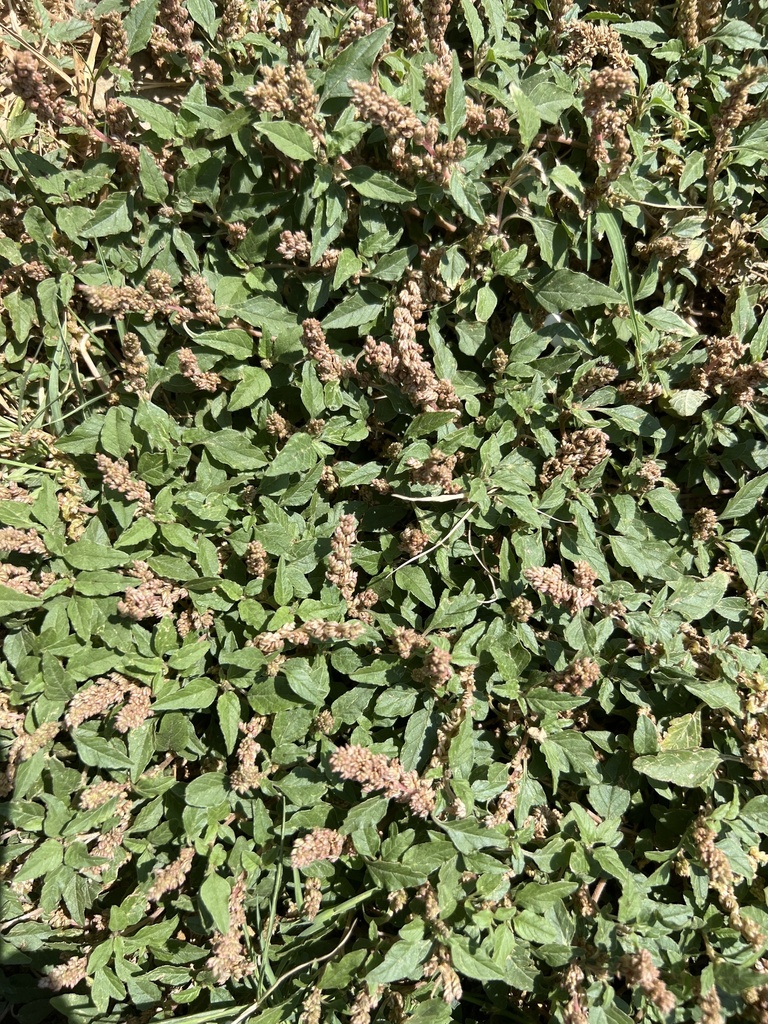
no rights reserved, uploaded by Alan Weakley · CC0
Family: Amaranthaceae · Type: Herb · Not Native
Amaranthus deflexus (Amaranth) is a non-native California herb in the Amaranthaceae family, recognized by . Key features: inflated indehiscent fruit, prostrate-ascending habit, short-lived perennial.
Amaranth is a naturalized perennial herb found in central western and southwestern California in disturbed areas like railroad right-of-ways at elevations below 650 meters. Flowering from May to November, this plant produces green flowers in spike-like inflorescences up to 2.5 centimeters wide. Growing with prostrate to ascending stems 10 to 50 centimeters tall that are branched at the base and occasionally brown or green, it has a sprawling growth habit. Its leaves are rhombic-ovate to lanceolate, 10 to 30 millimeters long with wedge-shaped bases and somewhat wavy margins. The small brown fruit is ovoid, inflated, and approximately 2 to 3 millimeters long.
Identification and appearance
Key characters: 16 sympatric species. Key features: inflated indehiscent fruit, prostrate-ascending habit, short-lived perennial
Habitat and range
Habitat: Railroad right-of-ways, disturbed areas
Elevation: < 650 m
California counties: San Luis Obispo, Santa Barbara, Alameda, Orange, Los Angeles, Ventura, Contra Costa, San Diego, San Mateo, San Francisco, Butte, Santa Clara, Marin, San Bernardino, Monterey, Stanislaus, Santa Cruz, Riverside, Sacramento, Yolo, Sonoma, Imperial, Solano, Nevada, Napa
Outside California: to eastern United States, native to South America, Europe, Asia
Bloom period
Amaranthus deflexus blooms May-Nov.
How to tell it apart
vs Celosia: Amaranthus has bristly flower spikes; Celosia has showy velvety flower plumes or crested combs.; vs Rumex: Amaranthus has dense bristly flower clusters; Rumex has flowers in whorls along stems with papery wings on fruits.; vs Salsola: Amaranthus has soft oval leaves and clustered flowers; Salsola has spine-tipped leaves and papery winged fruits.; vs Euphorbia: Amaranthus lacks milky sap and has separate male/female flowers; Euphorbia has milky sap and cup-like flower clusters.; vs Chenopodium: Amaranthus has bristly flower clusters; Chenopodium has mealy-coated leaves and flowers in loose balls.
Frequently asked questions
Is Amaranthus deflexus native to California?
No. Amaranthus deflexus is not native to California (recorded as not native).
When does Amaranthus deflexus bloom?
Amaranthus deflexus blooms May-Nov.
Where in California does Amaranthus deflexus grow?
Amaranthus deflexus occurs in San Luis Obispo, Santa Barbara, Alameda, Orange, Los Angeles, Ventura, Contra Costa, San Diego and other counties, at elevations of < 650 m.
What plant family does Amaranthus deflexus belong to?
Amaranthus deflexus is in the Amaranthaceae family, genus Amaranthus.
What habitat does Amaranthus deflexus grow in?
Amaranthus deflexus grows in Railroad right-of-ways, disturbed areas.
Related species
Other California species in the same genus, family, or bioregion.
Sources: Jepson eFlora · Index of California Plant Names · CalPhotos
Last updated 2026-10-07
Data from The California Species Project — 14,000+ California species with verified data from CNPS, CDFW, USFWS, Cal-IPC, and more.