Amaranthus powellii
Powell's amaranth
no rights reserved · CC0
Family: Amaranthaceae · Type: Herb · Native
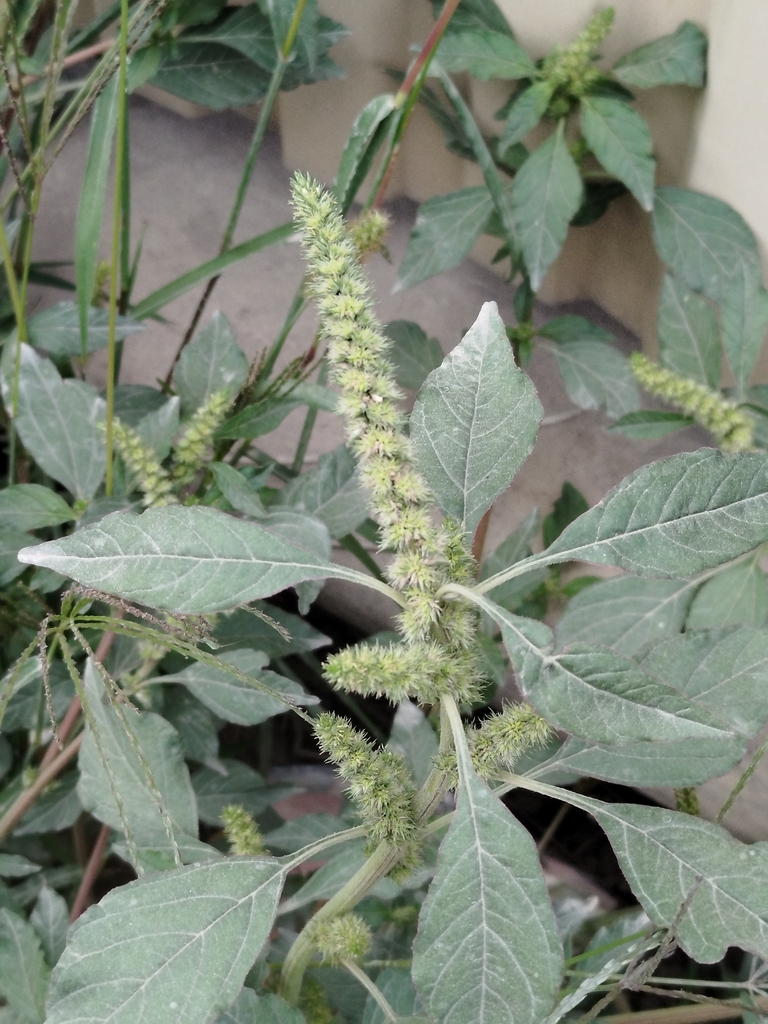
Amaranthus powellii (Powell's amaranth) is a native California herb in the Amaranthaceae family, recognized by . Key features: rigid erect branches, dense panicle, purple-striped stems, very long bracts.
Powell's amaranth is a California native perennial found in the North Coast Ranges, Central High Sierra, Sierra Nevada Foothills, northern and central Sierra Nevada, Central Valley, Central Western California, southwestern California, White and Inyo Mountains, and Modoc Plateau in agricultural fields and disturbed areas at elevations below 1,500 meters. Flowering from June to October, this plant produces green flowers with erect terminal panicles 3 to 12 centimeters long. Growing with erect stems 25 to 150 centimeters tall, characterized by distinctive green stems with purple stripes and branching patterns. Its leaves are elliptic to rhombic, 30 to 80 millimeters long with wedge-shaped bases and flat margins, featuring petioles 30 to 60 millimeters long. The fruit is small, 2 to 3 millimeters long, ovoid, and gray-cream to light brown with seeds that are dark brown to black and shiny.
Identification and appearance
Key characters: 16 sympatric species. Key features: rigid erect branches, dense panicle, purple-striped stems, very long bracts
Habitat and range
Habitat: Agricultural fields, disturbed areas
Elevation: < 1500 m
California counties: San Diego, Ventura, Riverside, Santa Barbara, Los Angeles, Plumas, San Bernardino, Solano, Mono, Santa Cruz, Modoc, Santa Clara, San Joaquin, Sonoma, Orange, San Mateo, Monterey, Napa, Yuba, San Francisco, Inyo, El Dorado, Sutter, Sierra, Alameda, Sacramento, Contra Costa, Kern, San Luis Obispo, Butte, Nevada, Lassen, Tehama, Siskiyou, Marin, Amador, Mendocino, Yolo, Stanislaus
Outside California: native to southwestern United States, adjacent Mexico, +- cosmopolitan weed
Bloom period
Amaranthus powellii blooms Jun-Oct.
How to tell it apart
vs Celosia: Amaranthus has bristly flower spikes; Celosia has showy velvety flower plumes or crested combs.; vs Rumex: Amaranthus has dense bristly flower clusters; Rumex has flowers in whorls along stems with papery wings on fruits.; vs Salsola: Amaranthus has soft oval leaves and clustered flowers; Salsola has spine-tipped leaves and papery winged fruits.; vs Euphorbia: Amaranthus lacks milky sap and has separate male/female flowers; Euphorbia has milky sap and cup-like flower clusters.; vs Chenopodium: Amaranthus has bristly flower clusters; Chenopodium has mealy-coated leaves and flowers in loose balls.
Frequently asked questions
Is Amaranthus powellii native to California?
Yes. Amaranthus powellii is native to California (recorded as native).
When does Amaranthus powellii bloom?
Amaranthus powellii blooms Jun-Oct.
Where in California does Amaranthus powellii grow?
Amaranthus powellii occurs in San Diego, Ventura, Riverside, Santa Barbara, Los Angeles, Plumas, San Bernardino, Solano and other counties, at elevations of < 1500 m.
What plant family does Amaranthus powellii belong to?
Amaranthus powellii is in the Amaranthaceae family, genus Amaranthus.
What habitat does Amaranthus powellii grow in?
Amaranthus powellii grows in Agricultural fields, disturbed areas.
Related species
Other California species in the same genus, family, or bioregion.
Sources: Jepson eFlora · Index of California Plant Names · CalPhotos
Last updated 2026-10-07
Data from The California Species Project — 14,000+ California species with verified data from CNPS, CDFW, USFWS, Cal-IPC, and more.