Amaranthus watsonii
Watson's amaranth, Watson's amaranth, Watson's amaranth
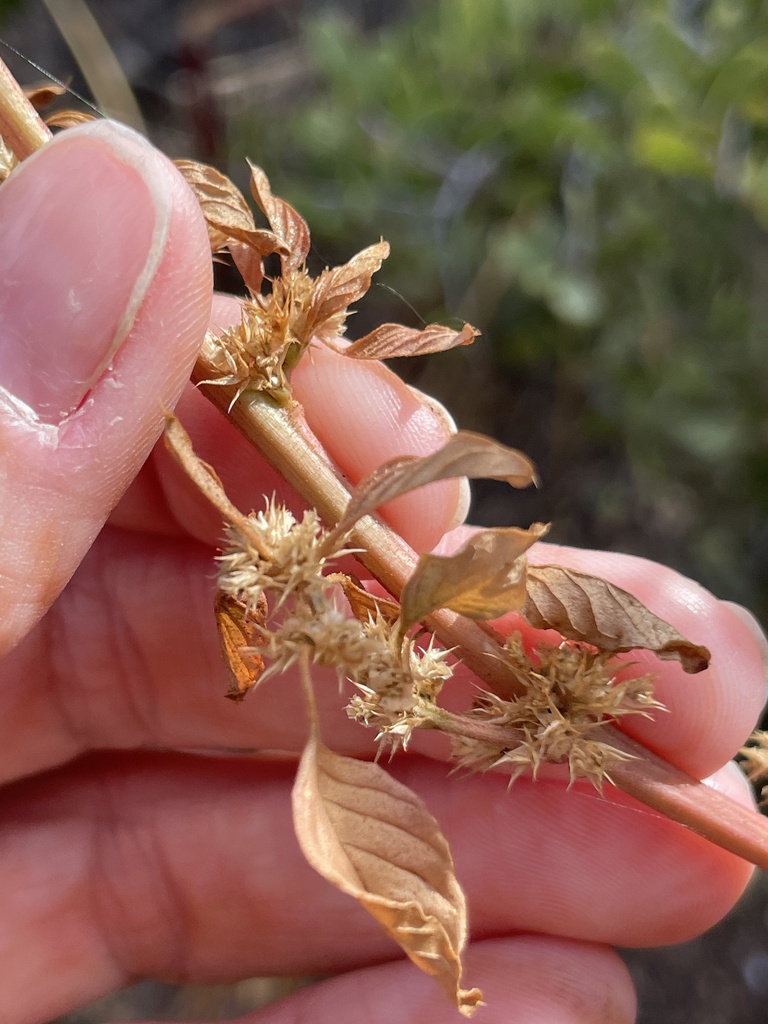
(c) Sula Vanderplank, some rights reserved (CC BY) · licence
Family: Amaranthaceae · Type: Herb · Native
Conservation status: CNPS 4.3
Amaranthus watsonii (Watson's amaranth) is a native California herb in the Amaranthaceae family, recognized by . Key features: coastal/sandy habitat, glandular bracts, fan-shaped perianth with jagged margins.
Watson's amaranth is a California native perennial found in southern California's San Gabriel Mountains and southern Colorado Desert in Imperial County, occurring on coastal dunes, beaches, sandy inland areas, and saline flats at elevations below 100 meters. Flowering from August to September, this plant produces small green flowers in dense, erect spikes 3 to 15 centimeters long. Growing with many-branched stems 10 to 100 centimeters tall that are glandular-hairy, particularly on the bracts, it has an upright and distinctive growth habit. Its leaves are ovate to oblong-elliptic, 10 to 80 millimeters long with wide wedge-shaped bases, featuring flat or slightly wavy margins. The fruit is a small, light-brown to brown circumscissile capsule containing shiny, red-black seeds.
Identification and appearance
Key characters: 10 sympatric species. Key features: coastal/sandy habitat, glandular bracts, fan-shaped perianth with jagged margins
Habitat and range
Habitat: Coastal dunes, beaches, sandy inland areas, +- saline flats, disturbed areas after winter rain
Elevation: < 100 m
Outside California: Arizona, northwestern Mexico
Bloom period
Amaranthus watsonii blooms Aug-Sep.
Conservation status
CNPS 4.3
How to tell it apart
vs Celosia: Amaranthus has bristly flower spikes; Celosia has showy velvety flower plumes or crested combs.; vs Rumex: Amaranthus has dense bristly flower clusters; Rumex has flowers in whorls along stems with papery wings on fruits.; vs Salsola: Amaranthus has soft oval leaves and clustered flowers; Salsola has spine-tipped leaves and papery winged fruits.; vs Euphorbia: Amaranthus lacks milky sap and has separate male/female flowers; Euphorbia has milky sap and cup-like flower clusters.; vs Chenopodium: Amaranthus has bristly flower clusters; Chenopodium has mealy-coated leaves and flowers in loose balls.
Frequently asked questions
Is Amaranthus watsonii native to California?
Yes. Amaranthus watsonii is native to California (recorded as native).
When does Amaranthus watsonii bloom?
Amaranthus watsonii blooms Aug-Sep.
What plant family does Amaranthus watsonii belong to?
Amaranthus watsonii is in the Amaranthaceae family, genus Amaranthus.
Is Amaranthus watsonii rare or endangered?
Amaranthus watsonii carries California Rare Plant Rank 4.3, state rank S3.
What habitat does Amaranthus watsonii grow in?
Amaranthus watsonii grows in Coastal dunes, beaches, sandy inland areas, +- saline flats, disturbed areas after winter rain.
Related species
Other California species in the same genus, family, or bioregion.
- Amaranthus albus — Tumbleweed
- Amaranthus arenicola — Sand amaranth
- Amaranthus blitoides — Procumbent pigweed
- Amaranthus blitum subsp. emarginatus
- Amaranthus californicus — Californian amaranth
- Amaranthus caudatus — Love-lies-bleeding
- Blitum californicum — California blite
- Blitum capitatum — Strawberry-blite
- Blitum hastatum — Over's blite
- Blitum nuttallianum — Nuttall's poverty weed
Sources: Jepson eFlora · CalPhotos · CDFW CNDDB
Last updated 2026-10-07
Data from The California Species Project — 14,000+ California species with verified data from CNPS, CDFW, USFWS, Cal-IPC, and more.